So You Want to Sell Hardware Online (Without Losing Your Mind)
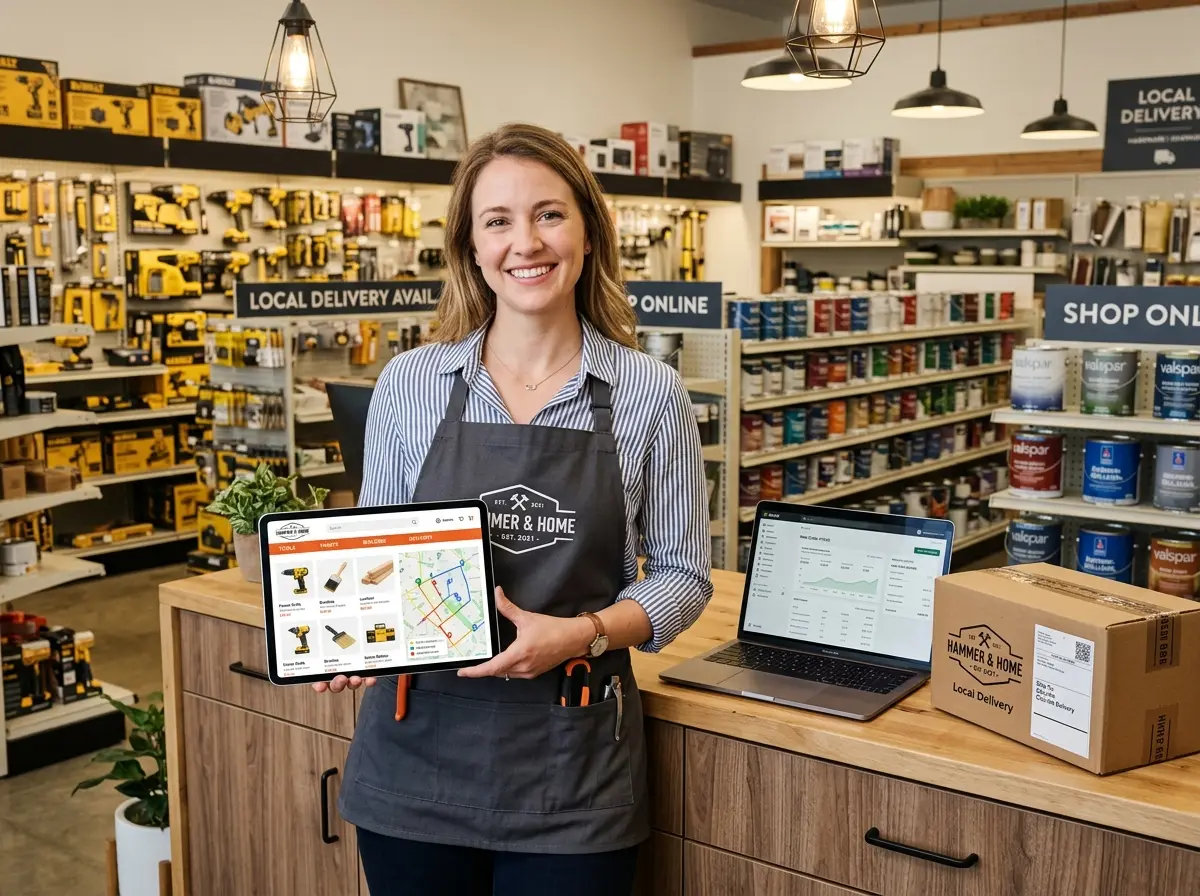
Let's be honest — when most people picture a hardware store, they picture a guy named Earl who knows exactly which aisle has the 3/8-inch lag bolts and will happily tell you about it for twenty minutes. What they don't picture is a slick e-commerce operation with local delivery. But here's the thing: that's exactly what modern hardware store owners need to be building right now.
Local delivery for hardware isn't just a "nice to have" anymore. Contractors need lumber delivered to a job site by 7 AM. Homeowners mid-project don't want to drive across town for a bag of grout. And your competitors — both big-box stores and other local shops — are already moving in this direction. According to a 2023 study by McKinsey, over 60% of consumers now expect same-day or next-day delivery options even from local retailers. If your hardware store isn't offering it, you're not just leaving money on the table — you're leaving it on someone else's table.
The good news? Setting up an online store with local delivery capability is more accessible than ever, even if you've never sold a single thing online. This guide walks you through exactly how to do it, from picking the right platform to getting orders out the door efficiently.
Building the Foundation: Your Online Store
Choosing the Right E-Commerce Platform
Not all e-commerce platforms are created equal, and the wrong choice here can cost you serious time and money down the road. For a hardware store with a physical location and local delivery needs, you have a few strong contenders.
Shopify is the most popular option for good reason — it's intuitive, scales well, and has excellent local delivery and pickup features built right in. With Shopify's "Local Delivery" settings, you can define delivery zones by zip code or radius, set minimum order amounts, and charge delivery fees accordingly. It also integrates with point-of-sale systems so your in-store and online inventory stay in sync. Plans start around $39/month.
WooCommerce is a strong choice if you already use WordPress and want more control over customization without monthly platform fees (though you'll pay for hosting and extensions). It requires a bit more technical comfort but offers flexibility that Shopify doesn't always match out of the box.
Square Online is worth considering if you already use Square for in-store payments — the integration is seamless and the free tier gets you started without upfront costs.
Whatever you choose, make sure the platform supports local delivery zones, real-time inventory management, and mobile-friendly design. Your customers are placing orders from their phones while standing in the middle of a half-renovated bathroom.
Setting Up Your Product Catalog (Yes, All of It)
Here's where hardware stores face their biggest unique challenge: inventory. You might carry 10,000 SKUs. You are not going to add them all at once, and that's perfectly fine. Start strategically.
Begin with your top 100-200 best-selling items — the things contractors order repeatedly and homeowners always need in a pinch. Power tools, common fasteners, PVC fittings, paint, caulk, batteries, and safety gear are great starting points. Use your POS data to identify what moves fastest and build from there.
For each product listing, include clear photos (yes, even for a box of screws — especially for a box of screws), detailed descriptions with specs, and accurate stock levels. Poor product data is the number one reason shoppers abandon hardware store websites. Nobody wants to order the wrong drill bit because your listing said "fits most" without any further detail.
Configuring Local Delivery Zones and Rates
This is where the magic happens — and where a lot of stores get it wrong by trying to do too much too fast. Start with a defined, manageable delivery radius. A 10-15 mile zone is realistic for most single-location hardware stores starting out. You can always expand later once operations are smooth.
Think carefully about your delivery fee structure. Offering free delivery over a certain threshold (say, $75 or $100) can meaningfully increase average order value. Many stores also charge a flat rate for smaller orders — $8-$12 is common. Just make sure your fees are clearly displayed before checkout. Hidden delivery fees are the fastest way to get an abandoned cart and a one-star review.
Keeping Customers Informed and Your Staff Sane
Automating Order Confirmations and Delivery Updates
Once orders start coming in, communication becomes critical. Customers placing hardware orders for delivery are often on tight timelines — a contractor waiting on supplies can't afford vague delivery windows. Set up automated email and SMS confirmations the moment an order is placed, and send a follow-up when the order is out for delivery. Most e-commerce platforms handle this natively, but services like Klaviyo or Postscript can give you more control over messaging.
If you're handling delivery with your own staff rather than a third-party courier, consider using a simple route optimization tool like Route4Me or OptimoRoute to save time and fuel. These tools can cut delivery time significantly when you have multiple stops in a day.
How Stella Fits Into the Picture
When you launch local delivery, your phone is going to ring more. "What's your delivery minimum?" "Can you deliver to my zip code?" "Is the 20-amp breaker panel in stock?" These are important questions — but they don't need to interrupt your staff a dozen times a day. Stella, the AI robot employee and phone receptionist, answers calls 24/7 with the same knowledge your best counter person has, handling routine questions so your team can focus on fulfillment and floor operations. And when a customer walks into the store while half your crew is packing delivery orders in the back, Stella's in-store kiosk presence keeps that customer engaged, answers their questions, and lets them know about your new online ordering options — without anyone having to leave the stockroom.
Operations: Getting Orders Out the Door
Staffing and Workflow for Fulfillment
Delivery fulfillment doesn't have to mean hiring a fleet. Most small hardware stores start by designating one or two existing staff members for pick, pack, and deliver duties during defined delivery windows — say, 9 AM to 1 PM for morning orders. This keeps things manageable while the operation grows.
Create a simple fulfillment checklist: print the order, pick items from inventory, verify quantities, pack appropriately (yes, you need to think about how lumber and light bulbs travel together), label the package, and mark the order as fulfilled in your system. Boring? Absolutely. Effective? Without question. Consistency in this process prevents the kind of fulfillment errors that result in one-star reviews and a very unhappy contractor on the phone.
As volume grows, consider bringing on a part-time delivery driver or partnering with a local courier service. Platforms like Shipday make it easy to dispatch and track drivers without building custom software.
Managing Returns and Delivery Issues
Hardware returns are a reality. Wrong size, changed mind, bought two just in case — it happens constantly. Your online store needs a clear, written return policy that handles both in-store returns of online purchases and coordinated pickup returns for larger items. Make this policy easy to find on your website and in your order confirmation emails.
For delivery issues — wrong item delivered, damaged in transit, missed delivery window — have a clear process in place before you launch. Empower your staff to resolve these quickly. A customer who had a problem that got fixed fast is often more loyal than one who never had a problem at all. That's not just a feel-good sentiment; research from Harvard Business Review supports it. Don't make customers jump through hoops for a $12 PVC elbow.
Marketing Your Local Delivery Service
You can build the greatest local delivery operation in your region and it won't matter if nobody knows about it. Start by announcing the service to your existing customers through email, social media, and in-store signage. A simple "We now deliver!" sign at the counter, backed by a short email to your customer list, goes a long way.
Local SEO is your best friend here. Make sure your Google Business Profile is updated with your delivery offerings, and consider creating a dedicated landing page on your website targeting terms like "hardware store delivery [your city]" or "building supplies delivered [your zip code]." Contractors in your area are searching for exactly this. Be the result they find.
Quick Reminder About Stella
Stella is an AI robot employee and phone receptionist designed for businesses exactly like yours — available as an in-store kiosk and as a 24/7 phone answering solution. At just $99/month with no upfront hardware costs, she greets customers, promotes your services, answers questions, and handles calls so your staff can focus on what they do best. For a hardware store managing both walk-in traffic and a growing delivery operation, that kind of reliable, always-on support isn't a luxury — it's just smart business.
Ready to Start Building? Here's What to Do Next
Launching an online store with local delivery is one of the highest-ROI moves a hardware store can make in today's retail environment. The technology is affordable, the customer demand is real, and the competitive advantage for early movers in your local market is significant. You don't need to be Amazon. You just need to be the most convenient, reliable option within 15 miles.
Here's your action plan to get started:
- Choose your platform — Shopify is the easiest starting point for most hardware retailers.
- Build your initial catalog — Start with your top 100-200 SKUs and expand from there.
- Define your delivery zone and pricing — Keep it simple and manageable at first.
- Set up order automation — Confirmations, delivery notifications, and inventory sync should be automatic from day one.
- Train your team on fulfillment — A simple, consistent process prevents costly errors.
- Announce it — Email your list, update your Google Business Profile, and put a sign on the counter.
You've spent years building expertise, inventory, and customer trust. An online store with local delivery is simply the logical next step in putting that investment to work. And if Earl wants to record a few product description videos in the meantime, nobody's stopping him.