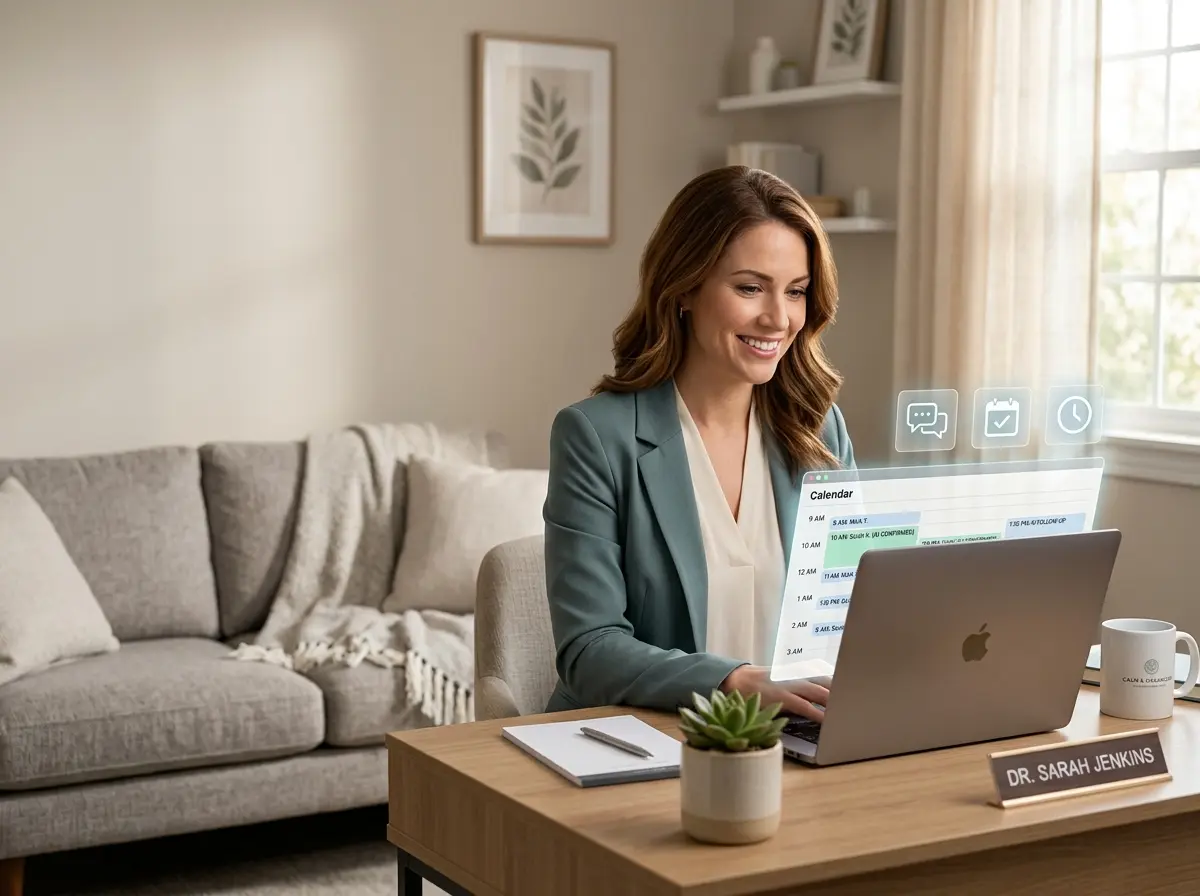
When Your Phone Becomes a Full-Time Job (And You Didn't Sign Up for That)
Picture this: You're a solo therapist. You've spent years earning your credentials, building your practice, and creating a safe, healing space for your clients. What you did not sign up for was spending half your workday playing phone tag, returning missed calls during the five-minute gap between sessions, and somehow managing to sound calm and professional while your 3:00 appointment is already sitting in the waiting room.
This was exactly the reality for Maya, a licensed clinical social worker running a solo therapy practice in Austin, Texas. Between back-to-back sessions, insurance paperwork, and the general chaos of running a one-person operation, her phone was simultaneously her lifeline and her biggest source of burnout. New client inquiries were slipping through the cracks. Existing clients couldn't confirm appointments without leaving a voicemail — and then waiting. And Maya was starting to feel less like a therapist and more like a very overwhelmed receptionist.
Sound familiar? Whether you're a therapist, a consultant, a personal trainer, or any kind of solo service provider, the communication problem is real — and it's costing you clients, time, and probably a few moments of peace you could really use right now. Let's talk about what actually changed for Maya, and what it could mean for your practice.
The Real Cost of Missed Calls in a Solo Practice
Missed Calls Are Missed Revenue (Yes, Do the Math)
Here's a stat that tends to wake people up: 85% of people whose calls go unanswered will not call back. They'll move on to the next provider on their list. For a solo therapist charging $150 per session and seeing a client weekly, that's potentially $7,800 in annual revenue lost from a single unanswered inquiry. And that's before you factor in the ripple effect of word-of-mouth referrals that never happened because the relationship never started.
Maya estimated she was missing three to five inquiry calls per week — not because she didn't care, but because she was literally in session, doing the work she was trained to do. There is no good time to answer the phone when you're a solo practitioner with a full schedule. The problem isn't effort or dedication. It's a structural gap that no amount of hustle can reliably fix.
The Hidden Emotional Toll on Solo Practitioners
Beyond the financial loss, there's something harder to quantify: the mental load. Constantly worrying about missed calls, scrambling to return messages in your lunch break, and apologizing to prospective clients for the delay isn't just inconvenient — it's exhausting. For therapists specifically, showing up fully present for clients is the entire job. Every minute spent anxious about phone logistics is a minute of cognitive bandwidth that belongs to your clients.
Maya described it as "carrying a low hum of guilt all day." She knew people were calling. She knew some of them needed help. And she knew she couldn't always get to them in time. That's not a sustainable way to run a practice — or, frankly, a life.
The Patchwork Solutions That Don't Quite Work
Most solo practitioners try to solve this with a combination of voicemail greetings, online contact forms, and the occasional virtual assistant — none of which fully solve the problem. Voicemail has a roughly 25% callback rate for new inquiries. Contact forms are passive and slow. And virtual assistants, while helpful, come with scheduling constraints, variable quality, and costs that scale uncomfortably as your needs grow.
What Maya needed wasn't another workaround. She needed a solution that was always on, always professional, and always ready to handle a new client inquiry with warmth and accuracy — without her having to press pause on her sessions to make it happen.
How Smarter Communication Tools Can Step In
AI Receptionists: Not Science Fiction Anymore
When Maya first heard about AI-powered phone answering, she was skeptical — and honestly, that's a reasonable starting position. The last thing a therapy client wants is to feel like they're navigating a robotic phone tree when they're working up the courage to ask for help. But modern AI receptionists have come a long way from "Press 1 for billing." They hold natural, conversational exchanges, understand context, and can answer nuanced questions about services, availability, and intake procedures without sounding like they're reading from a script.
Stella, an AI robot employee and phone receptionist designed for businesses of all sizes, is exactly the kind of tool Maya ended up adopting. Stella answers incoming calls 24/7, handles questions about services and policies, and can collect new client intake information conversationally — without requiring Maya to be on the other end of the line. Her built-in CRM automatically organizes contact details, intake responses, and AI-generated client profiles, so when Maya does follow up, she already has context. For a solo practitioner, that's not just convenient — it's genuinely transformative.
What Actually Changed for Maya (And What You Can Learn From It)
New Client Inquiries Stopped Falling Through the Cracks
Within the first month of implementing an AI receptionist, Maya noticed that prospective clients who called after hours — something that happened more often than she expected — were now getting a real response. Not a voicemail prompt, not a generic recording, but an actual conversational interaction that collected their contact information, answered basic questions about her approach and specialties, and let them know she'd be in touch. Her new client inquiry-to-booking rate improved noticeably, and she stopped discovering missed opportunities days after the fact.
More importantly, clients reported feeling heard from the very first contact. That first impression matters enormously in a therapy context, where trust is everything. An AI receptionist that handles the conversation with warmth and competence sets the tone before the first session even begins.
Appointment Management Became a Conversation, Not a Chore
One of the unexpected wins was how much smoother the scheduling process became. Existing clients could call to confirm, reschedule, or ask questions without creating a backlog of voicemails that needed to be individually returned. The AI receptionist handled the majority of these routine interactions, escalating to Maya only when something genuinely required her attention.
This meant Maya could batch her actual client communication into focused windows rather than having her attention fragmented across the day. She described it as "getting her brain back." Boundaries around session time improved. The guilt hum went quiet. And she found herself with more energy to invest in the work that actually matters — her clients.
The Data Surprised Her (In a Good Way)
Something Maya hadn't anticipated was the insight dimension. Her AI receptionist was tracking call patterns, common questions, and inquiry volume over time. She discovered that a significant portion of her calls came between 7:00 and 9:00 PM — a window she'd never been available to answer. That insight alone shifted how she thought about her availability and communication strategy. She also noticed that several callers were asking about services she offered but hadn't prominently featured on her website, which prompted an overdue update to her online presence.
Data that was previously invisible — because missed calls leave no record — was suddenly actionable. For a solo practitioner making decisions without a team to consult, that kind of visibility is genuinely valuable.
Quick Reminder About Stella
Stella is an AI robot employee and phone receptionist built for businesses of all sizes — including solo practitioners like Maya. She answers calls 24/7, collects client intake information, manages contacts through a built-in CRM, and handles routine communication so you don't have to. At $99/month with no upfront hardware costs, she's designed to be accessible from day one — no technical expertise required.
Your Next Steps Toward Actually Getting Your Time Back
If Maya's story resonated with you, the good news is that her solution isn't complicated or expensive. Here's a practical framework for any solo practitioner ready to stop losing clients to an unanswered phone:
Start by auditing your current call situation. How many calls are you missing per week? How quickly are you responding to inquiries? What percentage of voicemails turn into booked appointments? If you don't know the answers, that's already a signal that visibility is a problem. Even a single week of tracking will surface patterns that are hard to ignore.
Identify your highest-friction moments. For most solo practitioners, the biggest gaps are after hours, during sessions, and during focused work blocks. Once you know when you're most likely to miss a call, you can make informed decisions about what kind of coverage you actually need.
Choose a solution that meets clients where they are. Prospective clients — especially those reaching out for therapy, coaching, or other personal services — are often calling at unconventional times, when they finally feel ready. A solution that's available only during business hours misses a meaningful portion of your potential client base. 24/7 availability isn't a luxury for solo practitioners; it's a competitive advantage.
Don't let perfect be the enemy of better. You don't need a full administrative overhaul to improve your client communication. A single tool that reliably answers your phone, collects intake information, and keeps you informed can meaningfully change how your practice operates — and how you feel about running it.
Maya didn't fix everything at once. She made one change — how her phone calls were handled — and the ripple effects touched nearly every part of her practice. The clients she used to lose are now booking. The guilt hum is gone. And she has one less thing to worry about between sessions.
That's not a small thing. That's the difference between a practice that drains you and one that sustains you.