When Your Phone Rings at 7 PM and Nobody's There to Answer It
Let's paint a familiar picture. It's 7:15 on a Tuesday evening. Your physical therapy practice closed an hour ago. Your front desk staff has gone home, your therapists are done for the day, and somewhere across town, a potential new patient — someone who finally worked up the courage to call about that knee pain they've been ignoring for six months — hears your phone ring four times and then gets your voicemail. They hang up. They Google another clinic. They book an appointment there instead.
You'll never know it happened. That's the really fun part.
Missed calls aren't just an annoyance — they're a quiet revenue leak that most practice owners don't fully account for. According to research from Zippia, 85% of people whose calls go unanswered will not call back. In a specialty like physical therapy, where patients are often comparing several practices before committing, being unreachable after hours isn't just inconvenient — it's a competitive disadvantage dressed up as a scheduling problem.
The good news? This is a completely solvable problem, and one physical therapy practice figured out exactly how to fix it.
The After-Hours Problem Is Bigger Than You Think
Patients Don't Follow Business Hours Anymore
Here's a truth that might sting a little: your patients are thinking about their health at all hours of the day, and they're not waiting until 9 AM Monday to do something about it. Between work, family obligations, and the general chaos of adult life, a significant portion of healthcare-related phone calls happen outside of traditional business hours. Studies in healthcare administration consistently show that a meaningful slice of new patient inquiries — often 30 to 40 percent — occur in the evenings and on weekends.
Physical therapy patients, in particular, are often calling after a long workday when they've spent eight hours aggravating a shoulder injury or sitting at a desk making their lower back progressively angrier. By the time they pick up the phone, they're motivated. They want to book. And if you're not there to capture that moment, someone else will be.
The Real Cost of a Missed Call
Let's do some uncomfortable math. If your practice sees an average patient through six to twelve sessions at $75 to $150 per session, a single new patient relationship can be worth anywhere from $450 to $1,800 in revenue. Now consider how many calls you might be missing each week after hours — even two or three per week adds up to a staggering amount of lost business over the course of a year. And that's before you factor in referrals, because a happy patient who felt welcomed from their very first phone call is far more likely to send their spouse, coworker, or neighbor your way.
The front desk staff problem compounds this. Even during business hours, your receptionist is juggling check-ins, insurance verifications, scheduling changes, and a waiting room full of people who all need something. The phone is often the thing that gets put on hold — literally.
Why Traditional Solutions Fall Short
Answering services sound like a reasonable fix until you actually use one. Generic scripts, inconsistent quality, and representatives who know nothing about your specific services or intake process tend to create more confusion than they resolve. Hiring additional front desk staff helps during hours, but it doesn't solve the after-hours gap — and it comes with a salary, benefits, training time, and the inevitable reality that people leave. Voicemail alone is a dead end, as we've already established that most people won't leave one and even fewer will wait for a callback.
How One Physical Therapy Practice Solved It
Deploying an AI Phone Receptionist That Never Clocks Out
A physical therapy practice in a mid-sized suburban market was struggling with exactly this pattern. Their front desk team was excellent during business hours, but the practice was consistently losing after-hours inquiries. The owner estimated they were missing four to six calls per week outside of business hours alone — a number that felt manageable until she did the revenue math and nearly choked on her coffee.
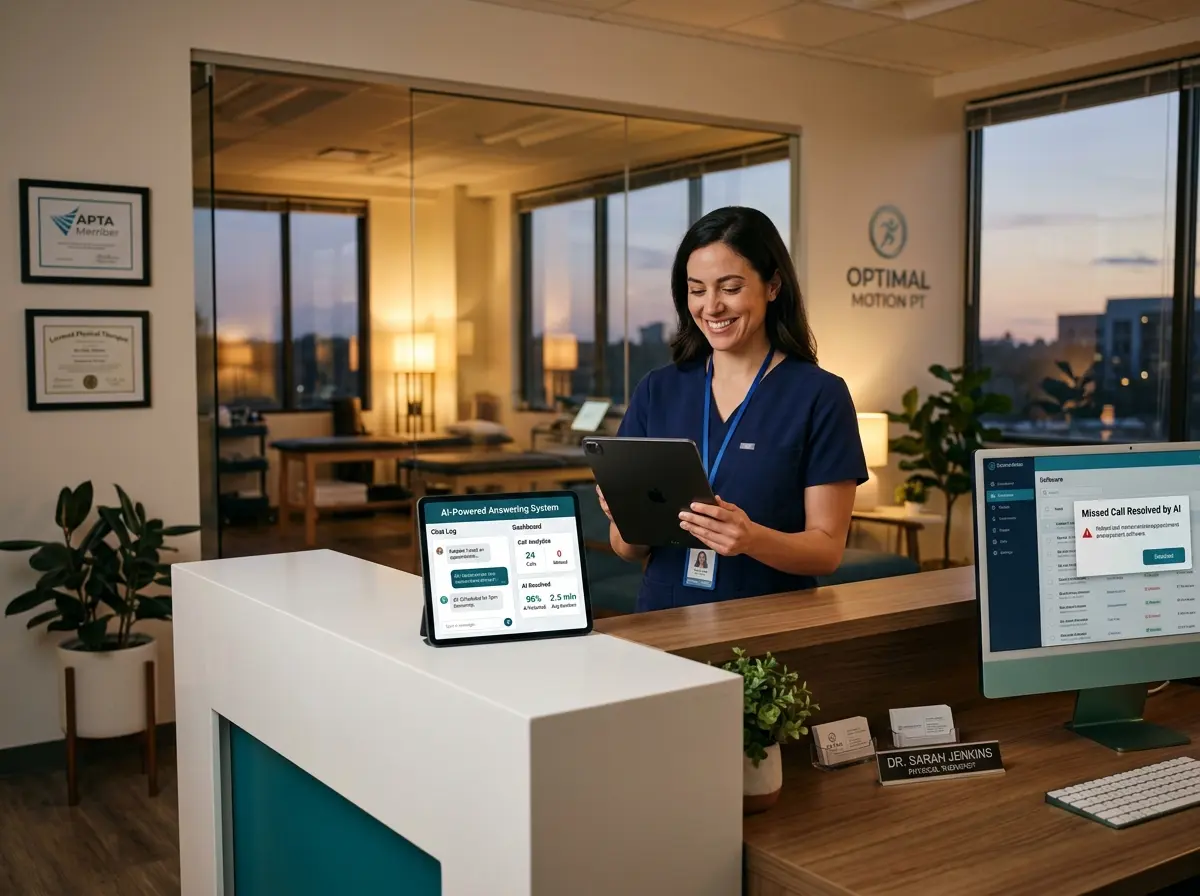
The solution came in the form of Stella, an AI robot employee and phone receptionist that handles calls 24 hours a day, seven days a week. Stella answered every incoming call with the same warmth and professionalism as a human receptionist — providing information about services, walking callers through the intake process, collecting patient information through conversational intake forms, and logging everything neatly into her built-in CRM so the front desk team arrived each morning to organized, actionable lead summaries rather than a string of confusing voicemails.
Beyond phone calls, Stella also operates as a physical kiosk presence inside the practice itself, greeting patients who walk in, answering common questions about services and scheduling, and reducing the volume of interruptions the front desk staff had to handle during busy periods. For a practice where every minute of staff time matters, that in-person support made a noticeable difference in day-to-day operations.
The Results: From Missed Calls to Managed Leads
Within the first month of implementation, the practice captured and responded to every after-hours inquiry — something that had simply never happened before. New patient conversion improved noticeably because callers were no longer falling into a voicemail black hole. Instead, they had a complete, helpful interaction that collected their information, answered their questions, and set the expectation for a follow-up call — all before any human staff member arrived the next morning. The practice owner's summary: "It felt like we hired a receptionist who never gets tired, never calls in sick, and never asks for a raise."
Best Practices for Capturing After-Hours Inquiries in a Physical Therapy Practice
Make Your After-Hours Experience Feel Personal, Not Automated
The biggest mistake practices make when setting up any kind of after-hours phone solution is treating it like a formality — a way to technically say the phone was "answered" without actually providing value to the caller. Patients calling about physical therapy are often in pain, anxious, or navigating a recovery from an injury or surgery. The last thing they want is a cold, robotic experience that makes them feel like a ticket number.
Whatever solution you implement, prioritize conversational warmth. Your AI receptionist or answering service should be able to speak to your specific services — whether that's sports rehabilitation, post-surgical recovery, pediatric therapy, or chronic pain management — and respond to common questions naturally. Generic answers erode trust before the patient has even walked through your door.
Capture Information Strategically During the First Call
Every after-hours call is an opportunity to begin your intake process. Rather than simply taking a name and number for a callback, a well-configured phone system can collect insurance information, the nature of the patient's condition, their availability for appointments, and whether they were referred by a physician or another patient. This does two things: it gives your staff everything they need to have a productive follow-up conversation, and it signals to the caller that your practice is organized and professional from the very first interaction.
Practices that capture structured intake data upfront consistently report faster time-to-first-appointment and higher new patient conversion rates — simply because the administrative friction has already been reduced before the relationship formally begins.
Create a Follow-Up Protocol That Treats Every Lead Seriously
The system only works if someone follows through. Establish a clear protocol: who reviews after-hours leads each morning, what the response time commitment is, and how those leads are tracked if the patient doesn't immediately book. A CRM that logs every interaction, tags leads by status, and sends push notifications to managers when new inquiries come in takes the organizational burden off your staff and ensures that no one slips through the cracks.
Consider setting an internal standard — for example, every after-hours inquiry receives a personal follow-up call within two business hours of the practice opening the next day. Communicate this standard to patients during the initial interaction so they know to expect it. That kind of responsiveness, especially when a competitor might not even have an after-hours option, becomes a genuine differentiator.
A Quick Reminder About Stella
Stella is an AI robot employee and phone receptionist designed for businesses of all types — including medical and therapy practices. She answers calls 24/7, handles intake conversations, manages a built-in CRM, and even greets patients in person as a kiosk inside your practice. At $99 per month with no upfront hardware costs, she's the receptionist who's always on shift, never overwhelmed, and never puts a patient on hold indefinitely while she tracks down an insurance card.
Stop Leaving New Patients on the Table
If you've read this far, you probably already know that after-hours missed calls are costing your practice real money. The question isn't whether the problem exists — it's whether you're going to do something about it before your competitor down the street does.
Here's what actionable looks like in practice:
- Audit your current call volume. Pull your phone records and identify how many calls are coming in after hours, on weekends, and during your lunch period. The number may surprise you.
- Calculate what a missed call actually costs. Take your average patient lifetime value and multiply it by a conservative estimate of weekly missed calls. That's your baseline for what a solution is worth.
- Evaluate your intake process. Determine what information you need from a new patient inquiry and whether your current system captures it consistently — or at all.
- Implement a 24/7 solution with real business knowledge. Whether that's an AI receptionist, a properly configured answering service, or a combination, make sure whoever answers your phone can actually represent your practice — not just read a script.
- Build accountability into your follow-up workflow. Assign ownership of after-hours leads, set response time standards, and track conversion from first call to first appointment.
Physical therapy patients are looking for someone who can help them feel better and make the process easy. That experience starts the moment they decide to pick up the phone. Make sure your practice is ready for that moment — even when your team isn't in the building.
Because the practice that answers the phone is almost always the one that gets the patient.