When Your Enrollment Inquiries Don't Sleep (But You Do)
Picture this: It's 10:47 PM on a Tuesday. A parent has just finished helping their kid with homework — or rather, attempting to help their kid with homework — and has officially decided that their child needs a tutor. They're motivated, they're ready to enroll, and they're reaching for their phone. They call your tutoring center. And they get... voicemail.
There goes a lead.
Enrollment inquiries for tutoring centers don't follow business hours. Parents are busy people — they're juggling jobs, school pickups, soccer practices, and dinner. When they finally get a quiet moment to research tutoring options, it's rarely during the 9-to-5 window when your staff is available to pick up the phone. And in a competitive market where families are comparing multiple tutoring centers at once, the business that responds first almost always wins.
This is exactly the problem that one tutoring center solved — not by hiring a night-shift receptionist (payroll is already painful enough, thank you), but by deploying an AI-powered receptionist to handle inquiries around the clock. Here's how it worked, why it worked, and what you can take away for your own enrollment process.
The Enrollment Inquiry Problem Tutoring Centers Face
The Timing Gap Is Costing You Students
Most tutoring centers operate with lean administrative teams. There might be one front desk person, a director who wears seventeen hats, and a roster of tutors who are very good at teaching but not exactly hired to answer enrollment calls. When inquiries come in outside of office hours — and research consistently shows that a significant portion of service inquiries happen evenings and weekends — those leads often go cold before anyone follows up.
Consider this: studies on lead response time have found that the odds of successfully contacting a lead drop dramatically after just five minutes of delay. After an hour, you're working an uphill battle. After overnight? That parent has already called two of your competitors and is comparing session rates.
Staff Interruptions Are Draining Productivity
Even during business hours, enrollment inquiries can create chaos. Your staff is in the middle of a session transition, a parent pickup, or a curriculum planning meeting — and the phone rings. Again. The same questions come in on a loop: "What subjects do you tutor?" "How much does it cost?" "Do you have availability on Saturdays?" "What ages do you work with?"
These are important questions, and every prospective family deserves a thorough answer. But when the same questions are answered ten times a day by a human employee who has other responsibilities, that's not a great use of anyone's time. It's repetitive, it's disruptive, and honestly, it's the kind of task that was practically invented for automation.
Inconsistent Intake Creates Gaps in Your Follow-Up
When inquiries are handled manually — especially during busy periods — information collection gets messy. A name gets written on a sticky note. A phone number is jotted down but the subject area is forgotten. A promising lead slips through because the follow-up email never got sent. Inconsistent intake isn't a staff failure; it's a systems failure. And a systems failure is something you can actually fix.
How AI Stepped In to Handle 24/7 Inquiries
Deploying an AI Receptionist That Actually Knows Your Business
The tutoring center in our example began using Stella, an AI robot employee and phone receptionist that handles both in-person and phone-based interactions. For this center, the immediate priority was phone coverage — ensuring that every call, regardless of when it came in, was answered with accurate, helpful information about their programs.
Stella was configured with the center's specific knowledge: the subjects offered, grade levels served, session formats, pricing tiers, scheduling options, and current enrollment promotions. She answered every call the same way a well-trained staff member would — professionally, warmly, and accurately — without ever needing a break, a lunch hour, or a sick day. For a tutoring center that had been losing evening and weekend leads for years, this was a significant shift.
Beyond just answering questions, Stella's built-in CRM and conversational intake forms allowed her to collect key information from prospective families — student name, grade, subjects of concern, preferred schedule, and contact details — all during the initial phone conversation. Every inquiry was automatically logged, tagged, and summarized, giving the center's director a clean, organized view of the lead pipeline each morning instead of a pile of disjointed notes. No more sticky notes. No more guessing.
What Actually Changed After Implementation
Evening and Weekend Inquiries Stopped Falling Through the Cracks
Within the first month of using an AI receptionist, the tutoring center began capturing inquiries it would have previously missed entirely. Calls that came in at 9 PM were answered. Calls on Sunday morning were answered. Families who called during a busy after-school rush — when staff were occupied with student transitions — were answered. The center didn't grow its team or extend anyone's hours. It simply made sure that every single inquiry got a real, informative response, regardless of when it came in.
This had a compounding effect on conversion. Families who got their questions answered immediately were more likely to schedule a consultation. Families who hit voicemail were more likely to move on. The math isn't complicated.
Staff Were Freed to Focus on What Actually Requires a Human
Here's an underappreciated benefit of automating repetitive inquiry calls: your people get to do more valuable work. When your front desk isn't fielding the same five FAQ calls all afternoon, they have more bandwidth for enrollment consultations, parent communication, session coordination, and the kind of relationship-building that actually retains families over time. Automation doesn't replace the human touch in tutoring — it protects the space where that human touch matters most.
Data-Driven Insights Improved the Enrollment Process
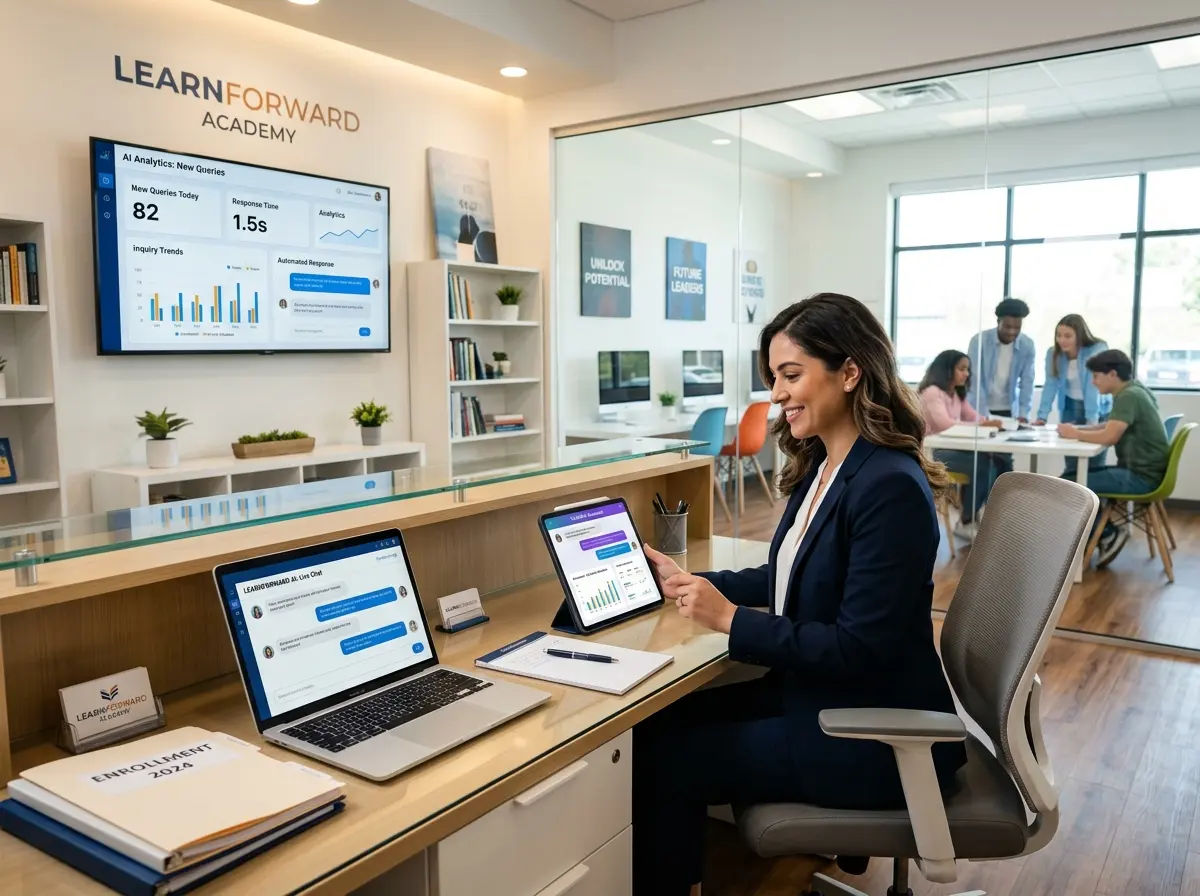
One unexpected win was the visibility the center gained into its own inquiry patterns. Because every interaction was logged and summarized, the director could see which questions came up most frequently, which promotions generated the most calls, and which time windows had the highest inquiry volume. This kind of data is invaluable for staffing decisions, marketing strategy, and program development. Previously, this information lived in people's heads (or didn't exist at all). Now it lived in a dashboard.
A Quick Reminder About Stella
Stella is an AI robot employee and phone receptionist designed to help businesses stay engaged with customers around the clock — whether that's greeting visitors in person through her human-sized kiosk presence or handling phone inquiries with full knowledge of your programs, pricing, and policies. She runs on an affordable $99/month subscription with no upfront hardware costs, making her one of the most practical hires you'll never have to onboard.
What Tutoring Centers Can Do Right Now
If you're running a tutoring center and you recognize yourself in any part of this story — the missed evening calls, the chaotic intake process, the staff fielding the same questions all day — here's a practical path forward.
Audit your inquiry response time. Pull your call logs or voicemail records and look at when inquiries are coming in versus when they're being responded to. If there's a gap of several hours or more, you're losing families to competitors who respond faster. Quantify the problem before you solve it.
Document your most common enrollment questions. Before implementing any AI solution, write out the 15 to 20 questions your staff answers most frequently. This becomes the foundation of your AI's knowledge base — and the exercise alone will often reveal gaps in how consistently you're communicating your offerings.
Standardize your intake process. Decide what information you need from every prospective family: student grade level, subject areas, scheduling preferences, how they heard about you. Build this into your intake flow so that no lead is ever missing key details when it reaches your follow-up queue.
Consider 24/7 phone coverage as a competitive advantage, not a luxury. In a market where families are choosing between multiple tutoring options, being the center that always answers — and always answers well — is a genuine differentiator. The first business to respond with helpful, accurate information is usually the one that earns the enrollment.
The tutoring centers that will thrive in the next several years won't necessarily be the ones with the most tutors or the fanciest facilities. They'll be the ones that make it easiest for families to say yes — and that starts with making sure every inquiry gets answered, every time, no matter what hour the clock reads.