Introduction: The Big Box Battle You Didn't Ask For
Let's be honest — competing against big box stores feels a little like showing up to a knife fight and discovering the other guy brought a shopping cart the size of a small aircraft carrier. They have massive budgets, sprawling parking lots, and an army of employees wearing matching vests. You have charm, expertise, and arguably better coffee in the break room.
But here's the thing: big box stores have one glaring weakness. They can't be everywhere at once — at least not in the minds of customers who are already near you. That's where geo-fenced advertising comes in, and it might just be the most underutilized weapon in the small business arsenal.
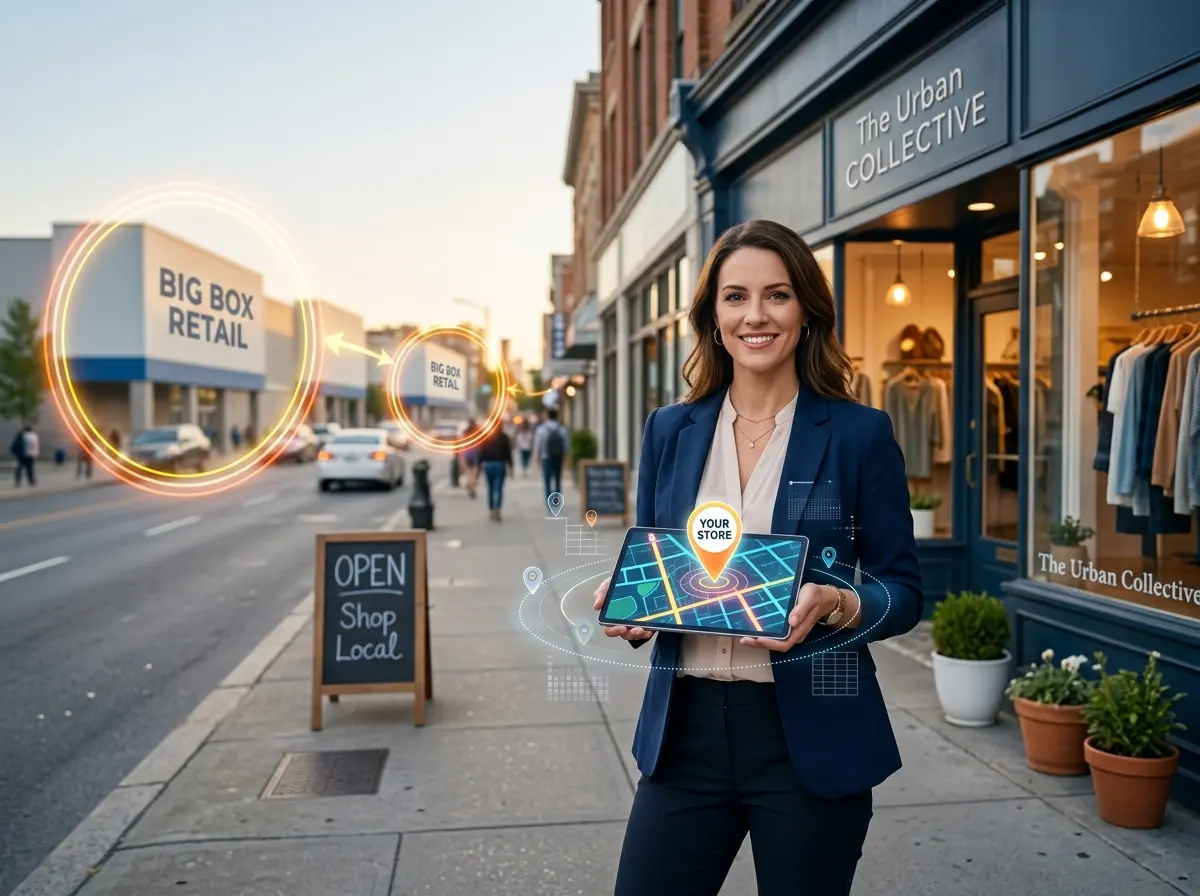
Geo-fencing lets you draw a virtual boundary around a specific location — say, that big box competitor down the street — and serve targeted ads to anyone who enters that zone. When a shopper walks into the parking lot of your giant competitor and their phone lights up with your irresistible offer, you've just inserted yourself into a buying decision that was almost made without you. According to Google, searches including "near me" have grown by over 500% in recent years, which tells you exactly how location-aware consumers have become. It's time to take advantage of that.
This post will walk you through how geo-fenced ads work, how to set them up strategically, and how to make sure that once you've lured those customers in, you're actually ready to wow them.
Understanding Geo-Fencing and Why It Works
What Geo-Fencing Actually Is (No Tech Degree Required)
Geo-fencing is the practice of creating a virtual geographic boundary — a "fence" — around a real-world location using GPS, Wi-Fi, or cellular data. Once that boundary is defined, you can trigger specific actions when a mobile device enters or exits the zone. For advertisers, that action is usually serving a targeted ad through platforms like Google Ads, Meta (Facebook/Instagram), or programmatic ad networks.
Think of it as a polite digital tap on the shoulder: "Hey, before you spend your money in there, we'd love a moment of your time." It's not invasive — users are already seeing ads on their phones constantly. The difference is that yours will be remarkably well-timed and relevant to exactly where they are and what they're likely thinking about buying.
Why Small Businesses Win with Hyper-Local Targeting
Large retailers spend millions on broad awareness campaigns. You don't need to match that. Geo-fencing lets you punch well above your weight by focusing your budget on the precise moments and locations that matter. Instead of hoping the right person sees your billboard, you're reaching someone who is standing in a store that sells what you sell — right now, today, actively in shopping mode.
The conversion advantage is significant. Research from Factual found that geo-fenced mobile ads can drive up to 7x higher click-through rates compared to traditional display ads. And because your audience is already primed to buy, the leap from click to customer is much shorter. For small businesses operating on lean marketing budgets, that kind of efficiency isn't just nice to have — it's essential.
Setting Up Your Geo-Fencing Strategy
Choosing the Right Locations to Target
Your most obvious target is a direct competitor's location, but don't stop there. Think about the entire ecosystem of where your ideal customer spends time before they need you. An auto repair shop might geo-fence a busy commuter parking lot. A local gym could target the parking garage of a larger fitness chain across town. A boutique clothing store might draw a fence around the mall's anchor department stores.
Be strategic about fence size. Too small and you miss people before your ad loads. Too large and you're wasting impressions on people who aren't actually shopping nearby. A radius of 100 to 500 meters around a target location tends to perform well for most retail and service-based businesses. Test, adjust, and refine over time — this is not a set-it-and-forget-it tactic.
Crafting Ads That Actually Pull People Away
Your geo-fenced ad has approximately the attention span of a goldfish to make an impression, so lead with your strongest differentiator. Do you offer same-day service? Price matching? A genuinely knowledgeable staff member who actually knows what they're talking about? Say it fast, say it clearly, and pair it with an offer that creates urgency.
Consider offers like a time-limited discount, a free add-on with purchase, or a "show this ad" promotion redeemable in-store. Phrases like "Just 0.3 miles away" or "Skip the checkout line" add a geographic and emotional hook that generic ads simply can't match. Keep the creative visually clean — someone glancing at their phone in a parking lot isn't going to read a paragraph. Bold text, one clear offer, one clear call to action.
Converting Clicks into Customers Once They Arrive
How Stella Helps You Close the Loop
Getting a customer through the door is only half the battle. The other half is making sure they're greeted, engaged, and genuinely helped — especially during busy periods when your staff is already stretched thin. Stella, an AI robot employee and phone receptionist, stands inside your store and proactively greets every customer who walks in, answers questions about your products, services, hours, and current promotions, and even upsells and cross-sells relevant items — all without ever needing a coffee break.
If your geo-fenced ad mentions a specific promotion, Stella can be configured to discuss that exact deal with walk-in customers, reinforcing the message that brought them in and guiding them toward a purchase. She also handles inbound phone calls 24/7, which means that customers who call to ask about your ad before visiting will get an immediate, knowledgeable response — not a voicemail. In a world where a slow response often means a lost customer, that matters more than most business owners realize.
Measuring Success and Optimizing Over Time
The Metrics That Actually Matter
Geo-fencing campaigns generate a rich stream of data, and it's worth taking the time to understand what you're looking at. Beyond basic click-through rate and impressions, focus on visit rate (how many people who saw the ad actually came in), cost per visit, and ultimately revenue attributed to campaign-driven visits. Many geo-fencing platforms, including options within Google Ads and Meta Ads Manager, offer store visit conversion tracking when your business meets certain volume thresholds.
Set a baseline in your first month, then make one change at a time — tweak the offer, adjust the fence radius, or test a new creative — so you can clearly attribute what's driving improvement. Avoid the temptation to overhaul everything at once. Incremental optimization beats chaotic experimentation every time.
Retargeting: Staying in the Conversation After They Leave
One of the most powerful extensions of geo-fencing is retargeting. Once someone has entered your geo-fence or clicked your ad, you can continue serving them follow-up ads across the web for days or even weeks afterward. This is particularly effective for businesses with longer consideration cycles — think furniture stores, med spas, auto shops, or legal services — where the customer might need several touchpoints before committing.
A well-structured retargeting sequence might start with your awareness ad inside the competitor's zone, follow up with a testimonial-focused ad the next day, and close with a limited-time offer by day five. This kind of sequential storytelling keeps your brand top of mind and dramatically improves conversion rates compared to a one-and-done ad approach. Budget for retargeting from the start — it's rarely expensive and almost always worth it.
Seasonal and Event-Based Geo-Fencing Opportunities
Don't limit your geo-fencing to competitor locations on regular shopping days. Think about events, seasons, and local occasions that bring high-intent buyers into your area. A local sporting goods store might geo-fence a youth sports complex during tournament season. A florist could target the parking lot of a bridal show. A restaurant could serve ads to attendees leaving a nearby concert venue on Friday nights.
These moment-based campaigns often outperform static campaigns because the audience's intent is unusually high and the emotional context is already primed. Keep a calendar of local events relevant to your customer base and plan campaigns around them well in advance. The businesses that win at local marketing aren't necessarily the ones with the biggest budgets — they're the ones paying closest attention to what's happening in their community.
Quick Reminder About Stella
Stella is an AI robot employee and phone receptionist built for businesses like yours — she stands in your store greeting customers and answering questions, and answers phone calls around the clock so you never miss a lead. At just $99/month with no upfront hardware costs, she's designed to be the reliable, professional presence that works even when your team can't. Whether you're driving foot traffic with geo-fenced ads or just trying to make sure every customer gets a great first impression, Stella is ready to help close the gap.
Conclusion: Go Claim Your Customers
Big box stores have one enormous advantage over you: they can outspend you into oblivion on traditional advertising. But geo-fencing levels the playing field in a way that actually favors small businesses — because you can be surgical, local, personal, and fast in ways that lumbering retail giants simply cannot.
Here's your actionable starting point: identify your top one or two competitor locations, set up a geo-fence campaign through Google Ads or Meta Ads Manager, craft a single compelling offer with a clear call to action, and run it for 30 days. Measure your results, refine your approach, and layer in retargeting once the basics are working. Then start exploring event-based and seasonal opportunities to keep the momentum going year-round.
And when those new customers start walking through your door? Make sure you're actually ready for them. A beautifully targeted ad campaign deserves an equally impressive in-store and on-the-phone experience to back it up. The good news is, that part is very solvable. Now go steal some parking lot customers — you've earned it.