When "We'll Follow Up With You" Actually Means Something
Let's be honest — most medical practices have the follow-up process of a forgetful golden retriever. Patients walk out the door, life gets busy, and suddenly it's been three years since anyone's had their eyes checked. Meanwhile, the optometrist is wondering why their schedule looks like Swiss cheese and their front desk staff is fielding calls about whether they're "still open." Sound familiar?
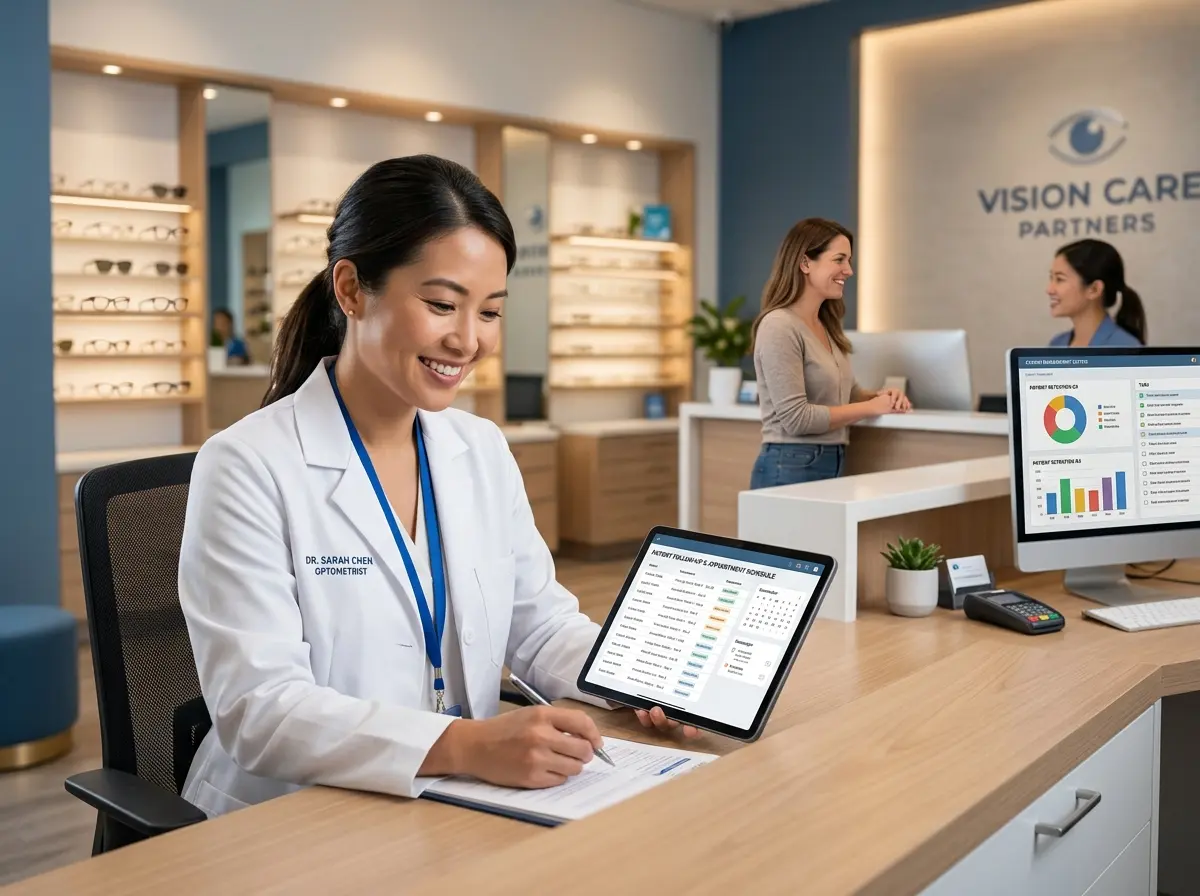
Dr. Marcus Webb, an independent optometrist in suburban Ohio, was living this exact reality. Despite having a loyal patient base, a spotless reputation, and genuinely excellent care, his patient retention rate was hovering around 62% — which is, frankly, pretty average for the industry. Patients liked him. They just... forgot to come back. And his front desk team, bless their hearts, were too busy answering phones and checking people in to chase down anyone who'd gone quiet.
Then he built a simple follow-up system. Within 18 months, his retention rate climbed to 90%. No gimmicks, no expensive marketing agency, no complete operational overhaul. Just a thoughtful, consistent process for staying in touch with patients — and the right tools to make it effortless. Here's what he did, and how you can do the same.
The Anatomy of a Follow-Up System That Actually Works
Step One: Know Who Needs to Hear From You (and When)
The first thing Dr. Webb did was stop treating all patients the same. Not every patient needs the same follow-up cadence — a 65-year-old managing glaucoma has different needs than a 28-year-old who came in once for a contact lens fitting and hasn't been seen since. He segmented his patient list into three buckets: due for annual exam, recently seen with specific follow-up needs, and lapsed patients who hadn't visited in over 18 months.
This segmentation is crucial because it determines both the timing and the tone of outreach. A patient who's due for their annual exam gets a friendly, low-pressure reminder. A lapsed patient gets a slightly warmer, more personal message that acknowledges the gap. Someone who just had a prescription change gets a check-in two weeks later asking how their new lenses are feeling. Each touchpoint feels relevant rather than generic — and that's the difference between a message that gets read and one that gets deleted.
Step Two: Build the Touchpoint Timeline
Dr. Webb's team mapped out a simple communication timeline for each patient segment. For standard annual patients, the sequence looked like this: a reminder postcard (yes, actual mail — it stands out) six weeks before their yearly anniversary, an email reminder two weeks out, a text message three days before the scheduled appointment, and a post-visit check-in one week after their exam. For lapsed patients, the approach was more of a gentle "we miss you" campaign — typically two or three messages spread over 60 days, each offering something of value like a seasonal promotion or a note about a new service the practice had added.
The key insight here isn't revolutionary, but it is underutilized: most patients don't leave because they're unhappy — they leave because they're passive. They're not going to a competitor. They're just not going anywhere. A timely, warm nudge is often all it takes to bring them back.
Step Three: Personalization Without the Extra Effort
Here's where a lot of practice owners get stuck. Personalization sounds great until you're staring down a list of 800 patients and realizing that "personalized" outreach at scale requires either a lot of time or a lot of automation. Dr. Webb solved this by using his practice management software's merge fields to pull in patient-specific details — first name, last visit date, the provider they saw, even their specific prescription type — into templated messages. The result was a message that felt like it came from a human, not a mail merge nightmare.
He also trained his front desk staff to add brief notes to patient records after every visit — things like "patient mentioned they're an avid reader" or "recently started working from home, interested in blue light lenses." These small observations became gold when crafting follow-up messages that felt genuinely personal. It takes 10 seconds to type a note. It can make a patient feel remembered for years.
How the Right Tools Make This Effortless
Automating the Parts You'd Otherwise Forget
None of this works consistently if it lives on a to-do list. Dr. Webb's real breakthrough came when he stopped relying on his staff to manually trigger follow-ups and started automating the routine ones. Appointment reminders, post-visit check-ins, and annual recall messages all went on autopilot. His staff's energy shifted from "remembering to reach out" to "handling the responses" — a much better use of their time.
For practices (and really, any business) looking to tighten up their patient or customer management, Stella is worth knowing about. Stella's built-in CRM lets you manage customer contacts with custom fields, tags, notes, and AI-generated profiles — exactly the kind of infrastructure that makes a follow-up system like Dr. Webb's scalable. Her conversational intake forms can capture patient information during phone calls or at the kiosk, so your records stay current without anyone having to remember to ask. And since Stella answers phones 24/7 — including after hours when patients often try to reschedule or ask questions — fewer inquiries fall through the cracks in the first place.
Retention Isn't Just About Reminders — It's About the Whole Experience
The Visit Itself Has to Earn the Return
A follow-up system is only as powerful as the experience it's inviting patients to repeat. Dr. Webb was clear about this: "If patients had a frustrating experience — long wait, rushed exam, confusing checkout — no reminder in the world was going to bring them back." He invested in smoothing out the friction points in his patient journey alongside building the follow-up system. Shorter wait times, clearer communication about costs, a warmer check-in process. The follow-up system amplified an already good experience. It didn't try to compensate for a bad one.
This is worth sitting with for a moment. Retention marketing gets a lot of attention, but retention operations — the nuts and bolts of how easy and pleasant it is to be your customer — matter just as much. If patients (or customers, clients, diners, members — pick your word) have a seamless experience every time, the follow-up just becomes a friendly wave rather than a Hail Mary.
Asking for Feedback — and Actually Using It
One of the most underrated parts of Dr. Webb's system was the feedback loop he built in. Every post-visit check-in message included a simple one-question survey: "How was your experience with us?" The responses weren't just logged and forgotten — they were reviewed weekly, flagged when negative, and used to identify patterns. Two patients mentioning that checkout felt rushed? Time to look at the checkout process. Multiple patients confused about their insurance coverage? Time to add a clearer explanation at the front desk.
Asking for feedback also has a retention benefit in itself. Patients who feel heard are significantly more likely to return. A Harvard Business Review study found that customers who provide feedback — even if the issue isn't fully resolved — have higher loyalty rates than those who never say anything at all. The act of asking signals that you care. Most practices never ask.
Creating Meaningful Touchpoints Beyond the Transaction
Dr. Webb's highest-performing follow-up messages weren't the appointment reminders — they were the educational ones. A short email in late summer about UV protection and sunglasses. A note in spring about allergy season and dry eye. A quick tip about screen time and eye strain sent to working-age patients in January, when everyone's making resolutions. These messages weren't selling anything directly. They were building trust and positioning Dr. Webb's practice as a resource, not just a vendor. Patients who received these messages consistently showed higher appointment booking rates when the actual recall reminder landed in their inbox.
Quick Reminder About Stella
Stella is an AI robot employee and phone receptionist designed for businesses of all kinds — including medical practices, retail shops, restaurants, salons, and service providers. She greets customers in person at a physical kiosk, answers phone calls 24/7, manages a built-in CRM, and handles intake forms — all for $99/month with no upfront hardware costs. If parts of your customer follow-up process are slipping through the cracks, she's worth a look.
Your 90% Retention Rate Starts With One Decision
Dr. Webb's results weren't magic. They were the product of a deliberate decision to stop leaving patient relationships to chance. If you're running a medical practice — or honestly, any business where repeat customers are the lifeblood of your revenue — a follow-up system isn't a nice-to-have. It's table stakes.
Here's where to start this week:
- Audit your current patient list. Identify who's due for a visit, who's recently lapsed, and who you haven't seen in over a year.
- Map a simple touchpoint timeline for each segment — no more than three to four touchpoints per patient per year for standard recall.
- Automate what you can. Appointment reminders and post-visit check-ins should never require manual effort.
- Add a feedback mechanism to your post-visit outreach. One question is enough.
- Build in educational content. At least two or three messages per year that aren't asking patients to book an appointment — just offering something useful.
The practices (and businesses) that win on retention aren't necessarily the ones with the flashiest technology or the biggest marketing budgets. They're the ones that make patients feel remembered, valued, and looked after — consistently, over time. It's not complicated. It's just not accidental, either.
Start building your system today. Your future self — and your schedule — will thank you.