When the Heat Is On, Your Phone Shouldn't Be Your Weak Link
Summer arrives. Temperatures spike. Every homeowner in a fifty-mile radius suddenly discovers their AC unit has been silently plotting against them all winter. Your phone starts ringing before 7 AM, your technicians are booked three days out, and somewhere in between dispatching crews and pulling permits, a potential customer hangs up because nobody answered. They call your competitor. Your competitor answers. You lose the job.
This is the unglamorous reality of busy season for HVAC companies. The demand is absolutely there — HVAC businesses report that peak season can account for 60–70% of their annual revenue — but capturing that demand requires something most small and mid-sized operators overlook: a reliable front-line communication system that doesn't buckle under pressure.
The good news? A growing number of HVAC companies are solving this problem not by hiring more office staff (good luck with that labor market), but by deploying AI receptionists that handle the phones around the clock. Here's how they're doing it, and why it's working better than most owners expected.
The Busy Season Problem Nobody Talks About Enough
Missed Calls Are Missed Revenue — Full Stop
It sounds obvious, but the math is worth sitting with for a moment. The average HVAC service call generates anywhere from $150 to $500 or more, and an AC replacement can run several thousand dollars. Now think about how many calls go unanswered on a 95-degree Tuesday when your entire office staff is either on hold with a parts supplier or trying to calm down a homeowner who hasn't slept in two days because their house is 84 degrees inside.
Studies consistently show that over 80% of callers who reach voicemail will not leave a message — they simply hang up and call the next company on Google. That means every unanswered ring during peak season isn't a minor inconvenience; it's a quiet, invisible drain on your revenue that never shows up on a report because you never knew the call happened in the first place.
The Staffing Paradox of Peak Season
Here's the cruel irony: the time when you need the most administrative support is exactly the time when it's hardest to find and onboard quality help. Hiring a seasonal receptionist means posting a job, interviewing candidates, training someone on your service offerings, teaching them how to handle frustrated customers, and crossing your fingers they show up consistently during the weeks that matter most to your bottom line.
Even if you find someone great, they work eight hours a day, five days a week. AC units don't follow business hours. Emergency calls come in at 9 PM on a Friday, and that homeowner with three young kids and no working air conditioning is going to book with whoever picks up — not whoever has a polite voicemail greeting.
Customer Expectations Have Changed Dramatically
Customers in 2024 have been conditioned by on-demand everything. They expect fast responses, clear information, and easy booking. If your phone process involves holding music, vague answers from an overwhelmed staffer, or a callback promise that takes four hours, you're losing trust before a technician ever sets foot in their home. First impressions in the HVAC industry are almost always made over the phone, which makes that interaction more valuable — and more fragile — than most owners realize.
How AI Receptionists Are Changing the Game for HVAC Companies
24/7 Coverage Without the Overhead
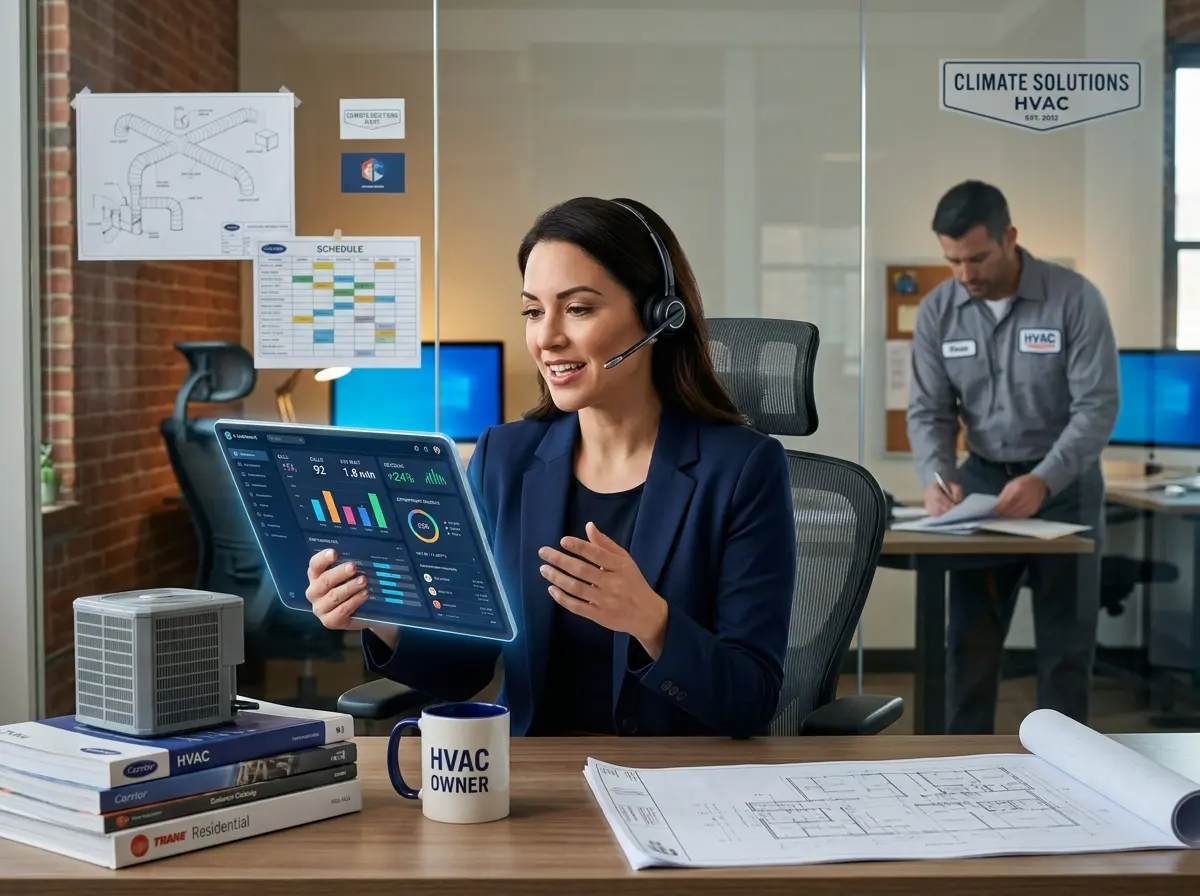
This is where tools like Stella, an AI robot employee and phone receptionist, are genuinely shifting how HVAC companies operate during their busiest months. Rather than relying on a human answering the phone during a narrow window of business hours, AI receptionists handle incoming calls around the clock — answering questions about services, collecting customer information, and routing urgent calls to on-call technicians based on configurable conditions you set in advance.
For HVAC companies specifically, this means a homeowner calling at 11 PM about a failed AC unit gets a professional, informed response immediately. Stella can gather the customer's name, address, the nature of the problem, and any relevant details through a conversational intake process — and then either connect them with an on-call tech or log everything in a built-in CRM so your team has a complete picture first thing in the morning. No missed leads. No scribbled sticky notes. No game of telephone between your answering service and your dispatcher.
Stella's built-in CRM and intake forms mean that every customer interaction is automatically documented, tagged, and ready for follow-up — which is exactly the kind of organized, scalable workflow that separates HVAC companies that dominate busy season from the ones that survive it.
Operational Strategies That Actually Work During Peak Demand
Triage Your Calls Before They Reach Your Technicians
Not every inbound call during busy season is an emergency, even if the customer believes otherwise. An AI receptionist can serve as a first-pass filter — collecting information about the situation and routing accordingly. True emergencies (no AC, elderly resident, medical equipment involved) get escalated immediately. Standard service requests get logged and queued. New customer inquiries get a professional response with your current availability and booking options.
This kind of intelligent call triage protects your technicians from being pulled into dispatch conversations when they should be in someone's attic replacing a blower motor. It also ensures your highest-priority jobs actually get prioritized, instead of just whichever customer happened to call right when someone at the office had a free moment.
Use Promotions Strategically — and Consistently
Busy season is also prime time for upselling and cross-selling, but it only works if every customer interaction actually includes those conversations. Human receptionists, when overwhelmed, skip the extras. They forget to mention the maintenance plan, the smart thermostat promotion, or the filter subscription service. An AI receptionist doesn't forget. It consistently surfaces the offers you've configured it to promote — every call, every time — which compounds meaningfully across hundreds of interactions over a busy summer.
Consider running a seasonal tune-up bundle, a priority service membership, or a referral discount during peak months. Program those promotions into your AI receptionist and let it do the talking while your team focuses on the work.
Protect Your Team From Burnout
Operational burnout in HVAC companies during busy season is real, and it's expensive. Turnover, mistakes, poor customer service — these are all downstream effects of a team that's been answering the same questions and managing the same administrative chaos for eight straight weeks. Reducing the volume of repetitive inbound inquiries that land on your staff isn't just good for efficiency; it's good for morale. When your office team isn't fielding thirty calls a day asking about your service area or your pricing structure, they can focus on the work that actually requires human judgment — scheduling, escalations, customer relationships, and keeping jobs moving.
Quick Reminder About Stella
Stella is an AI robot employee and phone receptionist built for businesses of all sizes — including HVAC companies navigating the chaos of peak season. She answers calls 24/7, collects customer information, promotes your services, routes urgent calls to the right people, and keeps everything organized in a built-in CRM. At $99/month with no upfront hardware costs, she's the team member who never calls in sick on a 100-degree day.
Stop Leaving Revenue on the Table This Season
Busy season in the HVAC industry is a finite window, and every missed call, every fumbled intake, every customer who hangs up and dials your competitor is a loss you can't recover. The companies that are pulling ahead aren't necessarily the ones with the most technicians or the flashiest trucks — they're the ones who figured out that the phone is a revenue channel, not an administrative burden, and staffed it accordingly.
Here's what you can do right now:
- Audit your current call handling. How many calls go unanswered during peak hours? How many after hours? If you don't know, that's already a problem.
- Map out your most common inbound questions. Services, pricing, availability, service area — these are exactly the kinds of questions an AI receptionist handles flawlessly.
- Identify your seasonal promotions and make sure every customer interaction includes them.
- Consider an AI receptionist that works around the clock, collects customer data, and integrates into your existing workflow without requiring a six-month onboarding process.
The busy season isn't slowing down. Your phone coverage should keep up. The HVAC companies that understand this — and act on it — are the ones customers remember when their AC dies next summer too.