Why Your Hotel Room Rates Shouldn't Be Set in Stone (Or Excel)
Let's be honest — if you're still pricing your hotel rooms the same way you did five years ago, you're probably leaving money on the table. Not just a little money. We're talking about the kind of money that could fund a lobby renovation, hire two more front desk staff, or finally fix that ice machine on the third floor.
Independent hotels face a genuinely difficult challenge: competing against major chains that have entire departments — yes, entire departments — dedicated to revenue management and dynamic pricing. These chains have algorithms, analysts, and dashboards that would make your head spin. You have a spreadsheet, a gut feeling, and maybe a very optimistic occupancy goal written on a whiteboard.
But here's the good news: the gap is closing. Revenue management tools and strategies that were once reserved for the big players are now accessible, affordable, and practical for independent hoteliers. This guide will walk you through the fundamentals of revenue management and dynamic pricing so you can stop guessing and start strategizing — without needing a PhD in economics or a team of analysts on retainer.
The Fundamentals of Hotel Revenue Management
Revenue management is the art and science of selling the right room, to the right guest, at the right price, at the right time. It sounds simple when you put it that way. It is decidedly less simple in practice — but it's absolutely learnable, and more importantly, it's incredibly profitable when done well. Hotels that implement even basic revenue management strategies see average revenue per available room (RevPAR) improvements of 5–10% or more. For an independent property, that's not a rounding error — that's real, meaningful income.
Understanding Your Key Metrics
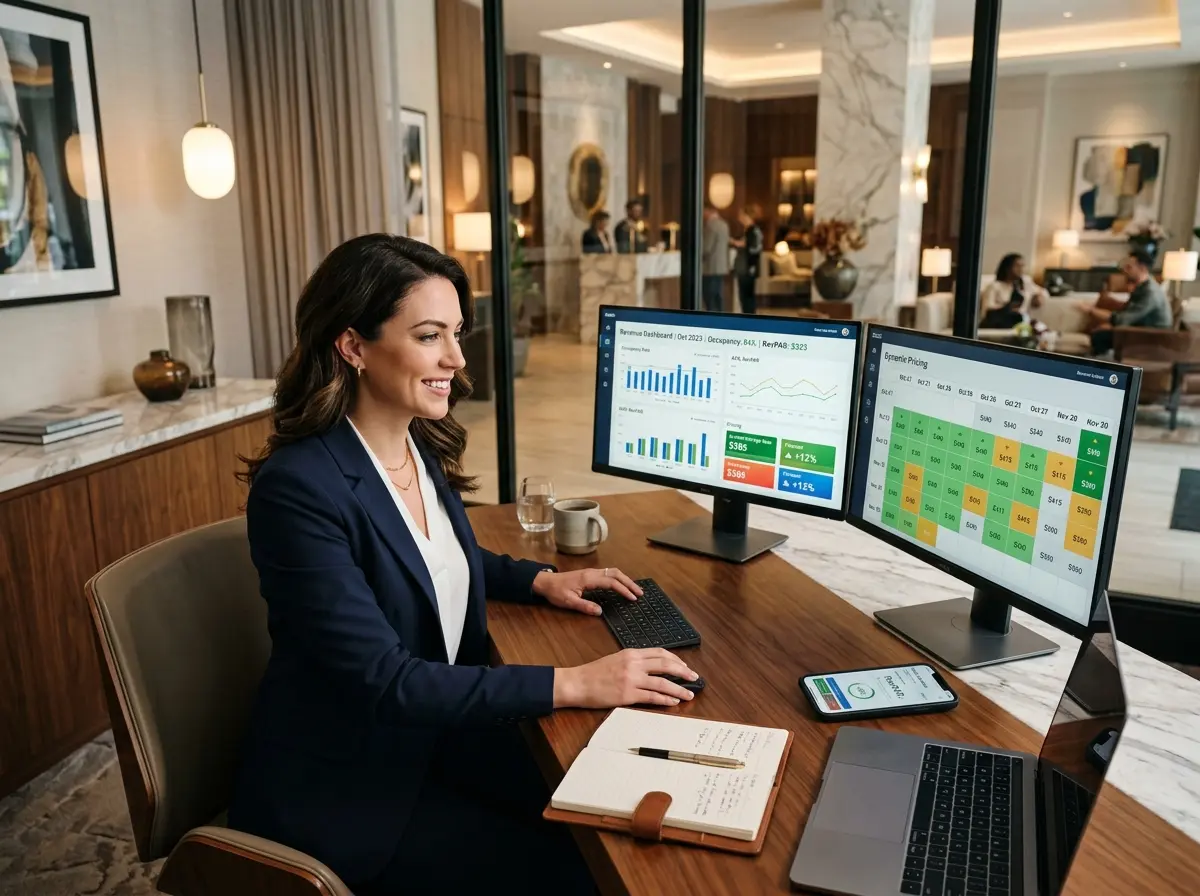
Before you can manage revenue, you need to understand what you're measuring. The three metrics every independent hotelier should live and breathe are Occupancy Rate, Average Daily Rate (ADR), and Revenue Per Available Room (RevPAR).
Occupancy tells you how full you are. ADR tells you how much guests are paying on average. RevPAR combines them both into a single performance indicator by multiplying occupancy rate by ADR. If your RevPAR is growing, you're doing something right. If it's flat or declining while your costs go up, you have a problem worth solving urgently. A fourth metric worth tracking is TRevPAR (Total Revenue Per Available Room), which accounts for ancillary revenue like parking, dining, and spa services — a useful reminder that rooms aren't your only revenue lever.
Segmenting Your Guests Like a Pro
Not all guests are created equal — and that's not an insult, it's a pricing opportunity. Revenue management starts with understanding who is actually booking your rooms. Leisure travelers booking eight weeks out behave very differently from business travelers booking Tuesday afternoon for a Wednesday check-in. Groups have different price sensitivities than solo guests. Last-minute bookers are a different animal entirely.
Start by segmenting your bookings into categories: leisure, corporate, group, OTA (online travel agency), and direct. Once you understand which segments drive your bookings — and at what times of year — you can build pricing strategies tailored to each. Corporate accounts, for instance, often trade rate flexibility for volume guarantees. Leisure travelers are far more price-sensitive but also more likely to add extras if you offer them at the right moment.
Demand Forecasting Without a Crystal Ball
Good pricing decisions start with good demand forecasting. You don't need sophisticated software to get started — though it certainly helps eventually. Begin by looking at your own historical data: What were your occupancy rates last year during the same weeks? Which local events drove spikes? Were there patterns around holidays, school breaks, or regional conferences?
Layer on external data sources. Your local convention and visitors bureau likely publishes event calendars. Google Trends can reveal when people start searching for accommodations in your area. Competitor rate shopping — simply checking what nearby hotels are charging — is a perfectly legitimate and extremely useful practice. The goal is to anticipate demand surges and slowdowns before they happen, not react to them after the fact.
Tools and Technology That Actually Help
Independent hoteliers don't need enterprise-level software with six-figure price tags. What they do need is a smart combination of affordable tools that work together — and one powerful addition that many hotel owners overlook entirely: front-of-house automation.
Making the Most of Modern Revenue Tools
Property Management Systems (PMS) like Cloudbeds, Little Hotelier, or WebRezPro have built-in reporting and some revenue management functionality. Channel managers help you distribute rates across OTAs without manually updating each platform. Rate shopping tools like OTA Insight give you real-time visibility into competitor pricing so you're never flying blind.
But technology alone doesn't close guests. Guest experience does. And that's where Stella quietly earns her keep. While your revenue management software is optimizing rates in the background, Stella is on the front line — greeting guests in the lobby, answering questions about room types, amenities, and current promotions, and handling phone inquiries 24/7 as an AI phone receptionist. When a potential guest calls at 11pm to ask about your weekend package or pet policy, Stella picks up, answers confidently, and can even collect guest information through conversational intake forms — all feeding into her built-in CRM so your team has full context the next morning. More bookings, better data, zero overtime.
Dynamic Pricing Strategies You Can Implement This Week
Dynamic pricing sounds intimidating, but at its core it just means adjusting your rates based on real-time demand signals rather than setting a flat rate and hoping for the best. Major airlines have done this for decades. Hotels of all sizes are doing it now. The question is how aggressively and how intelligently you can execute.
Building a Tiered Rate Structure
Start by establishing a rate floor (the lowest you'll ever go) and a rate ceiling (your peak-demand maximum). Then build a ladder of rates between them, triggered by occupancy thresholds. A simple example: if occupancy is below 40% with seven or more days to arrival, you're at your promotional rate. Between 40–65%, you're at standard rate. Above 65%, you shift to a premium rate. Above 80% and you're near sellout — push to ceiling rates and consider closing out discounted channels entirely.
This tiered approach is easy to manage manually or semi-automatically through most channel managers, and it immediately brings discipline to your pricing decisions. No more "let's just keep it the same and see what happens."
Leveraging Length-of-Stay Controls
One underused lever for independent hotels is minimum length-of-stay (MLOS) restrictions. During high-demand periods — a major local festival, a long weekend, a regional sporting event — accepting one-night bookings can actually hurt you. Those rooms block your ability to accommodate three- and four-night guests who generate significantly more total revenue.
Implementing a two- or three-night minimum during peak periods is a straightforward way to optimize your revenue mix. Pair this with a closed-to-arrival restriction on particularly high-demand nights, and you're managing your inventory like a seasoned pro. It feels counterintuitive to turn away bookings, but when you run the numbers, the math consistently favors longer stays during compressed demand periods.
Timing Your Promotions Strategically
Discounts should never be a reflex — they should be a tool. Early-bird promotions for guests booking 30–60 days out help you build a base of confirmed revenue and reduce uncertainty. Last-minute promotions for rooms that would otherwise go unsold are equally valid, as long as you're protecting your rate integrity on OTAs and not training your guests to always wait for a deal.
Consider flash promotions tied to direct booking channels — email lists, loyalty programs, or your hotel's social media — where you can offer value without publicly undercutting your OTA rates. A complimentary breakfast or late checkout costs far less than a 20% rate reduction while still giving guests a compelling reason to book direct.
Quick Reminder About Stella
Stella is an AI robot employee and phone receptionist designed for businesses exactly like yours. She stands in your lobby engaging guests and answering questions around the clock, and she answers your hotel's phone calls 24/7 with the same knowledge and professionalism — so no inquiry ever goes unanswered. At just $99/month with no upfront hardware costs, she's the front-desk presence that never calls in sick, never needs a break, and never forgets to mention the weekend promotion.
Putting It All Together: Your Next Steps
Revenue management doesn't require a team of analysts or a budget that rivals a chain hotel's marketing spend. It requires consistency, discipline, and a willingness to make decisions based on data rather than habit. Here's where to start:
- Audit your current pricing strategy — Are you adjusting rates based on demand signals, or setting rates once and forgetting them? Be honest with yourself.
- Build your rate ladder — Establish a rate floor, ceiling, and at least three trigger points based on occupancy thresholds. Implement this week.
- Set up a competitor rate shop — Whether you use a formal tool or a manual process, check your competitive set's rates at least twice a week. Know what the market is doing.
- Review your booking segments — Pull the last 12 months of data and identify which segments are most valuable. Prioritize your pricing and marketing accordingly.
- Introduce MLOS restrictions — Identify your next three high-demand periods and apply minimum-stay requirements proactively, not reactively.
- Stop discounting reflexively — Before you drop rates, ask whether you've exhausted other demand levers: promotions to your email list, packages, direct booking incentives.
Independent hotels that commit to even a basic revenue management practice consistently outperform those that don't — full stop. You don't need to boil the ocean on day one. Pick two or three tactics from this guide, implement them properly, and measure the results. Then build from there. The chains have a head start, but they don't have your local knowledge, your flexibility, or your ability to make decisions without waiting for six committee approvals.
Use that advantage — and price your rooms accordingly.