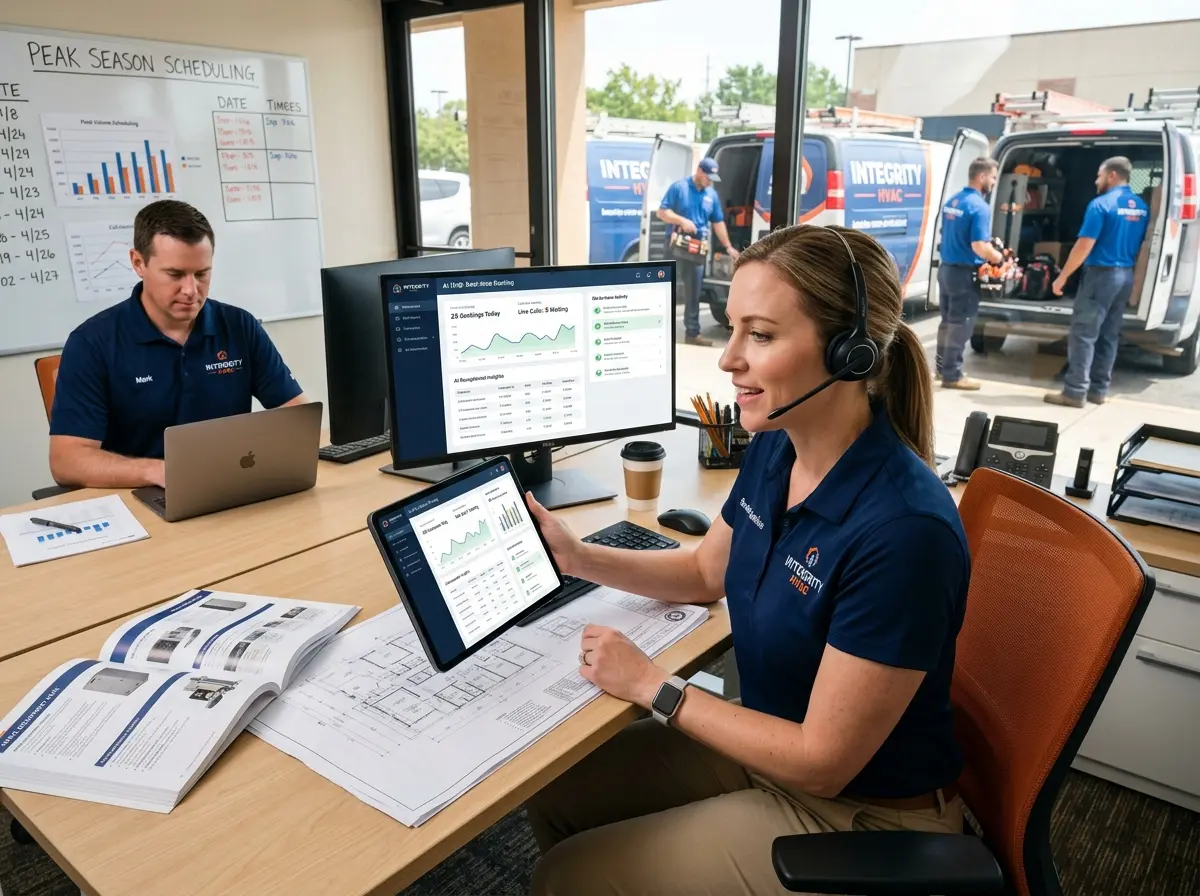
When the Phones Won't Stop Ringing (and Neither Will the Sweat)
Summer arrives, temperatures spike, and suddenly every HVAC company in the country is drowning in service calls, installation requests, and frantic homeowners who swear their AC was fine yesterday. The busy season is a beautiful thing — revenue is flowing, trucks are rolling, and your technicians are earning their keep. But there's a not-so-beautiful side to the chaos: your phones are ringing off the hook, your front office staff is one missed lunch break away from mutiny, and a solid chunk of those calls are going to voicemail, which is basically a polite way of sending customers straight to your competitors.
Sound familiar? You're not alone. The HVAC industry has one of the most brutal seasonal demand curves of any service business. The difference between companies that dominate the busy season and those that merely survive it often comes down to one thing: how well they handle customer communication when volume is at its peak. The good news? AI is leveling the playing field — and the smartest HVAC operators are already taking advantage of it.
The Real Cost of a Missed Call During Peak Season
More Than Just a Lost Lead
Let's be honest about what a missed call actually costs you during peak season. It's not just one annoyed customer — it's a ripple effect. Studies suggest that up to 85% of callers who don't reach a live person on the first try will not call back. They'll hang up, Google your nearest competitor, and book with them instead. During a summer heatwave, when every HVAC company in your market is getting slammed, that window of opportunity can close in minutes.
Now multiply that by the dozens of calls your team might be missing on a busy Tuesday afternoon when every technician is in the field, your office manager is scheduling three jobs simultaneously, and the hold music has been playing for so long it's practically its own radio station. The lost revenue from unanswered calls during a six-week peak season can be staggering — often tens of thousands of dollars for mid-sized HVAC operations.
The Staffing Problem You Can't Hire Your Way Out Of
The knee-jerk solution is to hire more office staff for the season. And sure, that helps — until you factor in recruiting time, training costs, the inevitable learning curve, and the awkward conversation in September when you have to let your seasonal hire go. Temporary staffing is expensive, inconsistent, and logistically painful. You're essentially spending money to solve a problem that reappears every single year.
The smarter play is to build a communication infrastructure that scales automatically with demand — one that doesn't need a W-2, doesn't call in sick on the hottest day of the year, and doesn't need three weeks of training before it can explain your maintenance plan to a customer. That's where AI-powered receptionists are quietly revolutionizing how HVAC companies operate.
How AI Receptionists Are Changing the Game for HVAC
Answering Every Call, Every Time — Without the Overhead
Stella, an AI robot employee and phone receptionist built for businesses like yours, answers every inbound call 24/7 with the same knowledge, the same professionalism, and the same energy — whether it's 9 AM on a Monday or 11 PM on a Saturday when someone's window unit just gave up the ghost. She knows your services, your pricing structure, your service areas, your current promotions, and your scheduling policies. She can collect customer information through conversational intake forms right during the call, building out lead profiles automatically so your team walks into every follow-up fully informed.
For HVAC companies specifically, this means no more missed emergency calls, no more customers lost to hold times, and no more office staff stretched thin trying to juggle incoming calls with job scheduling. Stella can handle routine inquiries entirely on her own, forward calls to human staff when the situation warrants it (based on conditions you configure), and capture voicemails with AI-generated summaries pushed directly to your managers — so nothing falls through the cracks even when your team is slammed.
A CRM That Builds Itself
One underrated advantage of AI-powered reception is what happens after the call. Stella's built-in CRM automatically logs customer interactions, generates AI-created contact profiles, and lets you add custom fields, tags, and notes — all without your staff manually entering data between calls. For HVAC companies juggling hundreds of service requests during peak season, this kind of automated record-keeping is the difference between a chaotic pile of sticky notes and a clean, actionable customer database you can actually use for follow-up campaigns, maintenance reminders, and repeat business outreach in the off-season.
Operational Strategies That Actually Work During Peak Season
Triage Your Calls Like a Pro
Not every call deserves the same level of urgency, and your team's time is too valuable to treat a "how much does a tune-up cost?" inquiry the same as a "my elderly mother has no AC and it's 98 degrees" emergency. Smart HVAC operators build a tiered response system that routes calls based on urgency, service type, and customer status. AI receptionists make this practical at scale — they can gather the relevant details upfront, categorize the call, and either handle it directly or escalate it appropriately, ensuring your human staff is focused on the situations that genuinely require a human touch.
Use the Off-Hours Window to Your Advantage
Here's a counterintuitive truth: some of your best leads come in after hours. Homeowners notice their AC struggling at 7 PM, start Googling solutions at 9 PM, and call whoever they find at 10 PM. If your competitors have voicemail and you have an AI receptionist who answers warmly, gathers their information, explains your emergency service options, and lets them know someone will follow up first thing in the morning — you've already won that customer before your competition even knows they called.
The after-hours window is a genuine competitive advantage that most HVAC companies are leaving completely on the table. Capturing those late-night and weekend inquiries with a professional, knowledgeable response rather than a generic voicemail greeting can meaningfully move the needle on your close rate during peak season.
Promote Seasonal Offers Without Lifting a Finger
Your AI receptionist isn't just answering questions — it's a marketing channel. When a customer calls to ask about a repair, a well-configured AI receptionist can organically mention your current seasonal promotion on maintenance agreements, your referral program, or your financing options for new system installations. This kind of consistent, low-pressure upselling is something human staff often forget to do when they're busy and stressed. An AI never forgets, never gets too rushed to mention the add-on, and never delivers the pitch with the exhausted energy of someone who's been on the phone for six hours straight.
Quick Reminder About Stella
Stella is an AI robot employee and phone receptionist designed to work for businesses of all sizes — including HVAC companies navigating the beautiful chaos of peak season. She answers calls 24/7, collects customer information, promotes your services, and manages contacts through a built-in CRM, all for a straightforward $99/month subscription with no upfront hardware costs. For businesses with a physical showroom or office, she also functions as a human-sized in-store kiosk that greets customers and answers questions in person — because some customers still like to walk in and talk to someone, even if that someone is very enthusiastically robotic.
Stop Surviving Peak Season — Start Owning It
The HVAC companies that will look back on this busy season as their best year yet aren't necessarily the ones with the most trucks or the lowest prices. They're the ones who figured out how to capture every lead, serve every caller, and run a tighter operation while their competitors are still playing phone tag. AI-powered reception isn't a futuristic luxury anymore — it's a practical, affordable tool that's already working for operators in your market.
Here's what you can do right now to start positioning yourself for peak season dominance:
- Audit your missed call rate. Pull your call logs and find out exactly how many calls you're not answering — the number will probably surprise you.
- Map your after-hours volume. Identify what percentage of your calls come in outside business hours and what you're currently doing with them.
- Define your call triage criteria. Know exactly which types of calls need a human and which can be handled automatically — then build a system around it.
- Evaluate AI reception tools. Look for solutions that offer 24/7 availability, CRM integration, intake form capabilities, and promotional features — everything you need in one place.
- Set it up before the rush hits. Don't wait until you're already overwhelmed to implement a new system. The time to build the infrastructure is before you need it.
Peak season is coming whether you're ready or not. The question is whether you'll spend it scrambling to answer calls — or let a very capable AI handle the phones while you focus on running a great HVAC business.