Your Menu Is Doing the Talking — Is It Saying the Right Things?
Let's be honest: most spa and salon service menus are basically just a list of things with prices next to them. Functional? Sure. Exciting? About as thrilling as a terms and conditions page. If your menu reads like a tax form, you're leaving serious money on the table — and probably confusing clients in the process.
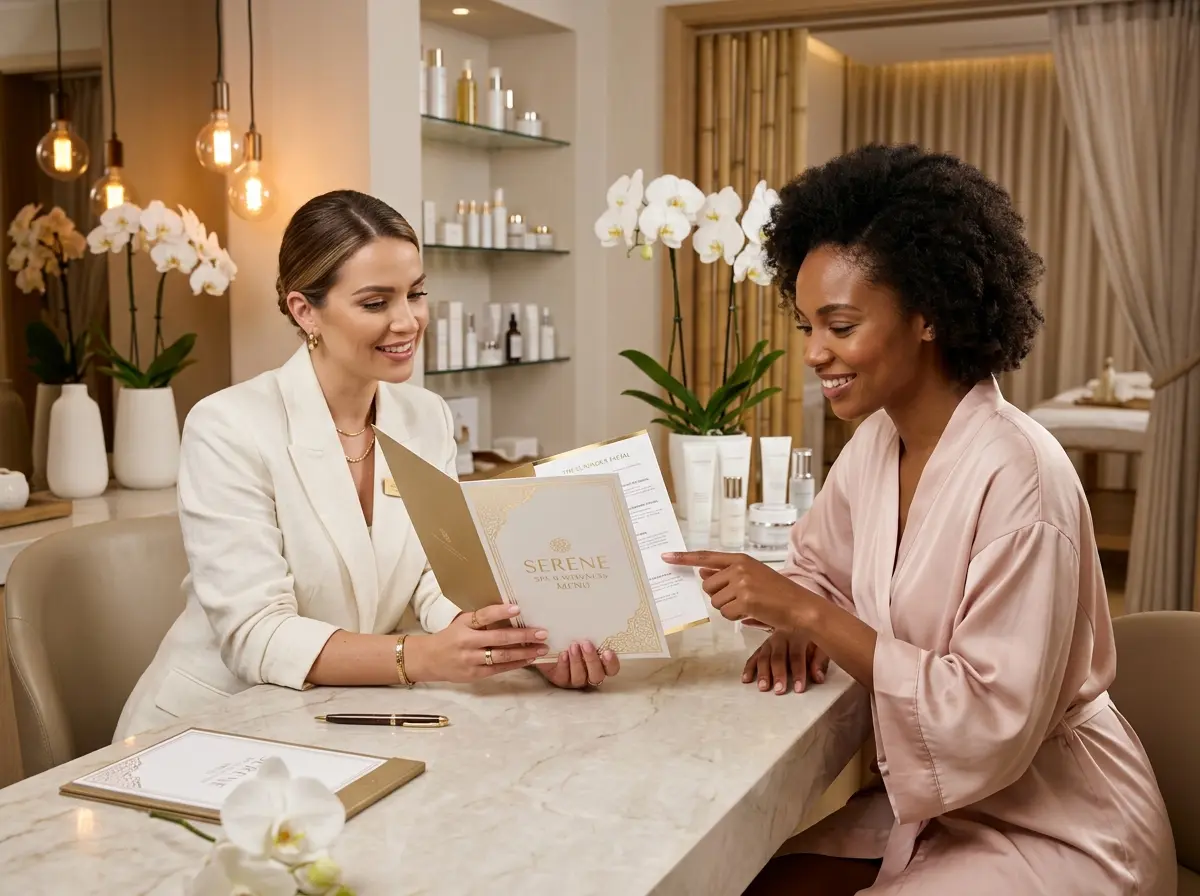
Here's the thing — your service menu isn't just a price list. It's a sales tool. Done right, it should guide clients toward higher-value services, spark curiosity about add-ons they didn't know they needed, and make the decision to upgrade feel completely natural. The best service menus don't feel like they're selling anything at all. They just make the premium option seem obvious.
According to research from the Professional Beauty Association, salons and spas that actively upsell add-on services see an average revenue increase of 20–30% per client visit without adding a single new customer. That's not a marketing budget problem. That's a menu design problem — and it's entirely fixable.
So let's talk about how to build a service menu that sells smarter, not harder.
The Anatomy of a Menu That Sells
Lead With Experience, Not Just Services
The fastest way to commoditize your business is to describe your services in purely mechanical terms. "60-Minute Swedish Massage — $85" tells a client what they're getting and what it costs. It does not tell them how they'll feel walking out the door. Compare that to: "Unwind Swedish Massage — A full-body escape designed to melt away tension and reset your nervous system. 60 minutes. $85." Same service. Completely different energy.
Outcome-focused language taps into why clients are there in the first place: they want to feel better, look better, or escape the chaos of their daily lives for an hour. When your menu descriptions speak to those desires, clients stop comparing prices and start imagining the experience. That's exactly where you want them.
Use Strategic Tiering to Make Upgrades Feel Obvious
Tiered service structures are one of the most effective upselling tools available, and the psychology behind them is delightfully simple. When you present three versions of a service — a standard option, an enhanced option, and a premium option — most clients gravitate toward the middle tier. This is called the compromise effect, and it means that by simply offering a premium version, you've already made your mid-tier service more appealing than it was before.
Structure your tiers clearly. For example, a facial menu might offer a Classic Refresh (30 min), a Signature Glow Facial (60 min with a vitamin C serum treatment), and a Platinum Renewal Experience (90 min with LED therapy and a collagen mask). Each tier should feel like a natural progression — not a price gouge. Clients should be able to look at the premium option and think, "Okay, that does sound amazing." Whether they book it or not, they've already recalibrated their expectations upward.
Make Add-Ons Irresistible and Easy to Say Yes To
Add-ons are where the real margin lives, but most menus bury them at the bottom in a tiny font like an afterthought. Instead, position your add-ons directly alongside the services they complement. A scalp massage listed under your blowout service. A paraffin wax treatment listed next to your manicure. A brow tint mentioned right next to your lash appointment.
Keep the price point low enough that it feels like a no-brainer, and frame the language around indulgence or results. "Add a deep conditioning treatment — because your hair deserves it too. +$15." Nobody's going to argue with that. The goal is to make saying yes feel easier than saying no — and when add-ons are visible, relevant, and reasonably priced, they practically sell themselves.
Let Technology Do Some of the Heavy Lifting
How Stella Can Help You Upsell Around the Clock
Designing a great menu is step one. Making sure that menu is being actively communicated to every single client — walk-in or caller — is step two, and it's where a lot of businesses drop the ball. Staff get busy, forget to mention the seasonal promotion, or feel awkward pushing add-ons during checkout.
Stella, the AI robot employee and phone receptionist, solves this problem elegantly. As an in-store kiosk, she greets every client who walks in, proactively highlights your current specials and services, and recommends relevant add-ons based on whatever the client is interested in — consistently, every single time, without ever feeling pushy. As a phone receptionist, she handles incoming calls 24/7, answers questions about your services and pricing, and promotes your offerings to every caller with the same energy your best staff member brings on their best day. She doesn't forget to mention the hydrating scalp treatment. She doesn't get distracted. She just keeps selling — naturally and helpfully.
Pricing Psychology That Works in Your Favor
Drop the Dollar Signs and Round Numbers
This one sounds small, but it isn't. Research consistently shows that removing dollar signs from menus reduces the psychological "pain of paying" and encourages higher spending. Instead of "$95.00," write "95" — or better yet, "from 95." That tiny shift makes the price feel less transactional and more like a simple number on a page. Many high-end spas and salons have adopted this approach specifically because it works, and it costs you absolutely nothing to implement.
Similarly, avoid overly round numbers where possible. Prices like $80, $100, and $120 can feel arbitrary. Prices like $87 or $113 feel calculated — like they actually reflect the value of what's being delivered. It's a small psychological signal that says "we priced this thoughtfully," which subtly reinforces the perception of quality.
Anchor High to Sell the Middle
Make sure your most premium service is visible and described beautifully — even if you don't expect most clients to book it. Its job isn't just to generate revenue directly. Its job is to anchor perception. When a client sees a Luxury Diamond Facial listed at 185, suddenly your Signature Facial at 95 feels like excellent value. Anchoring is one of the oldest tricks in pricing psychology, and it's completely ethical. You're not tricking anyone — you're just helping them appreciate what they're getting.
Feature your anchor service prominently, give it a compelling name and description, and let it do its job quietly in the background. The ripple effect on your mid-tier bookings will speak for itself.
Bundle Services to Increase Average Ticket Value
Bundling is another powerful lever that often goes underutilized in the spa and salon world. A "Date Night Package" that combines a blowout, express facial, and gel manicure at a slight discount is more compelling than three separate line items — and it increases your average ticket while simplifying the decision for the client. They're not choosing between services anymore. They're choosing an experience.
Seasonal bundles work especially well because they create urgency. A "Summer Glow Bundle" or "Holiday Refresh Package" taps into existing buying intent and makes it easy for clients to treat themselves (or someone else) without the mental overhead of building a custom booking from scratch. Name your bundles well, price them strategically, and watch how often clients choose the convenient option over the à la carte one.
A Quick Reminder About Stella
Stella is an AI robot employee and phone receptionist built for businesses like yours. She greets in-store customers, promotes your services and specials, and answers phone calls 24/7 — all for just $99/month with no upfront hardware costs. Whether your clients find you in person or call to ask about your menu, Stella makes sure they always get a warm, knowledgeable, professional response that keeps your upsells working even when you're not in the room.
Your Menu Is Ready — Now Put It to Work
Building a service menu that upsells itself isn't about being pushy or manipulative. It's about making it genuinely easy for your clients to discover services and experiences they'll love — and to spend a little more doing it. When your menu speaks to outcomes, uses smart tiering, positions add-ons thoughtfully, and applies a few proven pricing psychology principles, the selling happens naturally in the background while you focus on delivering incredible service.
Here's your action plan to get started:
- Audit your current menu. Read every service description out loud. Does it sound like an experience or a brochure? Rewrite anything that feels flat.
- Build your tiers. Identify your top three or four core services and create a standard, enhanced, and premium version of each.
- Reposition your add-ons. Move them next to the services they complement, give them compelling names, and keep pricing accessible.
- Add at least one bundle. Start with a seasonal offering and see how clients respond.
- Remove the dollar signs. Trust the research on this one. It takes five minutes and costs nothing.
Your menu is the silent salesperson working every hour your doors are open. Give it something worth saying — and make sure every client, whether they walk in or call in, hears it loud and clear.