From "Just a Buffet" to the Event Everyone's Still Talking About
Let's be honest — buffets are the reliable minivan of the catering world. Practical, efficient, gets the job done. But full-service events? That's the luxury SUV with heated seats, a panoramic sunroof, and someone who actually refills your drink before you have to ask. If your catering company is primarily booking buffet-style events, you're leaving serious money on the table — and not the kind with a linen tablecloth and a centerpiece.
The jump from buffet catering to full-service events isn't just about adding more staff or fancier chessecloth. It's a strategic upsell that requires the right positioning, the right timing, and the right conversations with clients. The good news? Most of your existing clients are already a perfectly warm audience. They've tasted your food, they trust your operation, and somewhere in the back of their minds, they've probably wondered what it would look like if you really showed up for their next event.
This guide will walk you through how to make that upsell feel natural, valuable, and mutually beneficial — because when done right, nobody feels sold to. They just feel excited.
Understanding the Upsell Opportunity in Catering
Why Buffet Clients Are Your Best Full-Service Prospects
There's a tempting instinct to chase brand-new clients when you want to grow revenue. But your buffet regulars — the corporate HR manager booking the quarterly luncheon, the couple who used you for their engagement party — already believe in your food and your reliability. That trust is worth more than any cold lead. According to research from Bain & Company, increasing customer retention by just 5% can boost profits by 25% to 95%. You don't need more clients right now. You need deeper relationships with the ones you already have.
The key is recognizing that your buffet clients often don't realize full-service is even an option with you. They may associate full-service with fancy downtown caterers they assume are out of budget. Your job is to reframe the conversation — not as "spend more money," but as "let us handle more so you can actually enjoy the event you're paying for."
Knowing When to Introduce the Upgrade
Timing is everything. Pitching a full-service upgrade mid-booking for a casual Friday office lunch? Probably not the moment. But when a client mentions their boss's retirement party, a milestone anniversary, or a holiday gala with 150 guests? That's your window. Train yourself — and your staff — to listen for event-type cues that signal an opportunity for a more elevated experience. Key phrases to tune into include: "it's a special occasion," "we want it to feel a little more upscale," or the ever-reliable "I just don't want to deal with the stress of it."
That last one is gold. Stress relief is arguably your strongest selling point for full-service. Clients aren't just buying food — they're buying the ability to be a guest at their own event.
Building Tiered Packages That Make the Choice Easy
One of the most effective structural changes you can make is building clearly defined service tiers. Think of it like a coffee shop menu — nobody walks in and asks for "coffee." They order a medium oat milk latte with one pump of vanilla. Give your clients the same clarity.
A simple three-tier model might look like this:
- Essential Buffet: Drop-off or basic setup, standard chafing dishes, self-serve.
- Attended Buffet: Staff present to serve, refill, and maintain the buffet line — a natural midpoint that feels more polished.
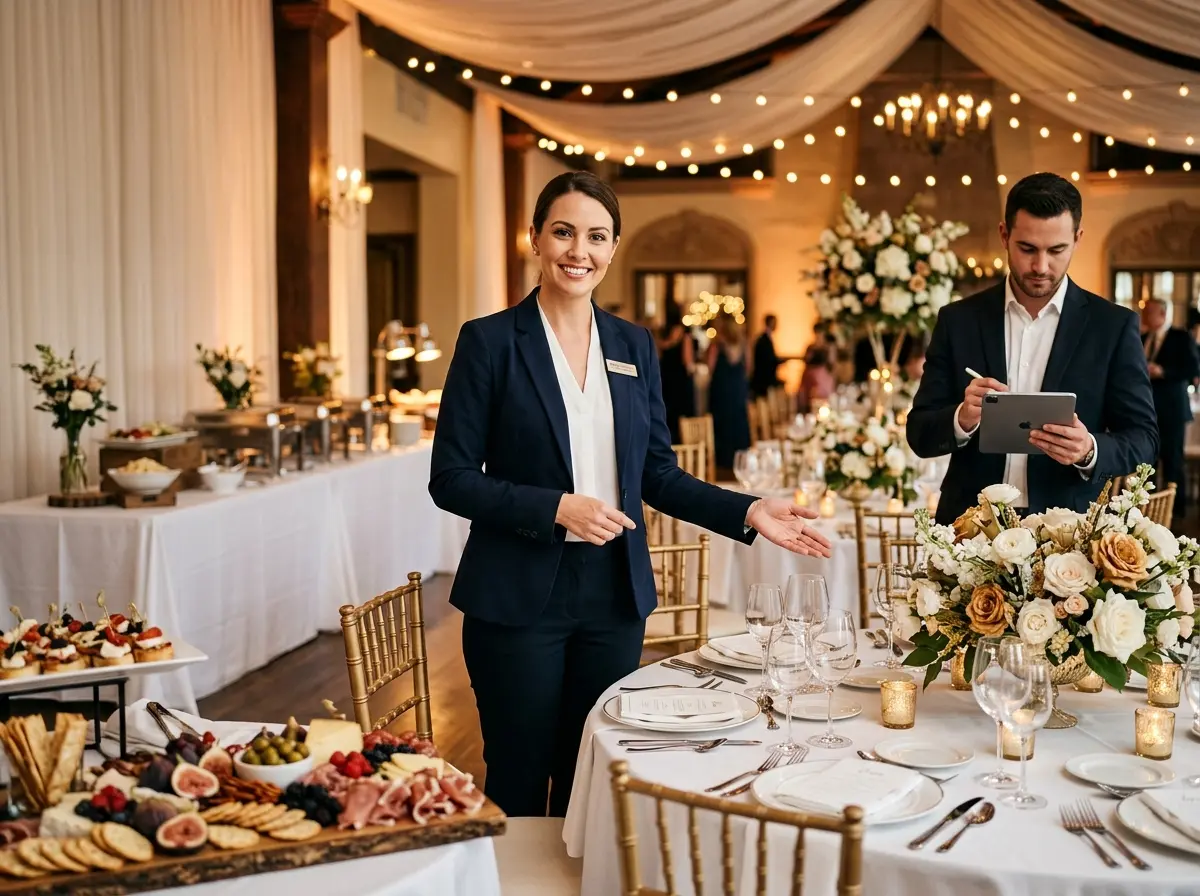
- Full-Service Experience: Plated courses or action stations, dedicated servers, coordinated timing, full cleanup, and a point-of-contact on-site throughout.
When clients see the progression laid out this way, the upgrade doesn't feel like a leap — it feels like a logical next step. And the attended buffet tier? It's a brilliant stepping stone that eases clients into spending more without the sticker shock of jumping straight to full-service.
Streamlining Your Client Communications and Intake Process
Why the Booking Conversation Is Where Upsells Are Won or Lost
You could have the most beautifully structured service tiers in the industry, but if the first phone call a potential client makes goes to voicemail — or gets answered by a rushed staff member who's simultaneously plating 200 chicken breasts — you've already lost momentum. The upsell conversation requires presence, attentiveness, and the right questions asked at the right time.
This is exactly where Stella, the AI robot employee and phone receptionist, can quietly do a lot of heavy lifting. Stella answers calls 24/7, engages clients in natural conversation, collects intake information through conversational forms, and can highlight your service tiers and current promotions before a human ever picks up the phone. For catering companies with a physical location — a storefront, tasting room, or showroom — Stella also operates as a friendly, human-sized in-store kiosk that proactively greets walk-in clients and answers their questions about your offerings. Her built-in CRM lets you tag clients by event type, track upgrade interest, and build detailed profiles that help you follow up with the right offer at the right time. It's not magic — it's just smart infrastructure that makes sure no opportunity slips through the cracks.
Crafting the Upsell Pitch That Doesn't Feel Like a Pitch
Lead With the Experience, Not the Price Tag
Nobody wants to feel like they're being upsold. But everyone wants to feel like someone is genuinely looking out for them. The framing of your full-service pitch should center entirely on the client's experience — what they gain, what stress they shed, and what the event will feel like for their guests.
Instead of saying "for an additional $18 per head, we can do full-service," try: "A lot of our clients who are hosting milestone events tell us afterward that the best decision they made was having our team fully manage the evening — they actually got to be present for it." That's not a sales pitch. That's social proof wrapped in empathy, and it lands very differently.
Use specific, vivid language. Paint the picture: "You walk in, the tables are already set, the team is in uniform, the appetizers are circulating, and your only job is to say hello to your guests." Let the mental image do the selling.
Using Add-Ons to Build Toward the Full Package
If a client is hesitant to commit to a full-service package outright, individual add-ons are a brilliant workaround. Offer staff for just the first hour of cocktail service. Add a dedicated on-site coordinator for an additional flat fee. Propose a passed appetizer round before the buffet opens. These smaller commitments accomplish two things: they increase your revenue on the current booking, and they give the client a taste — literally and figuratively — of what full-service feels and looks like.
Many catering companies have found that clients who try even one or two add-ons almost always book the full package for their next event. The experience sells itself. Your job is simply to get them in the door.
Following Up After the Event Is Non-Negotiable
The post-event follow-up is one of the most underutilized upselling tools in the catering industry. A personalized thank-you message sent within 48 hours — while the memory of a smoothly run event is still fresh — is the perfect moment to mention upcoming availability, introduce your full-service packages, or offer a returning-client incentive. If the event went well (and with your food, why wouldn't it?), you're following up from a position of pure goodwill. That's about as warm as a lead gets.
Build this into your process as a standard operating procedure, not an afterthought. Keep notes on each event — what went well, what the client mentioned during the event — and personalize the follow-up accordingly. "We loved being part of your team's holiday lunch — if you're thinking ahead to the annual gala, we'd love to talk about what a full-service experience could look like for that one."
Quick Reminder About Stella
Stella is an AI robot employee and phone receptionist that works for your catering business around the clock — answering calls, greeting in-store clients, promoting your service packages, collecting client information, and managing contacts through her built-in CRM. She runs on a straightforward $99/month subscription with no upfront hardware costs and no sick days. For a catering company juggling events, tastings, and a dozen moving pieces at once, having a reliable front-of-house presence that never drops the ball is less of a luxury and more of a genuinely smart business decision.
Start the Upsell Conversation — Before Your Competitors Do
The opportunity to grow from buffet-only bookings to full-service events isn't some distant aspiration — it's sitting right there in your existing client list, waiting for the right conversation. Start by building out clear service tiers so clients can see the pathway. Train yourself and your team to listen for upsell signals during the booking process. Lead every pitch with experience and outcome, not price. Use add-ons as low-commitment entry points for hesitant clients. And absolutely, without exception, follow up after every event.
Here are your immediate action steps:
- Audit your current packages and build at least three clearly defined service tiers if you don't already have them.
- Create a short list of add-on services with flat-fee pricing that can be layered onto any booking.
- Draft a post-event follow-up template that can be personalized and sent within 48 hours of every event.
- Identify your top 10 repeat buffet clients and schedule a proactive outreach to introduce your full-service offerings.
- Evaluate your intake process — phone calls, walk-ins, and online inquiries — to make sure no potential upsell conversation is slipping through unattended.
Full-service events aren't just a revenue upgrade — they're a reputation upgrade. The clients who experience your team at their best become your loudest advocates, your best referral sources, and your most loyal repeat bookings. That's the kind of growth that compounds. Now go make it happen.