Stop Leaving Money on the Table (Literally, It's Right There)
Let's be honest — if you're selling mop heads and floor cleaner separately without ever suggesting they go together, you're essentially handing customers half a sandwich and wishing them luck. Product bundling is one of the oldest tricks in the retail playbook, and yet so many cleaning supply business owners either ignore it entirely or bundle things so randomly that customers wonder if anyone's actually thought this through.
The good news? A well-executed bundling strategy can meaningfully increase your average cart value — sometimes by 20–30% — without spending an extra dime on advertising. You're working with the customers already in front of you. The even better news is that bundling in the cleaning supply world is practically a cheat code, because cleaning products are naturally complementary. Disinfectant and gloves. Degreaser and scrub pads. Floor stripper and a good mop. These things belong together the way bad news belongs in threes.
This post walks you through how to build bundles that actually sell, price them intelligently, and present them in ways that make customers feel like they're winning — because they are.
Building Bundles That Make Sense (And Sell)
Start With the "Obvious Pairs" Strategy
The easiest place to start is with products your customers already buy together — they're just not buying them from you in one shot. Pull your sales data and look for frequent co-purchases. If you consistently see customers buying toilet bowl cleaner and toilet brushes in separate transactions, that's a bundle waiting to happen. If restroom supply kits fly off the shelf while individual items collect dust, your customers are telling you something.
Think about your customer segments too. A commercial cleaning contractor has very different needs than a restaurant manager or a property management company. Build bundles around use cases, not just product categories. A "Restaurant Kitchen Degreasing Kit" hits differently than a generic "cleaning bundle," and it tells the customer immediately: this was made for me. That specificity is what converts browsers into buyers.
Create Tiered Bundle Options
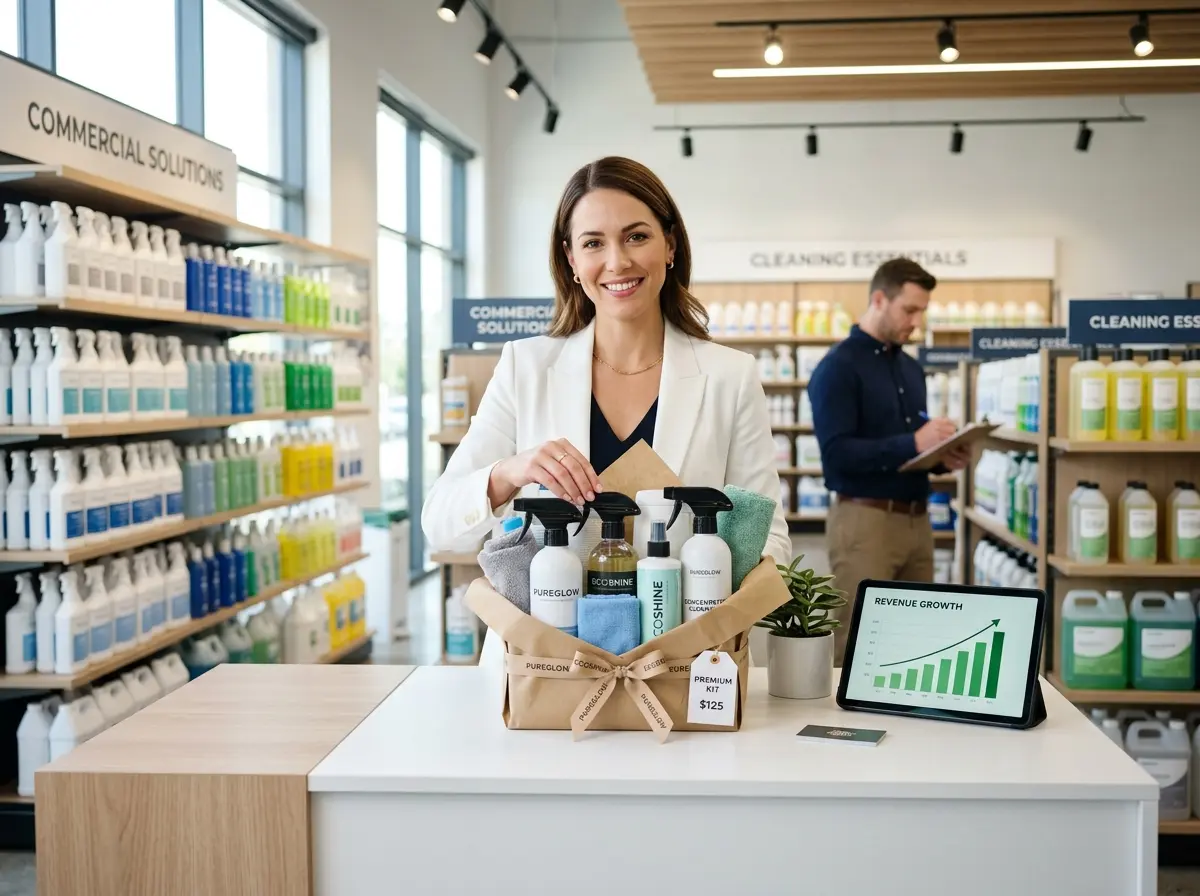
Not every customer has the same budget or the same scope of need, and a one-size-fits-all bundle often fits nobody particularly well. Consider offering Good, Better, and Best versions of your core bundles. A basic restroom kit might include cleaner, paper towels, and trash bags. A premium version adds a commercial-grade disinfectant, a dispensing system, and a microfiber mop head. Suddenly you've got an upsell path built right into the bundle itself.
This tiered approach also anchors perception. When customers see three options, they tend to gravitate toward the middle one — a well-documented behavioral pattern known as the "compromise effect." Price your tiers strategically, make the middle option feel like an obvious value, and watch your average order value climb without any awkward sales pressure.
Bundle Around Problems, Not Products
Your customers don't wake up thinking, "I need a 32-oz bottle of neutral floor cleaner." They wake up thinking, "My floors are disgusting and my manager is coming on Thursday." Sell them the solution. Frame your bundles around the problem being solved: floor restoration, odor elimination, deep bathroom sanitization, post-construction cleanup. When a customer sees a bundle labeled "Commercial Odor Elimination Kit" and they've been fighting a stubborn smell in their facility for three weeks, the bundle practically sells itself.
This also gives you natural storytelling fodder for your product descriptions, signage, and staff talking points. Instead of listing ingredients, you're describing outcomes — and outcomes are what customers actually want to buy.
Let Technology Do the Suggesting
How Stella Can Boost Bundle Awareness In-Store and on the Phone
Here's where things get interesting for cleaning supply retailers. One of the biggest missed opportunities in bundling isn't in the building of the bundles — it's in the promoting of them. Your staff is busy, customers don't always ask questions, and a display sign can only do so much. That's where Stella, the AI robot employee and phone receptionist, quietly becomes one of your best salespeople.
In a physical store, Stella proactively greets customers, engages them in natural conversation, and can highlight current bundle promotions without any prompting from staff. A customer walking past your floor care section doesn't need to ask — Stella can mention that your floor stripper and high-speed burnishing pads are currently bundled at a discount and explain exactly why they work better together. That's an upsell delivered with zero effort from your team. On the phone side, Stella answers calls 24/7, meaning a customer calling in at 7pm to ask about restroom supplies can be told about your premium restroom kit, its contents, and its pricing — all before a human ever picks up. For a cleaning supply company where bulk ordering and repeat purchasing are common, that kind of always-on product awareness is genuinely valuable.
Pricing and Presenting Your Bundles for Maximum Impact
Price to Feel Like a Win, Not Just a Discount
The psychology of bundle pricing deserves more attention than most business owners give it. The goal isn't just to lower the price — it's to make the customer feel like they're getting a deal worth acting on. Research from Harvard Business School suggests that mixed bundling (offering items both individually and as a bundle) tends to outperform pure bundling, because customers feel they have a choice rather than being forced into a package.
A solid rule of thumb: offer a 10–20% discount on the bundled price versus buying items individually. This is enough to feel meaningful without gutting your margins, especially if you're moving higher volumes or clearing out slower-moving inventory by pairing it with your bestsellers. Be transparent about the savings — show the original combined price crossed out, then the bundle price. Let the math do the convincing.
Make Your Bundles Visible and Unavoidable
A bundle that nobody sees is just inventory with a sticky note on it. Your presentation strategy matters enormously. In a physical location, co-locate bundled products rather than keeping them in separate aisles. Use shelf talkers, end-cap displays, or dedicated "Kit" sections that group everything a customer needs for a specific job. The fewer steps between "I see the bundle" and "I'm buying the bundle," the better.
For online and phone orders, train your team — or configure your AI tools — to mention relevant bundles at the point of inquiry. If someone calls to order floor stripper, that's your moment. A simple "A lot of our customers also grab our stripping pad set with that — we actually bundle them together at a discount. Want me to add that?" is all it takes. You're not being pushy; you're being helpful. There's a big difference, and customers can feel it.
Use Seasonal and Industry-Specific Bundles to Stay Relevant
Cleaning supply demand is seasonal in ways that are worth exploiting. Spring brings deep-cleaning campaigns. The fall school season means janitorial supply restocks. The holidays mean high-traffic facilities needing commercial-grade everything. Build limited-time seasonal bundles that create urgency and align with what your customers are already thinking about.
Industry-specific bundles are equally powerful. A "Healthcare Facility Starter Kit" with EPA-registered disinfectants, disposable gloves, and proper biohazard bags serves a completely different buyer than a "Restaurant Compliance Kit" with food-safe degreasers and sanitizing solutions. The more specific your bundle, the more it feels tailored — and tailored products command better margins and more loyal customers. Consider surveying your top commercial accounts about what they typically need to purchase together, then just... build that kit for them.
A Quick Reminder About Stella
Stella is an AI robot employee and phone receptionist designed to work tirelessly inside your store and on your phone lines — greeting customers, promoting deals, answering questions, and upselling products without ever needing a break or a performance review. She runs on a straightforward $99/month subscription with no upfront hardware costs, making her one of the more quietly impressive decisions a cleaning supply retailer can make for customer engagement and sales support.
Put It All Together and Watch the Numbers Move
Bundling is not a gimmick — it's a proven revenue strategy that works especially well in the cleaning supply space because of how naturally your products complement each other. The path forward is clear: identify your natural product pairings, build bundles around customer problems and use cases, price them to feel like wins, present them prominently, and use every touchpoint — in-store, online, and on the phone — to make sure customers actually know they exist.
Here are your actionable next steps to get started:
- Pull your sales data and identify your top five most frequently co-purchased product pairs.
- Build two or three use-case bundles based on your customer segments (commercial cleaners, facilities managers, restaurants, etc.).
- Set your bundle pricing at a 10–20% discount versus individual item totals, and display the savings clearly.
- Update your physical displays to co-locate bundled products and add clear signage.
- Train your team and your tech — whether that's staff talking points or an AI receptionist like Stella — to mention relevant bundles at every natural touchpoint.
- Build one seasonal bundle for the upcoming season and promote it actively for 30 days, then measure the results.
Cleaning supply customers are loyal, repeat buyers with consistent needs — which means every bundling win compounds over time. Start with one good bundle, measure it honestly, and build from there. The money isn't hiding. It's just waiting for you to package it properly.