The Phone Is Ringing. Your Receptionist Is at Lunch. Sound Familiar?
Let's paint a picture. It's 12:47 PM on a Tuesday. Your front desk receptionist is on their lunch break, your paralegal is buried in a deposition summary, and your office manager is handling a billing dispute. Meanwhile, a potential client — someone who just got into a car accident, received divorce papers, or is facing a looming business lawsuit — calls your law firm for the first time. The phone rings. And rings. And eventually goes to a generic voicemail that they probably won't leave a message on, because according to research by Lead Response Management, 78% of clients hire the firm that responds to them first. They'll just call the next firm on their Google search results.
Congratulations, you just lost a lead you never knew you had.
In a profession where trust, responsiveness, and first impressions are everything, missing phone calls isn't just an inconvenience — it's a revenue leak. The good news? AI receptionists are here, and they're quietly transforming the way law firms handle client intake, call management, and that all-important first point of contact. No lunch breaks required.
The Real Cost of Missed Calls at Your Law Firm
It's Not Just One Lost Client
When we talk about missed calls, it's tempting to think of it as a minor operational hiccup. One missed call here, one voicemail there — no big deal, right? Wrong. Studies suggest that nearly 62% of calls to small businesses go unanswered, and in the legal industry, where clients are often calling during a moment of stress or urgency, that missed connection can mean a permanently lost relationship. Legal matters don't wait for business hours. Someone who needs a criminal defense attorney at 9 PM isn't going to politely wait until 9 AM the next day when your office opens. They're going to call until someone answers them.
And the financial math is sobering. If your average case generates even $2,000 in revenue, and you're missing just five potential client calls per week, you're looking at a potential six-figure annual gap in billings. That's not a staffing problem — that's a strategy problem.
The Intake Process Is Broken at Most Firms
Even when calls do get answered, the intake process at many law firms is surprisingly inconsistent. Information gets scribbled on sticky notes, conflict checks get delayed, and follow-up calls slip through the cracks. New clients expect a smooth, professional experience from the very first interaction — and when that experience feels disorganized, it signals something about how the firm operates overall.
Modern clients are accustomed to seamless digital experiences in every other area of their lives. When they call a law firm and get fumbling, inconsistent intake procedures, it creates doubt. Automating and standardizing your intake process isn't just efficient — it actively builds confidence in your firm before a client has even met an attorney.
After-Hours Calls Are a Goldmine You're Ignoring
Here's a statistic worth sitting with: a significant portion of legal service searches happen between 5 PM and 9 PM, when people are home from work and finally have the mental bandwidth to deal with their legal problems. If your firm's phone system is essentially a wall of voicemail after 5 PM, you're invisible during one of the highest-intent windows of the entire day. Competing firms that answer those calls — even with an AI — are building relationships while you're offline.
How AI Receptionists Are Filling the Gap (Without the HR Headaches)
Meet the Receptionist Who Never Calls in Sick
AI phone receptionists have matured dramatically in recent years. They're no longer the clunky, robotic voice trees of the early 2000s that made callers want to throw their phones out the window. Today's AI receptionists can hold natural, conversational exchanges, answer detailed questions about your firm's practice areas, collect intake information, and route calls intelligently — all without making a caller feel like they've reached a call center in another dimension.
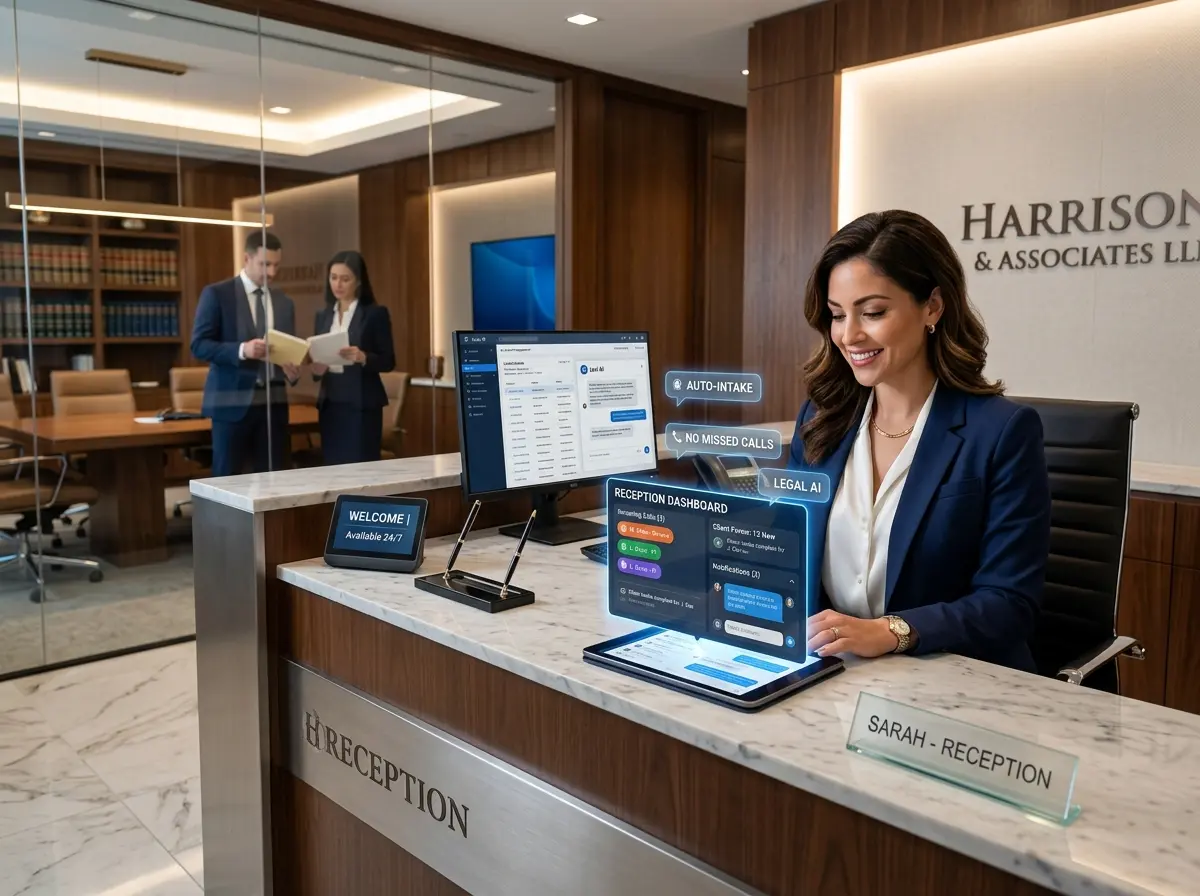
Stella, for example, is an AI robot employee and phone receptionist designed specifically to handle these kinds of interactions across industries, including law firms. She answers calls 24/7, gathers client information through conversational intake forms, and pushes AI-generated voicemail summaries with notifications directly to your team — so your attorneys and staff always know what came in, even if they were unavailable. Her built-in CRM lets your firm manage client contacts with custom fields, tags, notes, and AI-generated profiles, meaning your intake data doesn't vanish into a sticky note abyss. For firms with a physical office, Stella also operates as a human-sized kiosk that greets walk-in clients proactively — because first impressions happen in person too.
Configured for Your Firm, Not a Generic Template
A good AI receptionist isn't just a voice on the line reciting your hours of operation. It should know your practice areas, understand how to qualify potential clients, and know when to escalate a call to a live attorney versus when to collect information and schedule a callback. Configurable call forwarding rules mean that urgent matters — say, a criminal defendant who just posted bond — get routed to someone immediately, while general inquiries are handled gracefully without pulling staff away from billable work.
Setting Up Your Law Firm for AI Receptionist Success
Define What "Handled" Looks Like Before You Deploy
Before implementing any AI receptionist solution, your firm needs to get clear on what you actually want it to do. This sounds obvious, but it's where most implementations go sideways. Start by auditing your current call flow: What types of calls do you receive most frequently? Which ones require immediate attorney attention, and which ones are essentially information requests? Which practice areas generate the most inbound volume?
Once you've mapped that out, you can configure your AI receptionist to reflect real workflows rather than hypothetical ones. Define the intake questions you want asked for each practice area, establish your call routing rules, and decide which situations trigger immediate forwarding to a live person. The more intentional you are upfront, the smoother the experience will be for both callers and your team.
Train Your Staff to Work With AI, Not Against It
There's an understandable tension when firms introduce AI tools — staff sometimes worry about being replaced, or they quietly resist using the system because it feels like extra work. The truth is that an AI receptionist should reduce the burden on your human team, not add to it. The key is framing the tool correctly from the start.
Your AI receptionist handles the volume, the after-hours calls, the repetitive FAQs, and the initial intake data collection. Your human staff handles the nuanced, relationship-driven work that actually requires a person. When your receptionist isn't fielding the same "what are your office hours?" question for the fifteenth time this week, they can focus on client experience in ways that actually matter. That's not replacement — that's leverage.
Measure, Iterate, and Optimize
One of the underappreciated advantages of AI receptionists is the data they generate. You can see call volumes by time of day, understand which questions come up most frequently, track how many callers convert to booked consultations, and measure how promotional messaging performs. This is intelligence that most law firms simply don't have right now because their calls are handled inconsistently by rotating human staff.
Use that data. If you're seeing a spike in after-hours calls about a particular practice area, that's a signal to update your website content, adjust your intake questions, or even revisit your staffing model. AI receptionists don't just answer phones — they give you a window into how your clients actually behave.
Quick Reminder About Stella
Stella is an AI robot employee and phone receptionist built for businesses of all sizes, including law firms. She handles inbound calls around the clock, collects intake information through natural conversation, manages contacts through a built-in CRM, and even greets clients in person at your office as a human-sized kiosk — all for an affordable $99/month with no upfront hardware costs. She's easy to set up and, unlike most receptionists, never asks for a day off.
Stop Leaving Leads on the Table
The legal industry is competitive, and the firms that win new clients consistently are the ones that show up first, respond fastest, and make the intake process feel effortless. An AI receptionist isn't a futuristic luxury anymore — it's quickly becoming a baseline expectation for firms that take growth seriously.
Here's where to start. First, audit your current call handling and identify the gaps — after-hours coverage, inconsistent intake, missed calls during peak hours. Second, map out your ideal call flow and define what your AI receptionist should handle versus what requires a human. Third, implement a solution that fits your firm's size and budget, configure it thoughtfully, and actually commit to using the data it generates.
The phone is going to ring whether you're ready or not. The only question is whether someone — or something — is there to answer it professionally every single time. Your competitors are figuring this out. The clients who need you most are calling right now. Make sure they reach you.