Introduction: The Secret to Cleaning Company Profitability (That Isn't Scrubbing Harder)
Let's be honest — chasing one-off cleaning jobs is exhausting. You spend half your week marketing, quoting, and following up, only to clean someone's home once before they disappear into the void. Meanwhile, your trucks are driving all over town in wildly inefficient patterns, your technicians are burning fuel between jobs that are thirty minutes apart, and your revenue looks like a heart monitor reading — spiky, unpredictable, and slightly terrifying.
There's a better way to run a cleaning business, and it involves two beautiful words: recurring routes. When you build a business model around scheduled, repeat clients organized into tight geographic routes, everything changes. Your revenue becomes predictable. Your costs drop. Your team stops burning out. And you actually start to enjoy owning a cleaning company instead of just surviving it.
This guide walks you through exactly how to build recurring route-based revenue from the ground up — including how to acquire clients, structure your routes, price for profitability, and retain customers long enough for the math to really start working in your favor. Spoiler: it's not as complicated as it sounds, but it does require some intentional systems. Let's dig in.
Building the Foundation: Recurring Revenue Starts With the Right Clients
Why Recurring Clients Are Worth So Much More Than One-Time Jobs
A one-time deep clean might bring in $300. A weekly recurring client at $150 per visit brings in $7,800 per year — and that's before you consider how much less it costs to service a client you already have versus acquiring a new one. Studies consistently show that acquiring a new customer costs five to seven times more than retaining an existing one. In the cleaning industry, that math hits especially hard, because most of your marketing spend goes toward generating leads that convert once and evaporate.
Recurring clients also make your scheduling infinitely easier. When you know Mrs. Henderson gets a bi-weekly clean every other Tuesday, you can build your route around her. You can't do that with one-off bookings, because they're scattered and unpredictable by nature. The reliability of recurring revenue isn't just financially appealing — it operationally enables everything else in this guide.
How to Attract Clients Who Actually Want to Commit
Not all clients are created equal. Some people call for a one-time move-out clean and that's all they ever wanted. Others are genuinely looking for a long-term cleaning partner. Your job is to attract the second group — and to convert the first group into the second wherever possible.
The most effective way to attract recurring clients is to price your services so that committing makes obvious financial sense. Offer a meaningful discount for weekly or bi-weekly service compared to monthly or one-time rates. Something like 20% off for bi-weekly clients versus a one-time booking is enough to shift decision-making in your favor. You're not giving away margin — you're trading a small discount for the operational efficiency and lifetime value that recurring clients provide, and that trade almost always wins.
Beyond pricing, your marketing messaging matters. Lead with phrases like "your regular cleaning team" or "consistent, scheduled home care" rather than "one-time deep cleans available." You attract what you advertise. If your website and ads scream one-off jobs, that's exactly who will call you.
Onboarding Clients Into a Recurring Commitment
Once you have an interested lead, your onboarding process should naturally guide them toward a recurring plan. Start the conversation by asking about their lifestyle and cleaning goals — not just "how many bedrooms." A client who mentions they have pets, host guests regularly, or struggle to keep up with cleaning during the week is practically begging for a recurring service. Position your recurring plans as the solution to their specific pain point, not just an upsell.
Make it easy to commit. Offer simple, month-to-month recurring agreements — no scary long-term contracts — and explain the convenience of autopay. The fewer decisions a client has to make each billing cycle, the more likely they are to stay on your books indefinitely.
Smarter Client Communication With a Little AI Help
Never Miss a Lead Again — Especially After Hours
Here's a frustrating truth: a huge percentage of cleaning service inquiries happen outside business hours — evenings, weekends, and early mornings when people are finally home and thinking about their chaotic living rooms. If your phone goes to a generic voicemail at 7 PM on a Saturday, that lead is already Googling your competitor.
Stella, the AI robot employee and phone receptionist, handles exactly this problem. She answers every incoming call 24/7, engages callers naturally about your services, pricing, and availability, and collects lead information through conversational intake forms — all without you lifting a finger. Her built-in CRM automatically logs new contacts, applies tags, generates AI-powered profiles, and keeps notes so your team knows exactly what each prospective client discussed when they called. For cleaning companies managing a growing list of recurring clients, that kind of organized, always-on communication infrastructure is genuinely game-changing. If you have a physical location — say, a storefront or franchise office — Stella also operates as a friendly in-person kiosk, greeting walk-ins and answering questions while your staff focuses on getting the work done.
Designing Routes That Actually Make Money
The Geographic Clustering Strategy
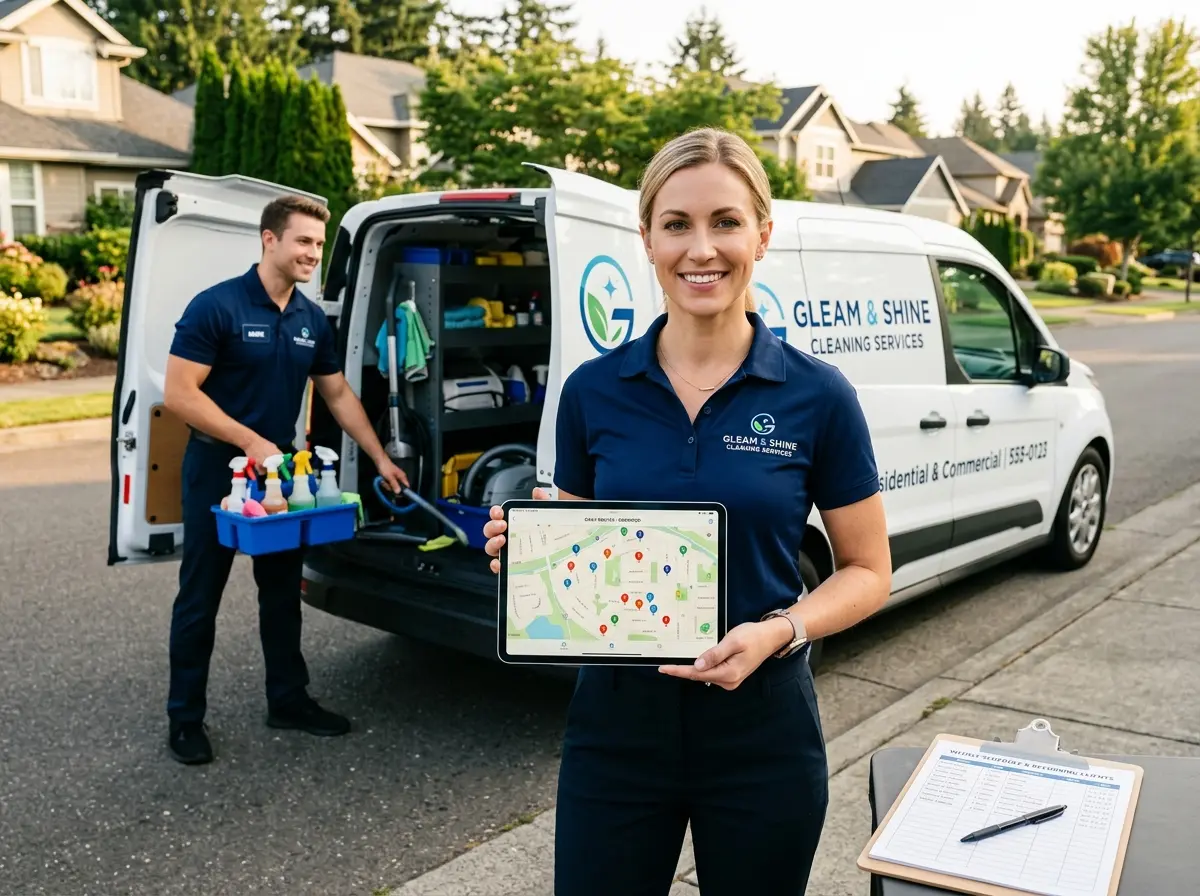
Route-based revenue only works if your routes are actually efficient. Driving forty-five minutes between a client in the north suburbs and a client downtown is eating your margins one tank of gas at a time. The solution is geographic clustering — building your client base in concentrated zones so that your team can complete multiple jobs per day with minimal drive time between them.
Start by defining two or three target service zones in your area, ideally neighborhoods with higher home ownership rates, above-median incomes, and dense residential populations. Focus your marketing dollars on those zones specifically. Use neighborhood-targeted Facebook and Instagram ads, Nextdoor campaigns, and even old-fashioned door hangers in the neighborhoods where you already have clients. Each new client you add in an existing zone increases your route density — and your profit per hour worked.
Once a zone reaches a critical mass of clients (typically five to eight per day), you have a profitable route. At that point, you can expand to a second zone while keeping the first running like a well-oiled machine. This is how cleaning companies scale without chaos.
Scheduling for Efficiency and Client Retention
Smart scheduling is about more than just proximity. You also need to consider which clients need which time slots and how to sequence jobs so your team isn't rushed and clients aren't inconvenienced by late arrivals.
Build your schedule with buffer time between jobs — fifteen to twenty minutes is usually sufficient for transit within a tight zone. Assign specific days to specific zones, so Monday is always the Westside route and Wednesday is always the Downtown route. This predictability benefits your team (they know exactly what to expect) and your clients (they can reliably plan around their cleaning day).
Don't underestimate the retention value of consistency. Clients who always see the same team member on the same day of the week cancel far less often than clients who get a rotating cast of strangers on unpredictable schedules. Whenever possible, assign consistent teams to consistent routes and protect those assignments.
Pricing Routes for Profitability, Not Just Competitiveness
Many cleaning companies make the mistake of pricing based purely on what competitors charge, without actually calculating their own cost to service each job. Before you set your recurring rates, do the math. Calculate your fully-loaded cost per hour including labor, benefits, supplies, vehicle costs, insurance, and overhead. Then price your recurring services to achieve a minimum gross margin of 40 to 50 percent — which is typical for well-run residential cleaning operations.
Route efficiency directly impacts your effective margin. A team that completes five jobs in a zone with twenty-minute drive times between stops is dramatically more profitable than a team completing five jobs scattered across the city. When you sell a recurring slot in a dense route, you're selling something worth more than a one-off appointment — and your pricing should eventually reflect that reality as your routes mature and tighten.
Quick Reminder About Stella
Stella is an AI robot employee and phone receptionist that works 24/7 to answer calls, engage customers, collect lead information, and manage contacts — all for just $99 per month with no upfront hardware costs. Whether a potential recurring client calls you at noon or midnight, Stella handles the conversation professionally and makes sure no opportunity slips through the cracks. She's the kind of employee who never calls in sick, never misses a lead, and never has a bad day.
Conclusion: Stop Chasing Jobs and Start Building Routes
Recurring route-based revenue is the difference between a cleaning company that survives and one that actually thrives. The business owners who crack this model stop feeling like they're starting from zero every month — because they're not. They walk into each new month with a full calendar, predictable cash flow, and teams that know exactly where they're going.
Here's your action plan to get started:
- Define your target service zones and concentrate your marketing efforts there immediately. Stop taking every job everywhere — it's killing your route efficiency.
- Restructure your pricing to make recurring plans clearly more attractive than one-time bookings. Do the math on your margins first so you're not accidentally discounting yourself into trouble.
- Revamp your onboarding process to guide every new inquiry toward a recurring plan. Train your staff (or your AI receptionist) to ask the right questions and position recurring service as the obvious choice.
- Assign consistent teams to consistent routes and protect those assignments. Familiarity drives retention, and retention drives profitability.
- Plug the communication gaps so you're capturing every lead — including the ones calling after hours, on weekends, or when your team is heads-down on a job.
The cleaning industry is competitive, but it rewards operators who think systematically. Build your routes with intention, price them honestly, and deliver consistent service that makes canceling feel like a genuinely bad idea. Do that, and the recurring revenue will follow — no magic required. Well, maybe a little AI magic.