Introduction: A Picture Is Worth a Thousand Words (and Possibly Thousands of Dollars)
Let's be honest — when a homeowner is scrolling through landscaping companies at 11pm trying to decide who gets to transform their sad, neglected backyard, they're not reading your mission statement. They're not impressed by your list of certifications. They want to see the magic. They want the before-and-after.
Before-and-after project photos are one of the most powerful marketing tools available to landscaping companies, and yet so many businesses either skip them entirely, shoot them with the lighting of a crime scene, or post them inconsistently and hope for the best. That's a missed opportunity of staggering proportions.
The good news? With a little strategy and even less equipment than you might think, your project photos can become your most effective salesperson — working around the clock, convincing potential clients before you even pick up the phone. This guide walks you through exactly how to capture, present, and leverage before-and-after photos to win more landscaping clients. Let's dig in.
Capturing Photos That Actually Impress People
The Setup: Getting the "Before" Right
Here's where most landscaping companies drop the ball before the project even starts. The "before" photo is taken hastily, from a weird angle, in bad lighting, right before the crew starts working — and it shows. A compelling before-and-after transformation requires that both images be shot from the exact same angle, at the same time of day, and in similar lighting conditions. This isn't just aesthetics. It's credibility.
Make it a non-negotiable habit: when your crew arrives on a new job, take five minutes to document the starting point properly. Stand at a deliberate spot, note the location (or mark it with a flag), and shoot multiple angles — wide, medium, and a few detail shots of particularly problematic areas. The overgrown hedges, the cracked patio, the bare dirt patch that a dog clearly claimed as its own. These details make the "after" that much more satisfying.
The "After" Shot: Timing Is Everything
Never take your "after" photo while the crew is still packing up the truck and there are footprints in the fresh mulch. Give the landscape time to settle, ideally returning for the final shot a day or two after completion when everything looks its best. If the project includes new plantings, consider returning during golden hour — that warm late-afternoon light does things for a freshly landscaped yard that no filter can replicate.
According to a BrightLocal study, businesses with compelling visual content receive up to 94% more views than those without. In a visually driven industry like landscaping, that gap is even more pronounced. Your photos are doing the selling while you're busy doing the actual work.
Equipment and Editing: You Don't Need a Film Crew
A modern smartphone with decent lighting is genuinely sufficient for most landscaping photography. The real differentiator isn't the camera — it's the consistency and care. Keep your lens clean (sounds obvious, gets ignored constantly), shoot in landscape orientation for wider coverage, and avoid zooming in digitally. Move your feet instead.
For editing, free tools like Snapseed or Lightroom Mobile let you quickly adjust exposure, contrast, and saturation to make colors pop. Just resist the urge to over-edit. A lawn that appears neon green in your photo and disappointingly normal in person is not going to build trust with new clients.
Where and How to Share Your Photos for Maximum Impact
Platforms That Actually Move the Needle
Instagram and Facebook remain the dominant platforms for visual trades marketing, and for good reason — they're where homeowners go to dream. Post your before-and-afters consistently, use location-specific hashtags (think #AustinLandscaping or #DenverYardDesign), and write captions that tell the story of the transformation. What was the client's problem? What was your solution? How long did it take? People respond to narrative.
Google Business Profile is often overlooked but arguably more valuable for local service businesses. Photos posted there directly influence how your business appears in local search results. A profile with fresh, high-quality project photos signals to Google — and to potential clients — that you're active, legitimate, and good at what you do.
Don't forget your own website. A dedicated project gallery or portfolio page, organized by project type (lawn renovation, hardscaping, garden design, etc.), gives visitors a place to browse deeply and get excited. It also helps with SEO when you write brief descriptions of each project with relevant keywords.
How Stella Can Help You Never Miss a Lead
You've done the work. You've taken the photos. You've posted them. Now someone sees your Instagram post at 9pm and wants to book a consultation — but you're off the clock. That's where Stella, the AI robot employee and phone receptionist, steps in. Stella answers your calls 24/7, handles inquiries about your services, and can even collect client information through conversational intake forms — so a motivated lead doesn't become a forgotten voicemail by morning.
For landscaping companies with a showroom or design center, Stella's in-store kiosk presence means walk-in visitors are greeted immediately and can get answers about your services, current promotions, and project portfolio while they wait to speak with your team. It's a professional, always-on presence that works as hard as your crew does — just without the sunburn.
Turning Photos Into a Client Conversion System
Build a Testimonial-Photo Combo Strategy
A before-and-after photo is powerful on its own. Pair it with a genuine client testimonial, and it becomes nearly irresistible. After project completion, make it standard practice to follow up with clients and ask for a quick review — on Google, on Facebook, or simply a sentence or two you can quote on your website. Most satisfied clients are happy to oblige if you make it easy for them.
Post the photo alongside the quote. Something like: "We hadn't been able to use our backyard for three years. Now we're out there every evening." — Sarah M., Austin TX is infinitely more persuasive than any marketing copy you'll ever write. Real people speaking to real results, anchored by visual proof. That combination closes clients.
Use Photos in Your Sales Process, Not Just Your Marketing
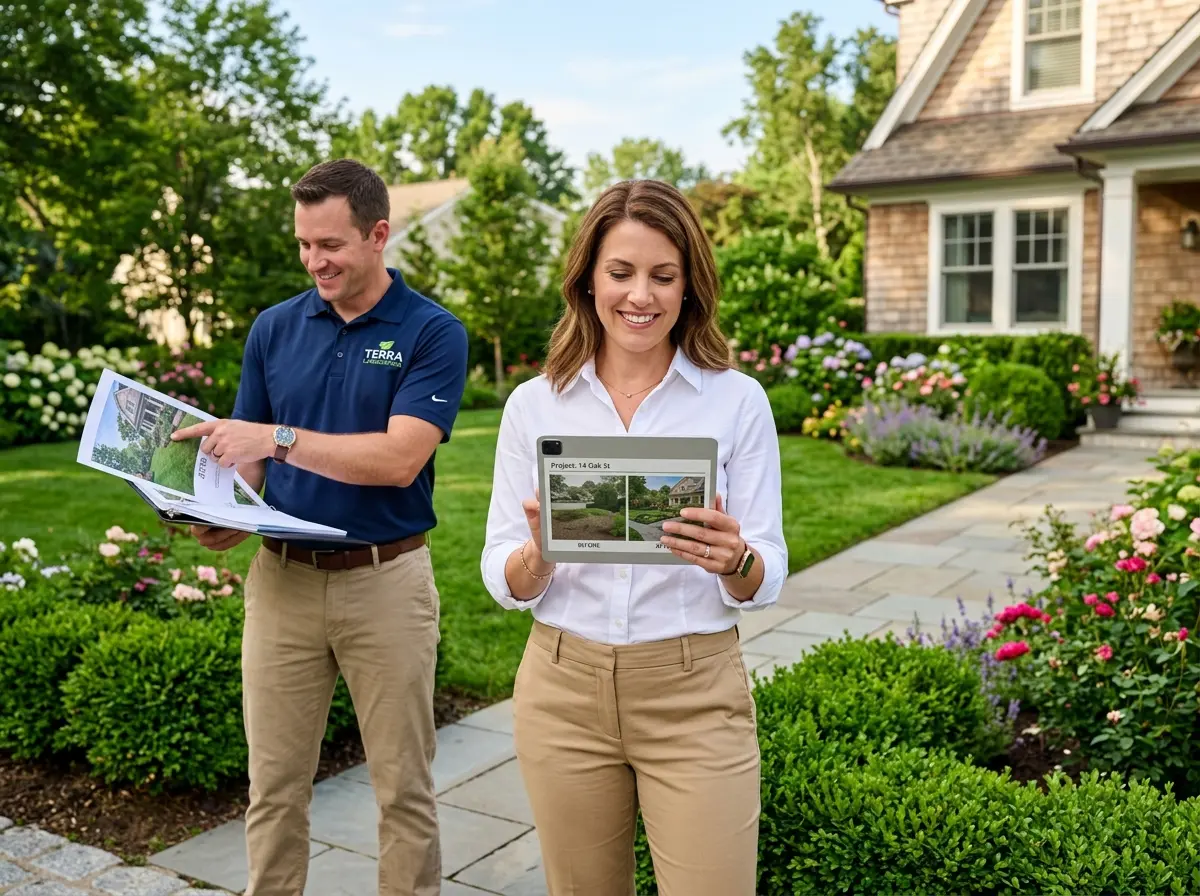
Your before-and-after photos shouldn't live only on social media. Bring them into your actual sales consultations. When you meet with a prospective client on-site, pull up your phone or a tablet and walk them through similar past projects. Show them a backyard that looked just like theirs — and what it became. This is called social proof in context, and it dramatically reduces the hesitation that clients feel before committing to a significant landscaping investment.
Consider building a simple digital portfolio organized by project type or challenge — drainage issues, lawn renovation, full backyard overhauls, front curb appeal — so you can quickly pull up the most relevant example for any prospect you're speaking with. A few well-chosen photos shown at the right moment can be the difference between a signed contract and a "we'll think about it."
Run Targeted Ad Campaigns With Your Best Photos
Once you've identified which before-and-after transformations get the most engagement organically, put some paid budget behind them. Facebook and Instagram allow you to target homeowners by zip code, age range, and even income level — meaning your most dramatic lawn transformation can show up in the feeds of exactly the kind of clients who can afford and appreciate your services. Start with a modest budget of $5–$10 per day and test two or three images against each other. Let the data tell you which photo wins, then scale what works.
Quick Reminder About Stella
Stella is an AI robot employee and phone receptionist that answers calls 24/7, greets customers in person at your location, promotes your services, and captures leads — all for just $99/month with no upfront hardware costs. She's the kind of team member who never calls in sick, never puts a client on hold indefinitely, and always knows what to say. For a landscaping business generating interest through great photography, having a reliable front line to handle incoming inquiries isn't optional — it's essential.
Conclusion: Start Shooting, Start Winning
The landscaping industry is visual by nature. Your work literally reshapes the way people experience their homes. That transformation deserves to be documented, showcased, and leveraged at every stage of your marketing and sales process — not buried in a camera roll or posted once and forgotten.
Here's your actionable game plan going forward:
- Standardize your photo process on every job — same angle, same lighting, before and after without exception.
- Build a project gallery on your website organized by project type, with brief keyword-rich descriptions.
- Post consistently on Instagram, Facebook, and your Google Business Profile with location tags and storytelling captions.
- Pair photos with testimonials to create conversion-ready social proof.
- Bring your portfolio into consultations to reduce friction and close more deals on the spot.
- Run targeted paid ads featuring your strongest transformations to reach homeowners in your service area.
- Make sure someone — or something — is ready to answer when all that great marketing generates a call at an inconvenient hour.
Your past projects are your best sales pitch. They're proof that you can do exactly what you're promising to do. Document them properly, share them strategically, and watch your phone start ringing from clients who already believe in you before you've exchanged a single word.