You Didn't Open a Martial Arts Studio to Leave Money on the Table
Let's be honest — you didn't spend years perfecting your craft, earning your black belt, and building a studio from the ground up just to sell monthly memberships and call it a day. Your students want more from their training, and your business deserves more from its revenue streams. The good news? Upselling private lessons and gear isn't about being pushy or salesy. It's about connecting the right students with the right offerings at the right time — and doing it with the same intentionality you bring to the mat.
The not-so-good news? Most studio owners are so busy running classes, managing schedules, and, you know, actually teaching martial arts, that upselling falls through the cracks entirely. A student walks in, pays their monthly dues, and walks out — and nobody mentioned that a few private sessions could fast-track their progress to the next belt rank. Meanwhile, that same student just ordered a cheap gi online that'll fall apart in six months, when you have a perfectly good one sitting on your retail shelf.
This guide is here to change that. We'll walk through practical, proven strategies to turn your existing student base into a more engaged — and more profitable — community, without ever feeling like you're running a used car dealership.
The Art of the Upsell: Building a Framework That Works
Know Your Students' Goals (Then Sell to Those Goals)
The foundation of any effective upsell strategy is understanding what your students actually want. A teenager training for sport competition has entirely different motivations than a 40-year-old parent learning self-defense or a retiree looking for fitness and discipline. If you're pitching private lessons to every student using the same script, you're leaving most of them cold — and leaving revenue on the table.
Take the time to segment your student base. A simple intake form when students enroll can tell you their goals, experience level, and how often they plan to train. From there, you can craft targeted conversations. For the competitor, privates are about gaining a technical edge. For the beginner, they're about building confidence faster than group classes allow. Frame the value in terms they already care about, and the conversation stops feeling like a sales pitch and starts feeling like a genuine recommendation from a coach who gets them.
Create Private Lesson Packages That Are Hard to Ignore
Single-session private lessons are fine, but packages are where your revenue gets serious. Consider structuring your offerings in tiers — a starter pack of three sessions, a mid-tier monthly retainer, and a premium intensive package for competitors or those preparing for belt testing. Bundling creates perceived value, encourages commitment, and smooths out your revenue in ways that one-off sessions simply can't.
Price your packages thoughtfully. Research suggests that customers presented with three pricing tiers will gravitate toward the middle option roughly 60–70% of the time — a principle known as the "compromise effect." Design your middle tier to be the one you actually want to sell most, and you've got a simple psychological nudge working in your favor without a single awkward conversation.
Sweeten the deal with add-ons: a free gear consultation, a video review session, or a goal-setting meeting. These cost you relatively little but signal to students that they're getting a premium, personalized experience — because they are.
Timing the Ask: When and How to Bring It Up
The worst time to pitch private lessons is during a crowded class when your student is catching their breath and thinking about their commute home. The best times are during natural touchpoints — enrollment, belt testing conversations, periodic check-ins, or when a student hits a visible plateau. Train your front desk staff (or your AI receptionist — more on that later) to recognize these moments and have a ready, warm response that opens the door without forcing it.
A simple script works wonders: "Hey, I noticed you've been working really hard on your [technique]. A lot of our students at your stage have found that even two or three private sessions can make a huge difference. Would you like to know more about what that looks like?" That's it. No pressure, no awkward close — just a relevant, timely observation from someone who clearly pays attention.
Let Technology Do the Talking (So You Can Focus on Teaching)
Automating the Touchpoints That Actually Drive Upsells
Here's where smart studio owners get a real edge. Stella, the AI robot employee and phone receptionist, is built exactly for moments like these. Standing inside your studio, Stella greets every student and visitor who walks through the door, proactively sharing information about private lesson packages, current gear promotions, and upcoming events — without you having to interrupt class or rely on a front desk employee to remember the pitch. She's consistent, friendly, and never has an off day (which, let's be honest, is more than you can say for most humans).
On the phone side, Stella answers calls 24/7 and is just as knowledgeable there as she is in person. A prospective student calling at 10 PM to ask about membership options will get a full, accurate rundown of your offerings — including private lessons and gear — and can even be walked through a conversational intake form that captures their goals and contact information before you've had your morning coffee. That data feeds directly into Stella's built-in CRM, where you can tag students by interest, track interactions, and follow up with precision. No leads slipping through the cracks, no forgotten conversations — just a clean, organized pipeline ready for you to act on.
Gear Sales: The Revenue Stream You're Probably Underutilizing
Stock Smart, Display Smarter
Gear sales might not be the first thing that comes to mind when you think about growing your studio's revenue, but they represent a significant and consistent opportunity. Students need uniforms, sparring equipment, belts, bags, and accessories — and they're going to buy them somewhere. The question is whether that somewhere is your studio or a random online retailer that ships a product you'd never personally recommend.
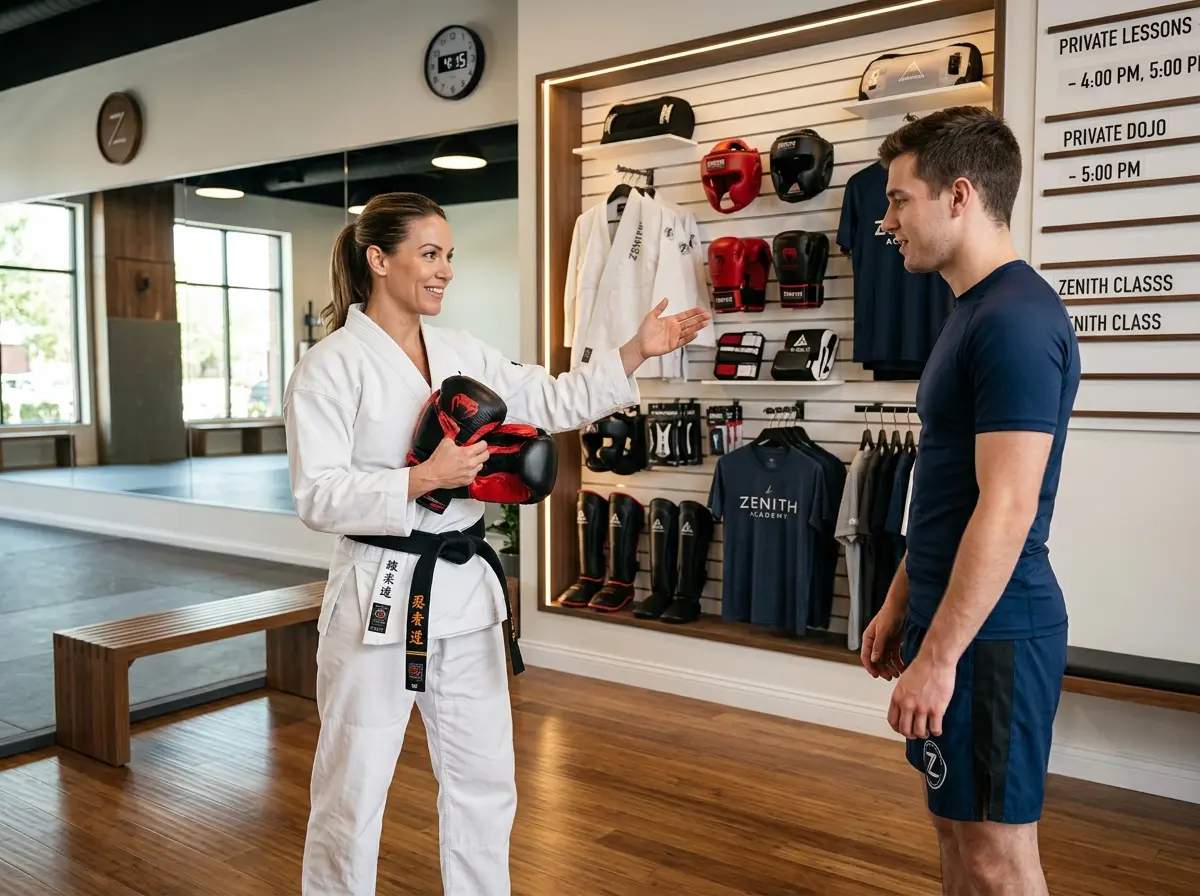
Start by being intentional about what you stock. You don't need a warehouse — you need a curated selection of quality items you genuinely believe in and can speak to with authority. Display them prominently near your entrance and reception area, not tucked in a corner where they collect dust. Good signage, clear pricing, and a "staff picks" section can do a surprising amount of heavy lifting without requiring a full-time retail employee to manage it.
Tie Gear to Progression and Private Lessons Naturally
The most elegant gear upsell isn't an upsell at all — it's a natural part of the student journey. When a student advances to sparring, they need sparring gear. When they test for a new belt, they may need a new uniform. When they commit to private lessons, it's the perfect time to discuss whether their current equipment is actually serving their development.
Build gear conversations into your belt testing process, your private lesson intake, and your new student orientation. A recommendation from a coach carries enormous weight. If you tell a student that a quality mouth guard and proper hand wraps will protect them and improve their training experience, they will listen — especially if the gear is right there and easy to purchase. Remove the friction between the recommendation and the transaction, and you'll be amazed how naturally revenue follows.
Bundle Gear with Lesson Packages for Maximum Impact
Want to make your private lesson packages even more irresistible? Bundle in a gear credit or a starter equipment kit. A three-session private package that includes a branded gym bag or a sparring gear discount feels like a premium experience — because it is one. Students perceive significantly higher value, and you're simultaneously driving gear sales and lesson uptake in a single offer. That's not manipulation; that's just good business strategy.
Consider running a seasonal promotion around tournament prep season, summer camps, or the start of a new school year — times when students and parents are already in a spending mindset. A "Competition Ready" package that includes a set of private sessions plus essential sparring gear hits differently than either product sold in isolation.
A Quick Reminder About Stella
Stella is an AI robot employee and phone receptionist that greets customers in person at your studio and answers calls around the clock — all for just $99/month with no upfront hardware costs. She's designed to help business owners like you promote offerings, upsell services, and never miss a customer interaction, whether they walk through your door or call after hours. If you haven't looked into what she can do for a martial arts studio specifically, it's worth a few minutes of your time.
Your Next Move Starts Today
The strategies in this guide aren't complicated — they're just consistently overlooked by studio owners who are stretched thin and understandably focused on delivering great training. But the revenue sitting in private lesson packages and retail gear sales is real, and it doesn't require reinventing your business to capture it.
Here's a simple action plan to get started:
- Audit your current offerings. Do you have clear private lesson packages with defined pricing and value propositions? If not, build them this week.
- Review your gear selection and display. Is it visible, curated, and easy to purchase? Make one improvement today.
- Train your team (and your tech) to make the ask. Whether it's a front desk script, an in-studio kiosk, or an AI phone receptionist, ensure that every student touchpoint is an opportunity to surface relevant offerings.
- Segment your student base and personalize your approach. One-size-fits-all pitches convert poorly. Tailored recommendations convert extremely well.
- Bundle and package strategically. Combine private lessons and gear into offers that feel generous and premium — because they are.
You've already done the hard work of building something worth coming to. Now it's time to make sure your students know about everything you offer — and that your business captures the full value of the community you've created. The mat is set. Time to step on it.