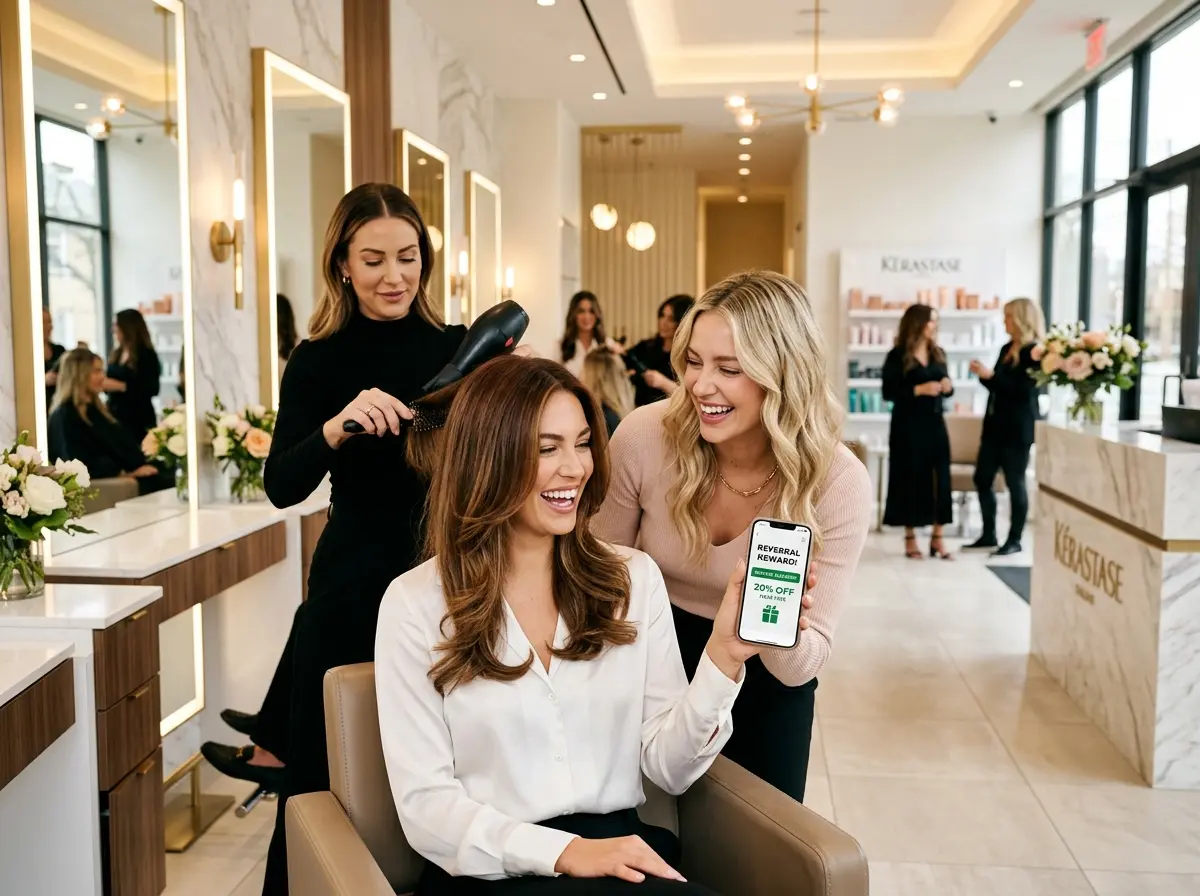
Word of Mouth Is Free — So Why Are You Leaving It on the Table?
Let's be honest: your happiest clients are basically walking billboards for your salon or spa. They rave about their blowout at dinner parties. They post their fresh nails on Instagram. They tell their coworkers who did their facial. And yet, most salon and spa owners never give those loyal clients a structured reason to send someone through the door. A refer-a-friend campaign fixes that — and it's one of the most cost-effective growth strategies in the beauty and wellness industry.
According to Nielsen, 92% of consumers trust referrals from people they know more than any other form of advertising. That means your best clients carry more marketing weight than your entire ad budget. A well-designed referral program turns that natural word-of-mouth energy into a repeatable, trackable system — one that rewards your regulars and keeps your appointment book full. Whether you're running a boutique blow-dry bar or a full-service day spa, this guide will walk you through how to build, launch, and manage a refer-a-friend campaign that actually works.
Building the Foundation of Your Referral Program
Choose the Right Incentive Structure
The most important decision you'll make when designing your referral program is what to offer — and to whom. A common mistake is rewarding only the new client while leaving the referrer feeling like a free marketing intern. The sweet spot is a double-sided reward: both the referring client and the new client get something valuable. For example, your current client might receive $20 off their next service, while the new client gets 15% off their first visit. Everyone wins, and everyone has a reason to come back.
Think carefully about what your margins can support. Service-based businesses like salons and spas have more flexibility than product retailers because the "cost" of a discounted service is primarily labor — which you're already paying for. Offering a free add-on (like a scalp massage or hand treatment) can feel more luxurious to the client while costing you very little. Whatever you choose, make the reward feel meaningful. A $5 discount on a $150 service isn't going to inspire anyone to text their friends.
Set Clear Terms and Keep It Simple
Nothing kills a referral program faster than confusing rules. If your clients need a law degree to understand how to redeem their reward, they simply won't bother. Keep your terms straightforward: the new client must be a first-time visitor, both parties receive their reward after the new client's completed appointment, and rewards expire within 90 days. That's it. You can always add nuance later, but start simple and iterate.
Document your terms clearly on any promotional materials — whether that's a card at the front desk, an email, or a social post. Ambiguity leads to uncomfortable conversations and unhappy clients, which is the exact opposite of what a referral program is supposed to create.
Decide How Referrals Will Be Tracked
Tracking is where many small businesses drop the ball entirely. If your tracking system is "just ask them who sent them," you're going to lose referrals in the chaos of a busy Saturday. Consider using a simple referral code tied to each client (easily generated in most booking or CRM platforms), a physical referral card with a unique ID, or a digital form filled out at booking. Whatever method you use, make sure every team member knows how it works and why it matters. Consistency is everything.
Using Technology to Streamline the Whole Thing
Let Automation Do the Heavy Lifting
Running a referral program manually — tracking codes, issuing rewards, following up — adds hours to your administrative workload. That's time you could spend on literally anything else. Use your booking software or CRM to automate reward notifications, flag referral completions, and remind clients about expiring rewards. If you're not already using a CRM with tagging and custom fields, now is an excellent time to start. You can tag referred clients, track where they came from, and measure the lifetime value of referral-sourced customers versus other acquisition channels.
This is also where Stella — the AI robot employee and phone receptionist — fits naturally into a salon or spa's workflow. Her built-in CRM allows you to store custom fields, apply tags, and build detailed client profiles automatically. When a new client calls to book their first appointment, Stella can handle the intake, collect their information, note who referred them, and log everything into the CRM without your staff lifting a finger. Her in-store kiosk presence means she can also greet walk-in referrals, explain your current promotions, and even collect their details on the spot — all while your stylists and therapists stay focused on the clients in their chairs.
Promoting Your Referral Program Effectively
Start With Your Existing Clients
Your referral program doesn't need a big launch event or a paid ad campaign. Your warmest audience is already sitting in your chairs. Train your team to mention the program at checkout — something as simple as, "By the way, if you love your service today and refer a friend, you'll both get a reward." Follow up with an email or text campaign to your existing client list announcing the program. Segment it by your most loyal clients first; they're your most likely advocates and deserve to feel like insiders.
Post-appointment follow-up messages are also a golden opportunity. When a client leaves a five-star review or responds positively to a satisfaction text, that's the perfect moment to introduce the referral program. Strike while the experience is still fresh and the enthusiasm is genuine.
Promote Across Every Touchpoint
Don't let your referral program live in one place. Put it everywhere your clients already are: your email newsletters, your Instagram bio, your website booking page, a printed card at the front desk, and your Google Business profile. If you have a loyalty program, integrate the referral reward into that ecosystem so clients can see their progress in one place. Consistency of messaging across touchpoints makes the program feel like a permanent part of your brand — not an afterthought.
Consider creating a simple one-page digital flyer that clients can share directly from their phones. Make it easy to forward. The fewer steps between "I want to refer my friend" and "my friend is booked," the better your conversion rate will be.
Measure, Adjust, and Celebrate Wins
A referral program that you launch and never look at again is a missed opportunity. Set a monthly reminder to review your numbers: How many referrals were made? How many converted to appointments? What's the average value of a referred client's first visit? Compare referred clients' retention rates to non-referred clients — referrals almost always show higher loyalty, which is a compelling data point to share with your team and use to justify investing more in the program.
When a client refers multiple friends, acknowledge it. A handwritten thank-you note, an upgraded service, or a small gift goes a long way. People remember being recognized, and recognition turns good clients into evangelists.
Quick Reminder About Stella
Stella is an AI robot employee and phone receptionist built for businesses like yours. She stands in your salon or spa as a friendly kiosk, engages walk-ins, promotes your current offers, and answers client questions — all without taking up a spot on your payroll. She also answers your phones 24/7, handles intake forms, and keeps your CRM updated automatically, so no lead, referral, or new client ever slips through the cracks. At $99/month with no upfront hardware costs, she's probably the most low-maintenance employee you'll ever hire.
Your Next Steps to a Referral Program That Actually Runs Itself
A refer-a-friend campaign isn't a complicated undertaking — it's a system. And like any good system, the effort you put in upfront pays dividends for months and years to come. Start by designing a double-sided incentive that feels genuinely rewarding, write clear terms your clients can understand in thirty seconds, and build a tracking method your team can follow consistently.
From there, let technology do the work. Automate your follow-ups, log your referrals in a CRM, and promote the program across every client touchpoint you already own. Review your numbers monthly, celebrate your top referrers, and adjust your incentives based on what the data tells you.
Your best clients already love you. A referral program just gives them the nudge — and the reward — to make that love official. Now go set one up before your competitor does.