Are Your Customers Walking By, Blissfully Unaware? Let's Fix That.
Let’s be honest. You could have the most beautifully curated window display in the history of retail, complete with hand-carved marionettes reenacting your new product launch, and half the people walking by wouldn't notice. Why? Because their faces are glued to a tiny, glowing rectangle in their hands. They’re scrolling, texting, and swiping their way right past your front door, oblivious to the retail magic you’ve worked so hard to create.
You’ve tried sidewalk signs. You’ve tried cheerful music. You may have even considered hiring a professional sign-spinner (no judgment). But what if you could meet your customers where they are—on their phones—and give them a gentle, digital tap on the shoulder? What if you could send a perfectly timed offer directly to their device, turning a casual passerby into an eager new customer? That's not science fiction; it's the very real, and surprisingly accessible, world of beacons and geofencing. It’s time to stop fighting the phones and start using them to your advantage.
Decoding the Tech: Geofencing vs. Beacons (And Why You Should Care)
Before your eyes glaze over at the mention of "proximity marketing technology," let's break this down. Think of these tools as your new secret weapons in the battle for foot traffic. They’re simpler than you think and more powerful than you can imagine. Understanding the difference is key to using them effectively, so you don't accidentally offer a discount on snow shovels to someone sunbathing in the park a mile away.
Geofencing: Your Digital Welcome Mat
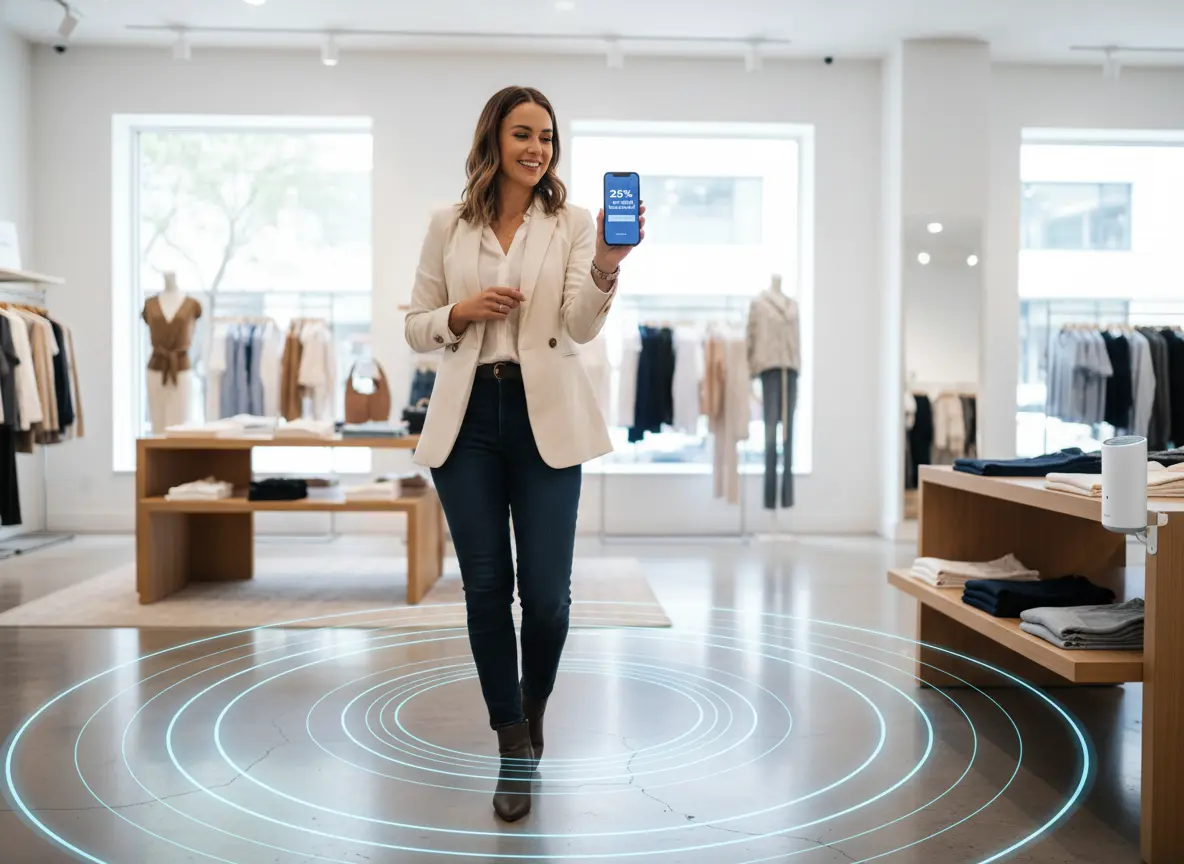
Imagine drawing a giant, invisible circle around your store, your shopping plaza, or even a competitor's location (yes, you can be that sneaky). That’s a geofence. When a shopper who has your store's app enters or exits this virtual boundary, it triggers a pre-programmed action on their phone—typically a push notification.
Example in the Wild: A customer is walking through the town square, about two blocks from your boutique. Their phone buzzes: "Hey, fashionista! You're just around the corner. Pop in and get 20% off all new arrivals today only."
Geofencing is your macro-level tool. It’s perfect for:
- Luring in nearby foot traffic.
- Sending broad, enticing offers to people in a specific area.
- Reminding past customers you exist when they're in the neighborhood.
It’s the digital equivalent of shouting, "Hey, the party's over here!" to the entire neighborhood. And according to recent studies, over 50% of consumers visit a retailer after receiving a location-based notification. That's a party people clearly want to attend.
Beacons: The In-Store Whisperers
If geofencing is a shout, beacons are a whisper. These are small, low-energy Bluetooth devices you place around your store. They broadcast a tiny signal that a smartphone can detect from a few inches to about 50 feet away. When a shopper’s phone picks up the signal, it triggers a highly specific, contextual notification.
Example in the Wild: A customer, already inside your home goods store, is lingering in the kitchenware aisle. Their phone pings: "Love that knife set? We've got the matching cutting boards right behind you. Buy both and save 15%!"
Beacons are your micro-level ninjas. They excel at:
- Providing in-depth product information right at the shelf.
- Upselling and cross-selling with hyper-relevant offers.
- Creating interactive experiences, like a "scavenger hunt" for discounts.
They turn your physical store into a dynamic, personalized space. It’s about delivering the right message, in the right place, at the exact right time.
Bridging the Digital Nudge with a Real-World Welcome
Getting a customer to walk through your door is a huge win, but the journey isn't over. In fact, the most critical part is just beginning. You've successfully beamed a message from the cloud to their pocket. Now, how do you make that transition from the screen to the store feel seamless and, dare we say, magical? The last thing you want is for a customer, excited by their exclusive offer, to be met with a chaotic environment or an overwhelmed employee who has no idea what they're talking about.
Let Stella Connect the Dots
This is where the experience can either fall flat or become truly memorable. A customer walks in, phone in hand, looking for the denim deal they were just promised. This is the perfect moment to close the loop. An employee greeter is great, but they can't be everywhere at once. Enter Stella. Because she's always at the front of the store, she provides a consistent, professional touchpoint for every single person who walks in. She can be programmed to know exactly what geofenced offers are running that day. Instead of a generic "hello," she can say, "Welcome! If you're here for our 25% off denim flash sale, you're in the right place. You can find the entire collection straight back and to the left." Instantly, the customer feels seen, understood, and intelligently guided. That digital promise has been fulfilled by a friendly, physical presence, creating a cohesive experience that builds immediate confidence and brand loyalty.
Your Proximity Marketing Playbook: A No-Nonsense Guide
Feeling inspired? Good. Now let's turn that inspiration into action. Implementing a proximity marketing strategy isn't about flipping a switch and watching money rain from the ceiling. It requires a bit of thought, but the payoff is well worth it. Here's a simple, three-step framework to get you started.
Step 1: Define Your Goal (Besides "More Sales," Obviously)
You need a clear objective before you start pinging every phone in a five-mile radius. A vague goal leads to vague results. Get specific. What problem are you trying to solve this week?
- Increase foot traffic on slow days? Set up a geofence around your business that only activates on Tuesdays with a "Two-for-One Tuesday" offer.
- Move specific inventory? Place a beacon near that mountain of last season's scented candles and push a "50% Off—Help Us Make Room!" notification.
- Drive loyalty program sign-ups? Trigger a beacon at your checkout counter offering 100 bonus points to anyone who signs up on the spot.
Step 2: Craft Offers That Don't Feel Creepy or Desperate
The line between "helpful tip" and "digital stalker" can be thin. The key is to always provide genuine value. A generic "10% off everything" is fine, but it’s forgettable. Context is king. Your offers should feel like a helpful inside scoop, not a desperate plea for business. Think about what would make your customer's life easier or more delightful in that exact moment.
Instead of: "Sale at Bob's Books!"
Try: "It's starting to rain! Duck into Bob's Books for a free coffee with any purchase and wait out the storm."
Instead of: "Check out our new shoes."
Try: "You're in the shoe department! Scan the QR code on any box with our app to see if we have your size in the back."
Personalization and utility will always win over generic spam.
Step 3: The Not-So-Scary Rules of Engagement
Let's address the elephant in the room: privacy. This all sounds great, but will customers think you're spying on them? Not if you do it right. The foundation of proximity marketing is consent. A customer must have:
- Downloaded your store's mobile app.
- Opted-in to receive push notifications.
- Enabled location services for your app.
This is a value exchange. You are asking for their permission in exchange for delivering valuable, timely content and offers. Be transparent in your app's privacy policy and make it easy for users to opt-out if they choose. When done respectfully, customers don't mind. In fact, research shows that more than 80% of shoppers are more likely to engage with a brand that offers personalized experiences.
A Quick Reminder About Stella
While you’re busy crafting the perfect digital handshake with beacons and geofencing, don't forget about the physical one. Stella, your in-store robot assistant, is the perfect partner to these technologies, ensuring that every digitally-acquired customer gets a five-star welcome the moment they step inside. She's the reliable, professional, and endlessly cheerful team member who bridges the gap between their phone screen and your sales floor.
Conclusion: Your Next Move
The days of passively waiting for customers to wander in are over. Your competition is already using every tool at their disposal, and the sidewalk is only getting more crowded. Beacons and geofencing aren't just trendy buzzwords; they are powerful, practical tools that allow you to engage with customers in a modern, relevant way. They give you the ability to cut through the noise and deliver a compelling reason for someone to choose your store, right now.
So, what’s the next step? Don’t try to boil the ocean. Start small. Pick one clear goal, design one compelling offer, and define one geofence. See what happens. Test, learn, and refine. Technology isn't here to replace the art of great retail; it's here to amplify it. Now go get their attention.