You Can't Save a Member You Didn't See Leaving
Here's a fun little game every gym owner plays, usually around the 20th of the month: staring at the membership roster, squinting at the screen, and trying to feel which members are about to ghost you. Spoiler alert — your gut feeling isn't a retention strategy. Neither is hoping they just forget to cancel.
The fitness industry loses somewhere between 30% and 50% of its members annually, depending on the type of gym. That's not a typo. It's also not inevitable. The difference between gyms that hemorrhage members and gyms that retain them isn't always the equipment, the classes, or even the price. It's whether the owner actually knows — in real time — who is disengaging before it's too late to do anything about it.
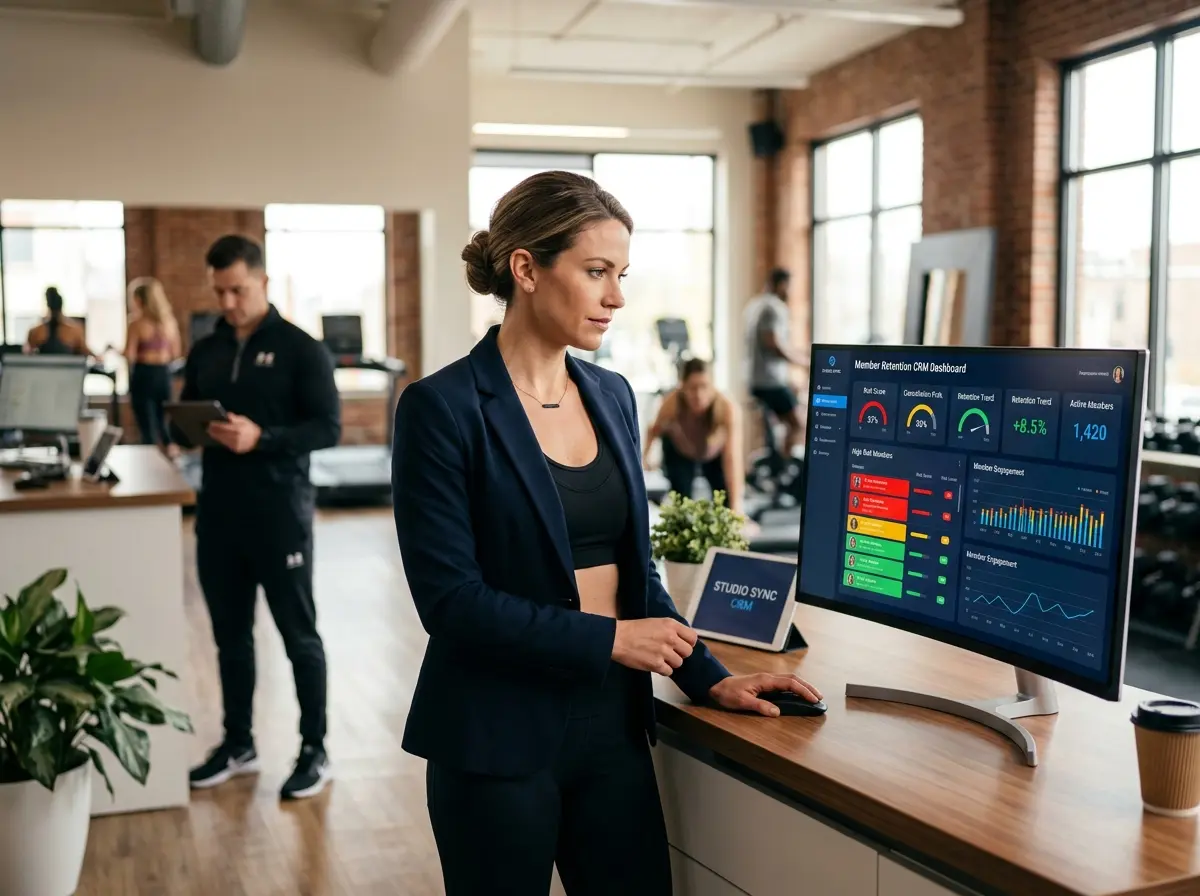
A well-configured CRM dashboard doesn't just store contact information. It tells you a story. And if you know how to read it, that story has a very clear chapter called "This person is about to cancel." Let's talk about how to build that dashboard, what signals to track, and how to act on them before the cancellation email lands in your inbox.
Understanding the Signals That Predict Cancellation
Attendance Drop-Off Is the Loudest Warning Sign
Members who are about to quit almost always follow a predictable pattern: they come less. This sounds obvious, but you'd be surprised how many gym owners don't have a systematic way to catch it. When someone goes from four visits a week to two, and then to zero for three weeks running, that's not a vacation — that's a goodbye in slow motion.
Your CRM should be tracking visit frequency at the individual member level and flagging anyone whose attendance has dropped by more than 50% compared to their personal baseline over the past 30 days. Not compared to the gym average — compared to their own normal. A member who always came twice a week and still comes twice a week is fine. A member who used to come five times a week and now shows up once is not.
Set up a custom tag or segment in your CRM — something like "At Risk: Attendance" — that automatically populates when this threshold is triggered. That list should be front and center on your dashboard, reviewed weekly, not monthly.
Engagement Metrics Beyond the Front Door
Attendance is the most obvious signal, but it's not the only one. Members who are mentally checked out often disengage from the community before they disengage from the gym itself. Watch for drops in class bookings if you offer them, silence from members who used to respond to your email campaigns, and lack of interaction on any loyalty or referral programs you run.
Your CRM should allow you to assign custom fields that capture these touchpoints. Build a simple engagement score — even a manual one — that combines visit frequency, class participation, and communication responsiveness. Members who score low across all three categories are statistically far more likely to cancel within 60 days. That's your intervention window, and it's not as wide as you think.
Billing Friction as a Predictor
Failed payments are more than an accounting headache. They are frequently the first hard signal that a member has mentally decided to leave, even if they haven't officially cancelled yet. When someone's card "accidentally" fails right before their renewal date, there's a reasonable chance they were hoping the system would just handle the awkwardness for them.
Your CRM dashboard should flag any member with a failed or delayed payment alongside their attendance data. When you see low attendance and a recent billing issue together, you're not looking at a coincidence. You're looking at someone who needs a personal, human outreach within 48 hours — not an automated dunning email, an actual conversation.
How Smarter Front-Desk Tools Make Retention Easier
Capturing the Right Data in the First Place
Here's the part nobody talks about: a CRM dashboard is only as smart as the data going into it. And gyms are notoriously bad at collecting consistent member information. Staff turnover, rushed check-ins, and inconsistent intake processes mean that half your member profiles are incomplete, outdated, or basically fictional.
Stella, the AI robot employee and phone receptionist, helps solve this at the source. Positioned as a kiosk inside your gym, she greets members and visitors, engages them in natural conversation, and can collect intake information through conversational forms — all of which feeds directly into her built-in CRM with custom fields, tags, and AI-generated member profiles. When a new prospect calls to ask about membership options, Stella answers the phone 24/7, gathers their information, and logs it cleanly so your team has something useful to work with. No more incomplete sign-up cards stuffed in a drawer somewhere. Clean data in, accurate retention insights out.
Building the Dashboard That Actually Works
The Four Panels Every Gym Owner Needs
A retention-focused CRM dashboard doesn't need to be complicated. In fact, if it's complicated, you won't look at it consistently, which defeats the entire purpose. Think of it as four core panels that give you a complete picture at a glance.
The first is your At-Risk Members List — anyone flagged by attendance drop-off, low engagement score, or recent billing issues. The second is a 30/60/90-Day Renewal Calendar, showing who is coming up for renewal and whether their recent engagement warrants a proactive check-in. The third is a New Member Watch List — the first 90 days of membership are when cancellation risk is highest, and new members need more touchpoints, not fewer. The fourth is a Win-Back Segment for recently cancelled members, because some of them can actually be brought back with the right offer at the right time.
Build these four views in your CRM using saved filters, tags, or segments depending on your platform. Review them every Monday morning. Make it a non-negotiable 15 minutes of your week.
Turning Dashboard Insights Into Human Actions
Data doesn't retain members. People do. The dashboard is just the compass — your team has to actually walk in the direction it points. When a member hits the at-risk threshold, the standard response should be a personal outreach within 72 hours. Not a mass email blast with a discount code. An actual message or call that references something specific about them.
For example: "Hey Sarah, we noticed we haven't seen you in a couple of weeks — Coach Mike was asking about you before Tuesday's class. Everything going okay?" That kind of message has a dramatically higher response rate than any automated campaign, because it demonstrates that someone actually noticed. That feeling of being seen is, ironically, one of the primary reasons people stay at a gym in the first place.
Closing the Loop With Post-Interaction Notes
Whatever happens after that outreach — a great conversation, a complaint, a request for a payment plan — it needs to go back into the CRM immediately. Notes, updated tags, a follow-up task. This is where most gyms completely fall apart. The conversation happens, it goes well, and then it lives exclusively inside a staff member's memory until that staff member leaves and takes it with them.
Treat your CRM notes like legal documentation. If it isn't written down, it didn't happen. Over time, those notes build a picture of each member's history that makes every future interaction smarter, more personal, and more effective at retaining them long-term.
Quick Reminder About Stella
Stella is an AI robot employee and phone receptionist built for businesses exactly like yours — she stands inside your gym as a friendly kiosk, greets members, answers questions, and promotes your current offers without ever needing a break. She also answers phone calls 24/7 and logs everything into a built-in CRM, so the data that powers your retention dashboard actually stays complete and current. At $99/month with no upfront hardware costs, she's probably less expensive than the membership you're about to lose.
Stop Guessing, Start Watching
Gym member retention isn't a mystery. It's a data problem with a very solvable solution — if you're willing to set up the systems, look at the numbers consistently, and actually act on what they tell you. The gyms that retain 70%, 80%, or more of their members year over year aren't doing something magical. They're watching, listening, and reaching out at exactly the right moments.
Start this week with three concrete steps. First, audit your CRM setup and make sure attendance, billing, and engagement data are actually being captured consistently. Second, build or configure the four dashboard panels described above — at-risk members, renewal calendar, new member watch, and win-back segment. Third, establish a weekly Monday morning ritual of reviewing that dashboard and assigning outreach tasks before the week gets away from you.
The member who was going to cancel this month? They left a trail of signals. You just need a dashboard that shows you where to look — and a team committed to acting on what they see.