Introduction: The Hidden Math Behind Every Haircut
Let's be honest — most barbershop owners didn't open their doors because they love spreadsheets. They opened because they love the craft, the culture, and the community. But here's the uncomfortable truth: if you're not thinking about your barber-to-client ratio and revenue per square foot, you're essentially flying a very expensive, very stylish plane without checking the fuel gauge.
Every square foot of your barbershop costs you money — rent, utilities, insurance, equipment. And every barber chair that sits idle during a rush, or every client who walks out because the wait was too long, is money quietly slipping out the door with a fresh fade. The good news? This isn't rocket science. It's barber science, which is arguably cooler.
Understanding how to optimize your barber-to-client ratio isn't just about squeezing more haircuts into a day. It's about building a smarter shop — one that maximizes your space, respects your barbers' time, and keeps clients coming back instead of walking down the street to your competitor. Let's break it down.
Understanding the Numbers: What Barber-to-Client Ratio Really Means
Defining Your Core Metrics
Your barber-to-client ratio is simply the number of clients served per barber during a given time period — typically measured per shift or per day. But don't let the simplicity fool you. This single number tells you a lot about your shop's efficiency, your customer experience, and your bottom line.
Industry benchmarks suggest that a skilled barber can comfortably handle 8 to 12 clients per day for standard cuts, assuming 30-45 minute appointments. If your barbers are consistently hitting 6 or fewer, you either have a scheduling problem, a marketing problem, or you're accidentally running a very expensive lounge. If they're pushing 14 or more with no breaks, you're burning your team out — and burnt-out barbers give rushed cuts, which means unhappy clients and no-show rebookings.
Revenue per square foot is your second critical metric. The average retail business in the U.S. generates about $300 to $500 per square foot annually. Barbershops, with their service-based model, can push well beyond that — but only if they're running efficiently. A 1,000-square-foot shop generating $200,000 per year is doing $200 per square foot. A well-optimized shop of the same size could realistically hit $350 to $450 per square foot with the right strategy.
Why the Ratio Matters More Than You Think
Here's where it gets interesting. Your barber-to-client ratio directly affects four things that collectively determine your profitability: client wait times, barber utilization, service quality, and upsell opportunities. When the ratio is off — too many clients per barber, or too few — at least two of those four things suffer simultaneously.
A shop that's chronically understaffed during peak hours trains its clients to expect long waits. Some will tolerate it. Many won't. And in an era where someone can book a competing shop on an app in 30 seconds, patience is a rapidly depreciating asset. On the flip side, an overstaffed shop during slow periods means you're paying barbers to lean on chairs and scroll their phones — which, admirable as the scrolling may be, doesn't pay the rent.
Mapping Your Peak Hours and Dead Zones
Before you can optimize anything, you need data. Pull your appointment records and walk-in logs for the last 90 days and identify your true peak windows. For most barbershops, these fall on Thursday through Saturday afternoons, with a secondary spike on Friday mornings. Your dead zones are likely Tuesday and Wednesday mornings.
Once you see the pattern, you can start scheduling barbers strategically — staggering start times, offering split shifts, or incentivizing barbers to take their off days during the slow stretches. This alone can meaningfully improve your revenue per square foot without adding a single square inch of space.
Smart Tools That Give You an Edge
Where Technology Fits Into a Barbershop
Running a tight operation means more than great cuts — it means never missing a client inquiry, a booking opportunity, or a chance to upsell a product. That's where Stella, the AI robot employee and phone receptionist, quietly becomes a barbershop's secret weapon. Stella can stand inside your shop and proactively greet walk-ins, answer questions about services, pricing, and promotions, and even upsell retail products like pomades or beard oils — all without pulling your barbers away from a client mid-fade.
On the phone side, Stella answers calls 24/7 with the same knowledge she uses in person. If someone calls after hours to ask about your Saturday hours or whether you do beard trims, she handles it. No missed calls, no voicemails that sit unheard until Tuesday. She can also collect client intake information conversationally — making your front-end smoother without adding front-desk headcount. At $99/month, she costs less than a single shift of front-desk labor.
Maximizing Revenue Per Square Foot: Practical Strategies That Actually Work
Rethink Your Layout and Service Mix
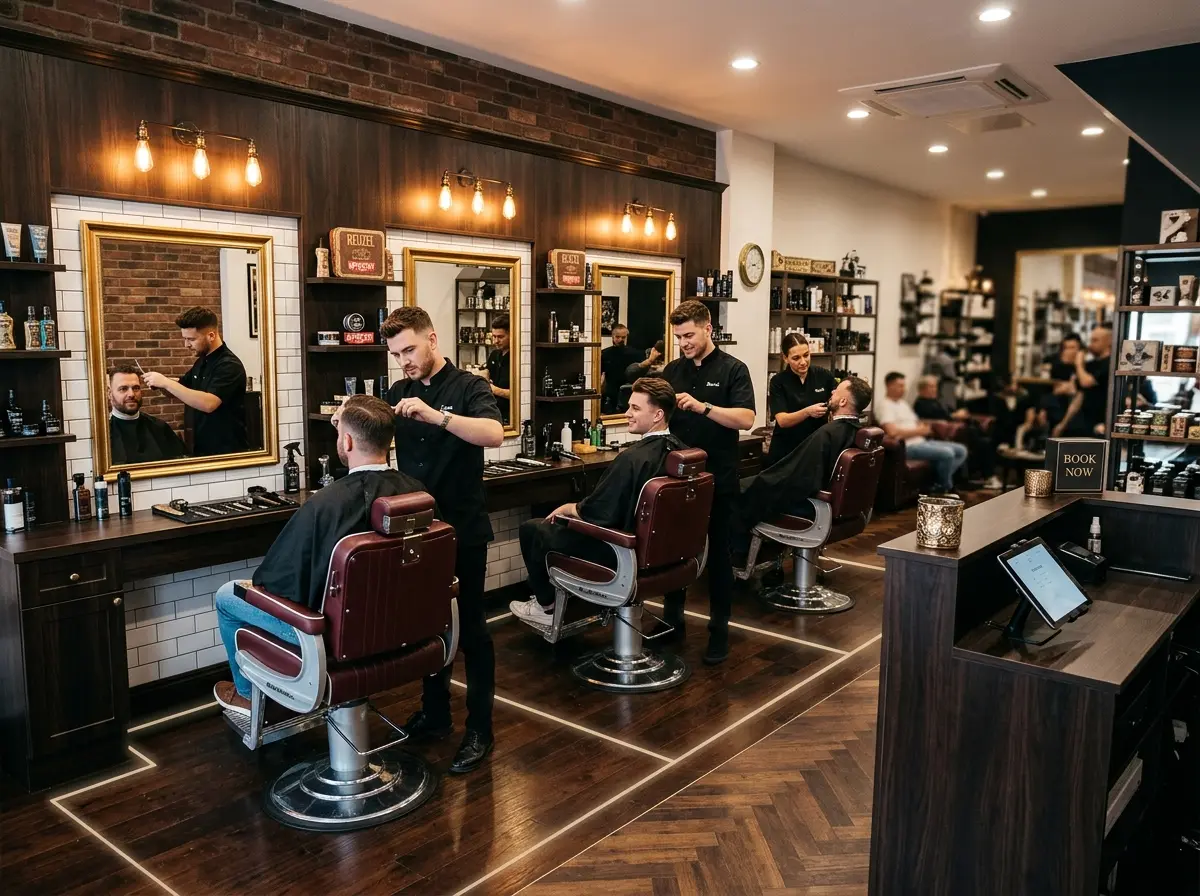
Revenue per square foot isn't just a scheduling problem — it's also a space design problem. If your waiting area takes up 30% of your floor plan but only fills up during two-hour windows on Saturdays, that's underutilized real estate. Consider downsizing the wait zone and adding a fourth chair. One additional barber doing even 8 clients per day at a $35 average cut adds over $70,000 in gross revenue annually. That's a meaningful return from a layout adjustment.
Your service mix also matters enormously. A basic haircut might take 30 minutes at $30. A cut-plus-beard-lineup combo might take 45 minutes at $55. That's $10 more per hour of chair time — which, multiplied across a full day and a full team, compounds quickly. Promoting higher-margin services during slower periods is one of the lowest-effort revenue levers available to you.
Build a Retail Layer Into Your Revenue Model
The most successful barbershops don't just sell time — they sell products. Retail sales generate revenue without occupying a chair, consuming a barber's time, or requiring a scheduled appointment. A modest retail display of 8 to 10 curated products near your checkout area can generate $500 to $2,000 per month in additional revenue, depending on your foot traffic and how actively your team recommends products.
Train every barber to mention one product per service — not in a pushy, car-salesman way, but in a natural, professional way. "I used this pomade on you today — gives that matte hold without getting flaky." That's not a sales pitch. That's expertise. And clients pay for expertise.
Use Booking Data to Eliminate Revenue Leaks
No-shows and last-minute cancellations are the silent killers of barbershop profitability. A barber sitting idle for 30 minutes because a client ghosted their 2:00 PM appointment isn't just annoying — it's a direct hit to your revenue per square foot calculation. Implement a clear cancellation policy, send automated reminder messages 24 and 2 hours before appointments, and consider requiring a card on file for repeat no-show offenders.
Waitlist management is equally important. During peak hours, maintain an active waitlist and have a system for notifying clients when a slot opens. A filled chair is always better than an empty one, even if the fill came from a last-minute text to three people on the waitlist. Most modern booking platforms support this natively — use it.
Quick Reminder About Stella
Stella is an AI robot employee and phone receptionist designed to work inside your shop and answer your phones around the clock. She greets clients, promotes services and deals, answers questions, and handles calls — all for $99/month with no upfront hardware costs. For a barbershop looking to run leaner and smarter, she's worth knowing about.
Conclusion: Stop Leaving Money on the Floor
Here's the actionable summary: your barbershop's profitability isn't determined by how good the cuts are — it's determined by how smartly you manage the space, the schedule, and the client experience around those cuts. The best barbers in the world can't overcome a fundamentally inefficient operation.
Start here. Pull your last 90 days of booking data and calculate your actual barber-to-client ratio by day and time block. Identify your peak windows and your dead zones. Look at your floor plan and ask honestly whether every square foot is earning its rent. Then build a service mix and scheduling strategy that closes the gaps.
From there, layer in the tools — smart booking software, automated reminders, a retail section, and yes, an AI receptionist who doesn't take lunch breaks or forget to mention your current promotion. Small optimizations compound fast in a service business. A 15% improvement in chair utilization across a four-chair shop is a real number with real dollars attached to it.
The math is on your side. You just have to do it.