It's That Time of Year Again (No, Not the One With the Pumpkin Spice)
Twice a year, like clockwork, your customers' HVAC systems silently beg for attention. Once before the heat of summer arrives, and once before winter reminds everyone that frozen pipes are not a fun home improvement project. And twice a year, most HVAC companies leave serious money on the table by failing to run a structured maintenance agreement renewal campaign.
Here's the uncomfortable truth: your customers are not sitting around thinking about their HVAC system. They're thinking about their kids, their jobs, and whatever's currently streaming on Netflix. If you don't reach out and remind them that a maintenance agreement exists — and why they should care — they simply won't renew. And then they'll call your competitor in a panic when their AC dies on the hottest day of the year. Don't let that happen.
A well-timed, well-executed seasonal renewal campaign isn't just a nice-to-have — it's a revenue engine that runs twice a year, builds customer loyalty, and keeps your technicians booked during the shoulder seasons when calls would otherwise slow down. Let's talk about how to build one that actually works.
The Business Case for Seasonal Renewal Campaigns
Recurring Revenue Is the Foundation of a Stable HVAC Business
Every HVAC owner knows the feast-or-famine cycle intimately. June and July are chaos, December can be brutal, and everything in between can feel like guesswork. Maintenance agreements are your antidote to that unpredictability. According to industry data, HVAC companies with strong maintenance agreement programs report 30–40% more predictable annual revenue compared to those relying solely on reactive service calls. That's not a rounding error — that's the difference between scrambling to make payroll in April and actually planning for growth.
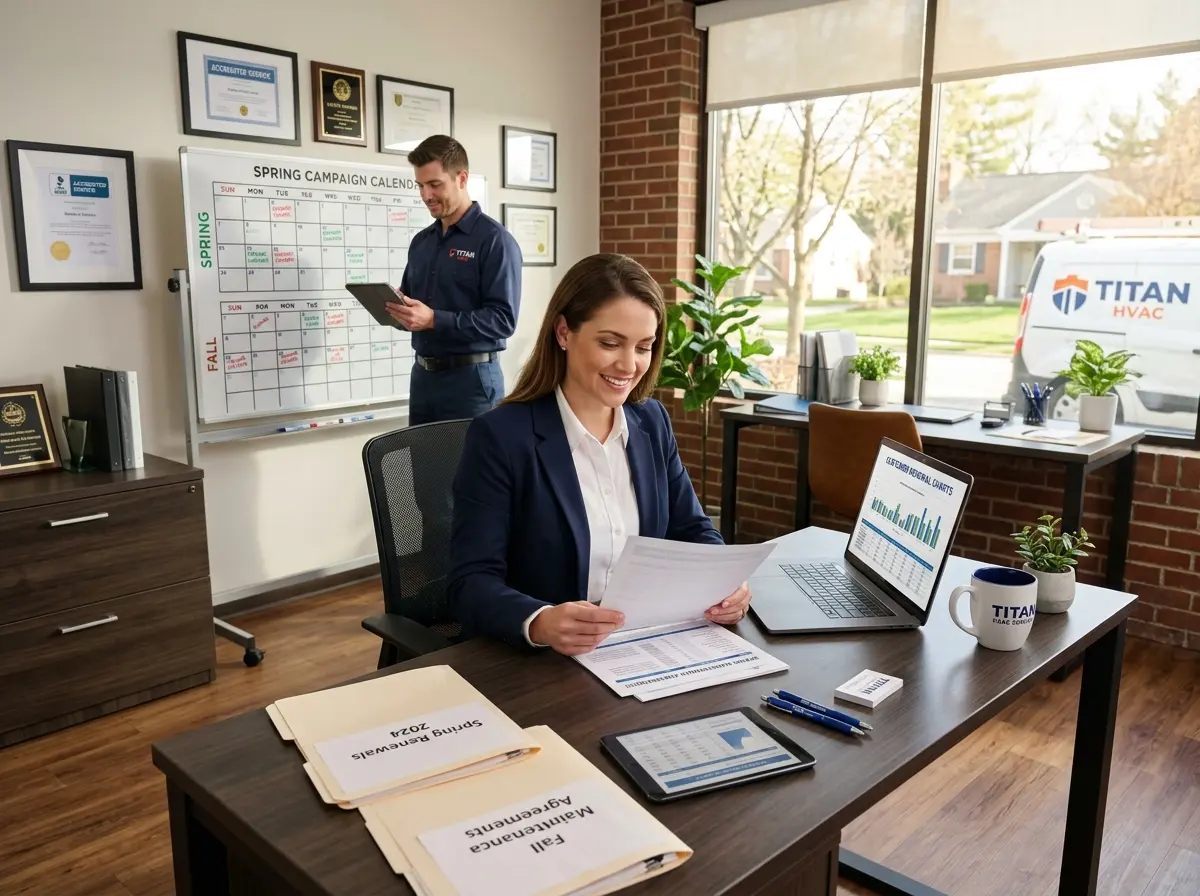
A spring campaign (targeting March through early May) catches homeowners before cooling season kicks off. A fall campaign (September through October) captures the pre-heating-season window. Together, they create two reliable spikes of renewal and upsell activity that you can actually build a schedule around. Your technicians stay busy, your cash flow stays consistent, and your customers stay protected. It's one of those rare situations where everyone wins.
Maintenance Customers Are Your Most Profitable Customers
This is worth saying clearly: a customer with a maintenance agreement is worth significantly more than a one-time service call customer — not just because of the agreement fee itself, but because of what comes after. Agreement holders call you first when something breaks. They're more likely to replace equipment through you. They're more likely to refer friends and family. And because you've built an ongoing relationship, they're far less likely to shop around on price.
Industry estimates suggest that maintenance agreement customers generate two to three times the lifetime revenue of non-agreement customers. If your average agreement is worth $200–$350 per year, and each of those customers generates additional service revenue on top of that, the math gets very compelling very quickly. Running a renewal campaign twice a year isn't just good marketing — it's good business arithmetic.
Expired Agreements Are Low-Hanging Fruit You're Ignoring
Here's the part that might sting a little: most lapsed maintenance agreement customers don't cancel because they're unhappy with you. They let it expire because life got busy, the renewal notice got buried in their inbox, or they simply forgot. A friendly, timely outreach campaign — especially one that feels personal rather than automated — can recapture a significant portion of those customers with minimal effort. Studies across service industries consistently show that re-engaging a lapsed customer costs five times less than acquiring a brand new one. You've already done the hard work of earning their trust. A seasonal renewal campaign just reminds them to act on it.
How to Run a Campaign That Actually Gets Renewals
Time It Right and Make It Feel Urgent
Timing is everything. Launch your spring campaign in mid-March, before the first warm weekend makes people panic-call for service. Launch your fall campaign in early September, before the first cold snap reminds everyone their furnace exists. The window between "it's getting warm/cold" and "our phones are ringing off the hook with emergencies" is your sweet spot — customers are thinking about their comfort, but they're not yet in crisis mode. That's exactly when they'll respond to a calm, proactive outreach about renewing their agreement.
Make the campaign feel time-sensitive without being obnoxious about it. Offer an early-renewal discount for customers who renew before a certain date. Highlight that scheduling fills up fast as the season approaches — because it genuinely does. A little honest urgency goes a long way.
Use Multiple Touchpoints — Not Just One Email
Sending one email and hoping for the best is a strategy, technically. It's just not a very good one. A strong renewal campaign uses a coordinated sequence of touchpoints: an initial email, a follow-up postcard or direct mail piece, a phone call or text, and possibly even a reminder when customers call in for unrelated reasons. Each touchpoint should feel consistent and professional, reinforce the value of the agreement, and make it genuinely easy to say yes.
Text messaging, in particular, is dramatically underused by HVAC companies. Open rates for SMS messages hover around 98%, compared to roughly 20% for email. If you're not incorporating a text outreach into your renewal campaign, you are voluntarily making your marketing less effective. That's a choice, but it's probably not the right one.
Where Technology Can Give Your Campaign a Serious Edge
Automate the Outreach Without Losing the Human Touch
The biggest reason most HVAC companies don't run structured renewal campaigns is simple: nobody has time to personally call several hundred customers twice a year. This is exactly where smart automation — and smart tools — pay for themselves immediately. CRM systems that tag customers by agreement status and expiration date can trigger automated email and text sequences without you lifting a finger. Your team just handles the customers who respond.
The goal is to make the campaign feel personal even when it's automated. Use the customer's name. Reference their specific equipment if you have it on file. Mention the last time you serviced their system. A little personalization dramatically improves response rates and makes customers feel like you actually know them — because, with the right data, you do.
Let Stella Handle the Phones While Your Team Focuses on Renewals
During a seasonal push, your phones can get overwhelming fast. Customers are calling to renew, to ask questions, to schedule appointments — all at once. That's where Stella, the AI robot employee and phone receptionist, can genuinely earn her keep. Stella answers every inbound call 24/7, can answer questions about your current maintenance agreement promotion, collect customer information through conversational intake forms, and forward calls to your team when human judgment is needed. Her built-in CRM can tag and track renewal inquiries so nothing falls through the cracks.
For HVAC companies with a physical location or showroom, Stella's in-store kiosk presence means walk-in customers get the same proactive promotion — she can engage customers who come in for parts or service and naturally mention the ongoing spring or fall maintenance agreement offer. It's consistent, professional outreach that doesn't depend on whether your front desk employee remembered to bring it up that day.
Building Customer Loyalty That Outlasts a Single Season
Make Renewing Easier Than Not Renewing
The path of least resistance wins every time. If renewing a maintenance agreement requires a customer to call during business hours, navigate a confusing process, and then wait for a confirmation, many of them just won't bother — not because they don't want to, but because friction kills follow-through. Online renewal with saved payment information, text-to-pay options, and auto-renewal with annual notification should be table stakes for any modern HVAC company.
The easier you make it to say yes, the more yeses you'll get. That's not a marketing insight — that's just human nature.
Add Value Beyond the Basic Tune-Up
Customers renew when they feel like they're getting something worthwhile. A basic agreement that promises two tune-ups per year is fine. An agreement that also includes priority scheduling, a discount on parts and repairs, an annual filter delivery, and a free diagnostic call? That's something people talk about. Tiered agreement structures — a basic plan, a standard plan, and a premium plan — give customers a choice and naturally push many of them toward the middle option, which should be your most profitable.
When you communicate the value of the agreement clearly and make the premium tier feel like an obvious upgrade, you're not upselling — you're helping customers make a smarter decision. Frame it that way, and your renewal rates will reflect it.
Track Results and Improve Every Campaign
After each seasonal campaign, take 30 minutes to review what worked and what didn't. What was your renewal rate? Which outreach channel drove the most conversions? Did the early-bird discount actually move the needle? Which customer segments responded best? This isn't glamorous work, but it compounds over time. A campaign that converts 40% of lapsed customers this fall becomes a campaign that converts 55% next fall, because you made three small improvements based on real data. That's how you build a machine, not just a one-time push.
A Quick Note About Stella
Stella is an AI robot employee and phone receptionist built for businesses exactly like yours — available as a friendly in-store kiosk and as a 24/7 phone answering solution. At $99/month with no upfront hardware costs, she's the kind of team member who never calls in sick, never forgets to mention the promotion, and never puts a customer on hold because she's helping someone else. For HVAC companies running seasonal campaigns, she's a reliable way to make sure no inquiry slips through the cracks.
Your Next Steps Start Right Now
If spring or fall is within the next eight weeks, you don't have the luxury of sitting on this. Here's what to do immediately:
- Pull your list. Identify every customer with an active or recently lapsed maintenance agreement. Tag them in your CRM by expiration date.
- Build your offer. Decide on your early-renewal incentive, finalize your agreement tiers, and make sure your pricing reflects the value you're delivering.
- Map your touchpoints. Plan the sequence — email, text, postcard, phone call — with specific dates and clear messaging for each.
- Reduce friction. Make online renewal and auto-renewal available before the campaign launches.
- Set up tracking. Know your starting renewal rate so you can measure improvement at the end of the campaign.
Seasonal maintenance agreement renewal campaigns are one of the highest-ROI activities an HVAC company can run. They're not complicated, they don't require a marketing degree, and they pay for themselves many times over. The only reason not to run one is inertia — and hopefully, this was enough to shake that loose.
Your customers' HVAC systems need attention twice a year. So does your revenue strategy. Go make both happen.