Introduction: The Shop Runs You — Until It Doesn't Have To
Let's be honest. You didn't open an auto shop so you could spend every waking hour answering the same five questions, chasing down technicians, and personally approving every oil change upsell. You opened it because you love the work — or at least, you used to, before the business started running you.
Here's a stat worth sitting with: according to the E-Myth Revisited principle popularized by Michael Gerber, most small business owners are so buried in working in their business that they never get the chance to work on it. For auto shop owners, this tends to mean: you're the first one in, the last one out, and somehow still the one who knows where the shop rags are kept.
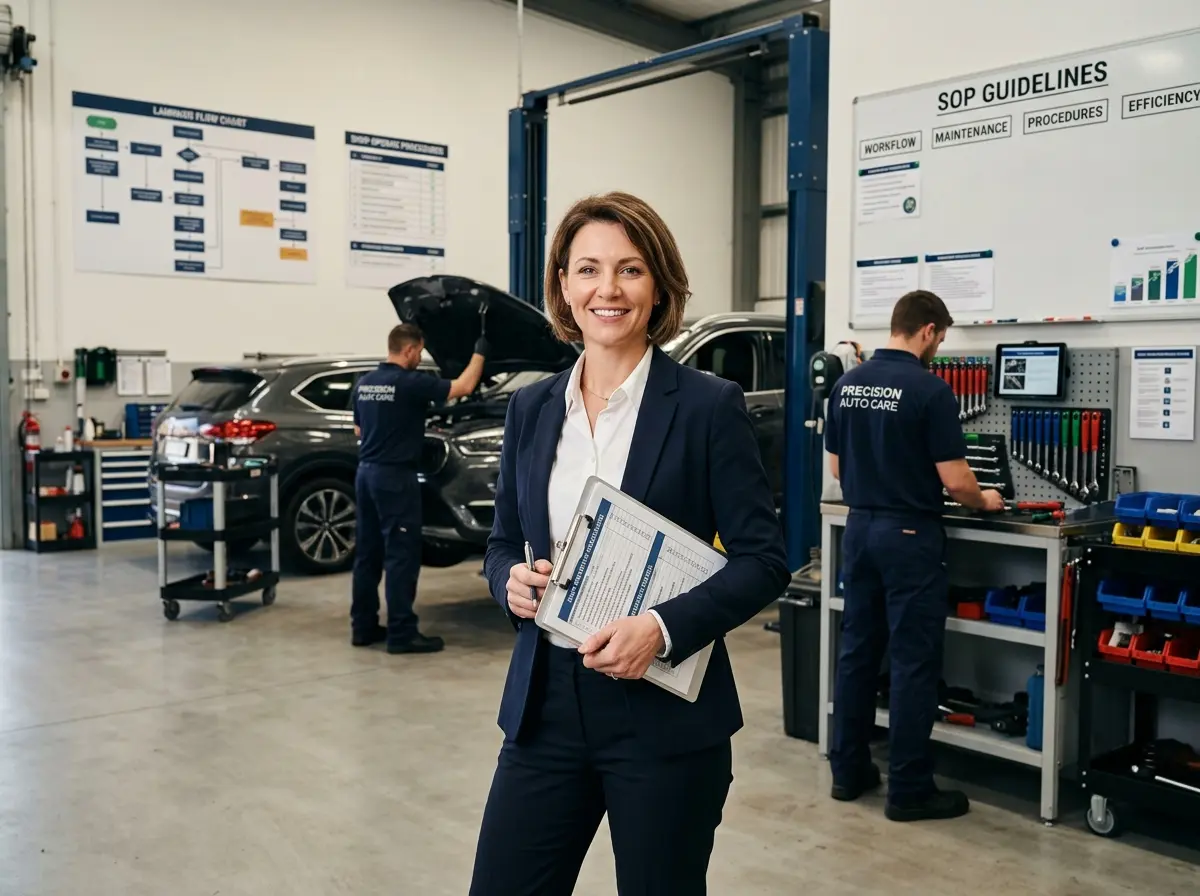
The solution isn't working harder. It's building Standard Operating Procedures — SOPs — that document exactly how your shop runs so that it can keep running without you hovering over every bay. Think of SOPs as your business's brain on paper (or in software). When done right, they transform your team from a group of people who need constant direction into a self-sufficient operation that frees you to actually grow the business — or, heaven forbid, take a vacation.
This guide breaks down how to build practical, effective SOPs for your auto shop, and how to use modern tools to take even more off your plate.
Building the Foundation: What to Document and Why
Start With What's Already Happening
The most common mistake shop owners make when building SOPs is trying to invent a perfect system from scratch. Don't do that. Start by documenting what's already working in your shop. Walk through your operation like a first-day employee and write down every step of every process — from how a vehicle gets checked in to how an estimate is presented to a customer to how the bay gets cleaned at end of day.
Your existing processes, even the informal ones, are a goldmine. The goal at this stage isn't perfection — it's documentation. You can refine later. Right now, you just need to capture institutional knowledge that currently lives only in your head (and maybe in the head of your most senior tech who you're desperately hoping never quits).
Prioritize the High-Impact Processes First
Not all SOPs are created equal. Focus first on the procedures that have the biggest impact on customer experience, revenue, and daily operations. For most auto shops, that means tackling these areas before anything else:
- Vehicle check-in and inspection workflow — How does a car get from the parking lot into the system, and who does what?
- Estimate presentation and customer communication — How are customers informed about recommended services, and how is upselling handled professionally?
- Parts ordering and inventory management — Who orders what, from where, and when?
- Quality control before vehicle return — What gets checked before keys go back to the customer?
- Phone and front desk handling — How are inquiries, appointments, and complaints managed?
Once these core processes are documented, you'll already feel a significant shift in how smoothly your shop operates. Everything else — marketing procedures, HR onboarding, vendor management — can follow in a second wave.
Make Your SOPs Actually Usable
An SOP that nobody reads is just a document that makes you feel productive for an afternoon. Format your procedures so they're fast to reference under real-world conditions — meaning when a tech has grease on his hands and needs an answer in 30 seconds. Use numbered steps, short sentences, and visuals where possible. If a picture of the correct tire rotation pattern saves you one argument per week, it was worth including.
Store your SOPs somewhere accessible — a shared Google Drive folder, your shop management software, or a simple binder at the front desk. Accessibility is non-negotiable. The best SOP in the world doesn't help anyone if it's buried in a folder on your personal laptop.
Lighten the Front Desk Load With Smarter Tools
Let Technology Handle the Repetitive Stuff
Even the best-written SOP for phone handling can only do so much when your front desk staff is juggling a waiting customer, a ringing phone, and a technician asking a question — all at the same time. This is where modern tools can pick up the slack in ways that no binder of procedures ever could.
Stella, the AI robot employee and phone receptionist, is one of those tools worth knowing about. For auto shops with a physical location, Stella stands as a human-sized kiosk inside the shop and proactively engages customers — answering questions about services, current specials, wait times, and policies without pulling your service advisor away from an estimate. She also answers phone calls 24/7, handles appointment inquiries, collects customer information through conversational intake forms, and forwards calls to human staff only when genuinely necessary. That means your front desk SOP for routine inquiries essentially runs itself, around the clock, without a coffee break. Her built-in CRM also gives you organized customer contact records and AI-generated summaries so nothing falls through the cracks.
The point isn't to replace your people — it's to give them back the bandwidth to do the high-value work your SOPs are designed to support.
Rolling Out SOPs That Your Team Will Actually Follow
Train to the SOP, Not Just to the Task
Writing great SOPs is only half the battle. The other half is making sure your team understands why the procedure exists, not just what the steps are. Technicians and service advisors who understand the reasoning behind a process are far more likely to follow it consistently — and to flag when something isn't working — than those who were simply told "do it this way."
Build your SOPs into your onboarding process from day one. New hires should spend meaningful time reviewing relevant procedures before they're thrown into the deep end. Pair written documentation with hands-on shadowing so employees can see the SOP in action. This combination dramatically reduces the ramp-up time for new staff and lowers the risk of costly mistakes during that vulnerable early period.
Build a Review Cycle Into the System
Your SOPs are not a "set it and forget it" project. The auto industry evolves — new vehicle technologies, updated shop management software, changing customer expectations — and your procedures need to evolve with it. Schedule a quarterly or semi-annual review of your core SOPs, and designate someone (maybe a senior tech or your service manager) as the internal owner of keeping documentation current.
More importantly, create a simple way for your team to flag when a procedure isn't working in practice. A sticky note system, a Slack channel, a standing agenda item in your weekly meetings — whatever fits your culture. The people on the floor often have the best insight into where the gaps are. Ignoring that input is like having a perfectly calibrated alignment machine and choosing to eyeball it instead.
Measure Whether Your SOPs Are Working
If you can't measure it, you can't improve it. Attach key metrics to your most important SOPs so you know whether they're delivering results. For example, if you've documented an upselling procedure for your service advisors, track your average repair order value before and after implementation. If you've standardized your vehicle check-in process, monitor customer wait time complaints. Data turns your SOPs from a good idea into a provable business asset — which matters a lot when you're trying to convince a skeptical team member (or yourself) that the documentation is worth maintaining.
Quick Reminder About Stella
Stella is an AI robot employee and phone receptionist built for businesses exactly like yours. She greets customers in-store, answers phones around the clock, promotes your services and specials, and keeps your front desk from becoming a bottleneck — all for $99 a month with no upfront hardware costs. If your SOPs are the brain of your operation, Stella is a tireless team member who already knows every page of them.
Conclusion: Build the Machine, Then Step Back
The goal of every SOP you write is the same: to transfer knowledge out of your head and into a system that works whether you're on the floor or not. That's not laziness — that's leverage. It's the difference between owning a business and being owned by one.
Here are your actionable next steps to get started without getting overwhelmed:
- This week: Pick one process that causes daily friction in your shop and write a rough draft SOP for it. Don't overthink the format — just capture the steps.
- This month: Document your five highest-impact procedures and store them somewhere your whole team can access.
- This quarter: Train your team to the documented SOPs, assign ownership for keeping them updated, and set your first review date.
- Ongoing: Layer in tools — like AI receptionists, shop management software, and automated reminders — that execute your processes consistently without requiring constant human supervision.
Your shop doesn't need you to be everywhere at once. It needs systems good enough that it runs brilliantly even when you're not. Build those systems, document them clearly, equip your team to follow them, and you'll find yourself doing something that once felt impossible: actually running your business instead of the other way around.