So You Want to Train Golfers (Without Losing Your Sanity)
Let's be honest — golf fitness is having a moment. Ever since the world watched elite athletes like Rory McIlroy and Bryson DeChambeau treat the gym like a second home, weekend warriors across the country have decided that their slice is a fitness problem, not a technique problem. (It's probably both, but let's not burst that bubble just yet.) The result? A massive, underserved market of golfers who are ready and willing to pay for specialized training — and a huge opportunity for personal trainers smart enough to build a program around it.
According to the National Golf Foundation, there are over 41 million golfers in the United States alone, and the sport has seen consecutive years of participation growth. That's a lot of people with a lot of disposable income who desperately want to hit the ball farther and stop embarrassing themselves on the back nine. If you're a personal trainer who hasn't yet tapped into the golf fitness niche, you're essentially leaving money on the tee.
This guide will walk you through exactly how to build a golf fitness specialty program that attracts clients, delivers results, and positions your training business as the go-to destination for golfers who are serious about improving their game.
Building the Foundation of Your Golf Fitness Program
Before you slap "Golf Fitness Specialist" on your website and call it a day, you need to actually build something worth selling. A well-designed golf fitness program isn't just regular personal training with a few hip rotations thrown in — it's a thoughtfully structured system that addresses the unique physical demands of the golf swing.
Get Certified and Know Your Stuff
Credibility matters, especially with golfers — a demographic that tends to be detail-oriented, research-heavy, and very good at spotting fluff. Pursuing a golf fitness certification from an accredited body like the Titleist Performance Institute (TPI) is one of the smartest investments you can make. TPI's Level 1 certification is accessible, widely recognized, and gives you a framework for assessing how a client's body affects their swing. Other solid options include the National Academy of Sports Medicine's Golf Fitness Specialization or the Golf Exercise Specialist credential from the National Strength and Conditioning Association.
Beyond the certification itself, you should genuinely understand golf. You don't need to be breaking par, but knowing the difference between a draw and a fade, understanding what "early extension" means in swing analysis, and being able to speak intelligently with a golf instructor will earn you enormous credibility with clients. Take a few lessons, watch instructional content, and if possible, build relationships with local golf pros who can refer clients your way.
Design a Program That Actually Mirrors the Demands of Golf
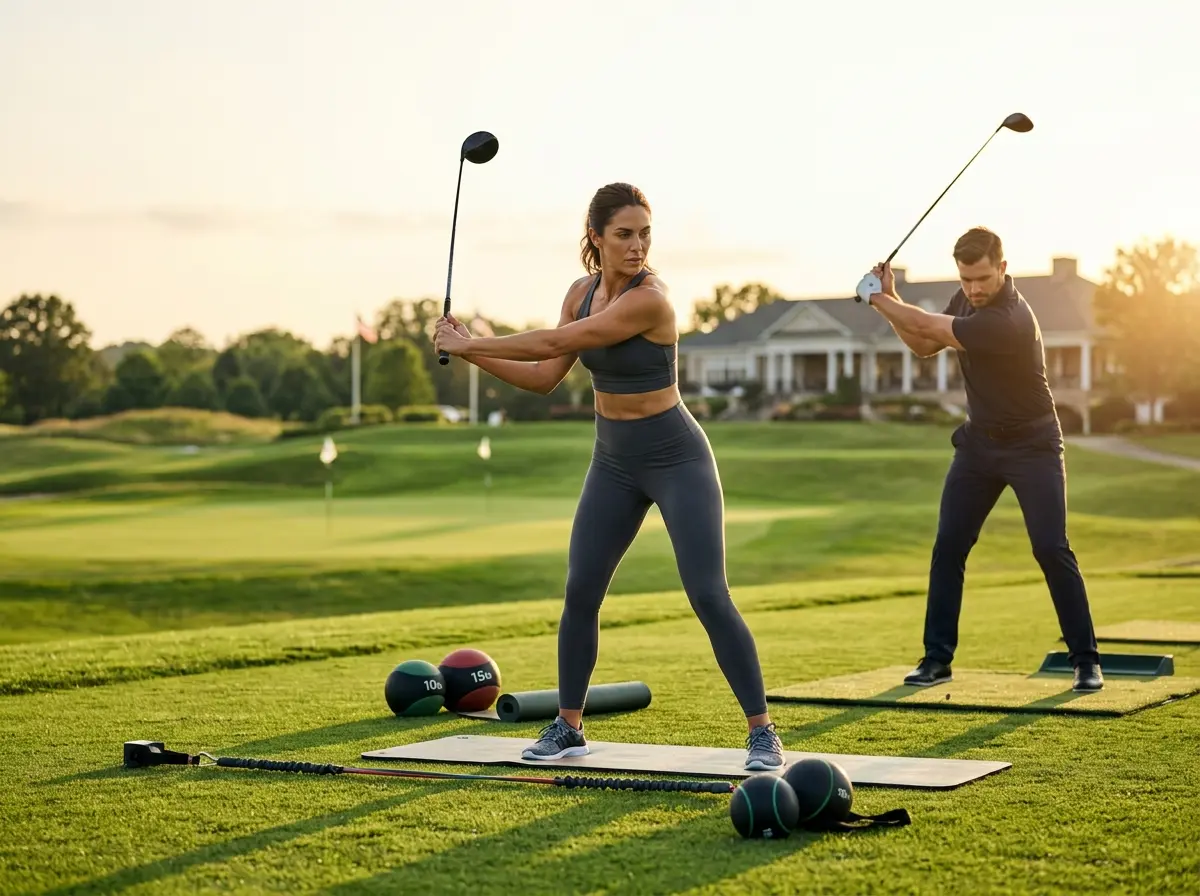
Golf is a rotational sport that demands mobility, stability, balance, and explosive power — often in that exact sequence. Your programming needs to reflect this. The most effective golf fitness programs are built around a few core pillars:
- Mobility work — especially thoracic spine rotation, hip mobility, and shoulder range of motion
- Rotational strength and power — medicine ball work, cable rotations, and anti-rotation exercises
- Stability and balance training — single-leg exercises, core stability, and ground force development
- Functional movement screening — to identify limitations that are directly impacting swing mechanics
Structure your program in phases — a mobility and assessment phase, a strength-building phase, and a power and performance phase — so clients can see a clear progression. This also gives you a natural justification for long-term engagement, because golf fitness isn't a one-and-done endeavor. The season never really ends for dedicated golfers, which means your revenue stream doesn't have to either.
Package and Price It Strategically
Golf fitness clients tend to have more purchasing power than the average gym member, and they're accustomed to paying premium prices for equipment, green fees, and lessons. Don't undersell yourself. Consider offering tiered packages: an introductory assessment session, a 12-week foundational program, and an ongoing performance membership. You might also explore group training options for golfers — small group sessions of four to six players can be highly profitable while fostering the kind of community that golfers naturally crave.
Streamlining Client Management Without Losing Your Mind
Here's the part nobody tells you about building a specialty niche: the training is the fun part. The phone calls, intake forms, scheduling questions, and "wait, what's included in the premium package again?" inquiries at all hours of the day? That's where things get exhausting fast.
Let Technology Handle the Repetitive Stuff
This is exactly where Stella, the AI robot employee and phone receptionist, earns her keep. Whether you run a standalone training studio or operate out of a larger gym, Stella can greet walk-in prospects, answer questions about your golf fitness program, explain your packages, and promote current offers — all without pulling you away from a client session. On the phone side, she answers calls 24/7 with the same knowledge she uses in person, so potential clients calling after hours don't just hit a voicemail and move on.
Stella also handles client intake through conversational forms — gathering contact information, fitness history, and golf-specific goals — and stores everything in her built-in CRM with custom fields, tags, and AI-generated client profiles. That means by the time you sit down for a new client's first session, you already know they're a 14 handicap with lower back issues who plays three times a week. That's the kind of preparation that makes clients feel like you actually care.
Marketing Your Golf Fitness Program to the Right Audience
You can build the most brilliant golf fitness program in the world, and it won't matter one bit if nobody knows it exists. Marketing a niche service requires a targeted approach — shotgun advertising to "anyone who exercises" is a waste of your budget and your energy.
Build Strategic Local Partnerships
Golf fitness exists at the intersection of two industries, which means you have twice as many partnership opportunities as a generic personal trainer. Reach out to local golf courses, driving ranges, and golf retailers to introduce yourself and your services. Many golf instructors don't have a fitness professional they regularly refer clients to — becoming that person for even two or three instructors in your area can generate a reliable stream of warm referrals. Offer to host a free workshop at the pro shop or driving range: something like "3 Exercises That Will Add Distance to Your Drive" is exactly the kind of value-driven event that attracts golfers and positions you as an authority.
You might also consider partnering with physical therapists or sports medicine clinics. Golfers deal with a predictable set of injuries — lower back pain, golfer's elbow, hip issues — and having a trusted referral relationship with a local PT creates a mutual pipeline of clients who genuinely need what both of you offer.
Create Content That Speaks Directly to Golfers
Social media content for a golf fitness program practically writes itself, which is a rare and beautiful thing. Short videos demonstrating hip mobility drills, posts explaining the connection between thoracic rotation and club head speed, and before-and-after stories from clients who shaved strokes off their handicap are all highly shareable within golf communities. Platforms like Instagram and YouTube work well for video content, but don't overlook golfer-specific communities on Facebook and Reddit where your expertise can shine.
Consider publishing a simple email newsletter targeted at local golfers — something short, practical, and maybe a little entertaining. Consistency matters more than perfection here. One genuinely useful tip delivered every two weeks builds more trust over time than a sporadic burst of polished content followed by three months of silence.
Leverage Testimonials and Results Relentlessly
Golfers are results-obsessed, and the most persuasive thing you can put in front of a potential client is a real story from someone just like them. Track measurable outcomes wherever possible — improved flexibility assessments, increased club head speed measured at the driving range, handicap reductions — and ask satisfied clients to share their experience in written or video testimonials. Even a simple quote paired with a before-and-after assessment score can be surprisingly powerful social proof. Make collecting testimonials a standard part of your program completion process, not an afterthought.
Quick Reminder About Stella
Stella is an AI robot employee and phone receptionist built to help business owners like you handle customer interactions without dropping the ball — or the 7-iron. She greets clients in person at your location, answers phones around the clock, manages intake, and keeps your CRM organized, all for just $99 a month with no upfront hardware costs. If your front desk is currently "you, between sets," it might be time for an upgrade.
Your Next Steps Start Now
Building a golf fitness specialty program isn't complicated, but it does require intention. The trainers who succeed in this niche aren't necessarily the ones with the fanciest equipment or the longest list of certifications — they're the ones who take the time to genuinely understand golfers, build programs that deliver measurable results, and market themselves consistently within the right communities.
Here's your action plan to get started:
- Get certified. Enroll in a TPI or equivalent golf fitness certification within the next 30 days. It's one of the highest-ROI investments you can make in your specialty.
- Design your signature program. Map out a 12-week golf fitness program with clear phases, measurable outcomes, and defined pricing tiers before you take a single client.
- Make five partnership calls this week. Reach out to local golf instructors, courses, or retailers and introduce yourself. Relationships take time — start building them now.
- Create one piece of golf-specific content. A short video, a blog post, or even a well-crafted social media post that demonstrates your expertise. Publish it this week.
- Solve your intake and communication problem. If you're still managing calls and client questions manually, look into tools that can handle that load so you can focus on actually training people.
The golf fitness market is growing, golfers are motivated and willing to invest, and most personal trainers haven't figured out how to serve them properly yet. That's not a problem — that's an opportunity. Get after it.