Introduction: The Metric That Separates Thriving Salons from the Ones Constantly Scrambling
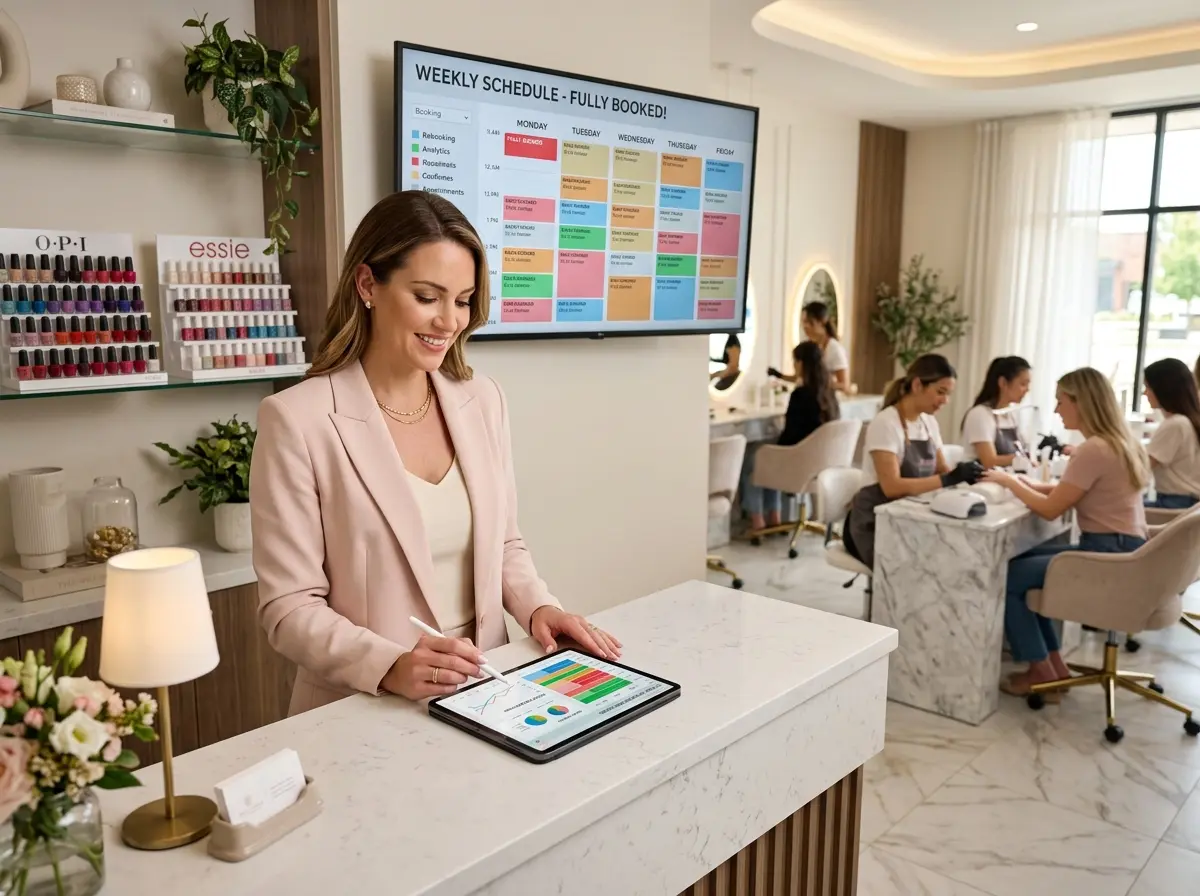
Let's paint a picture. It's Monday morning, you're staring at a half-empty appointment book for the week, and you're mentally calculating how many gel manicures you need to sell just to cover payroll. Sound familiar? If so, you're probably not paying close enough attention to your rebooking rate — and it might just be the most important number you're not tracking.
Your rebooking rate is the percentage of clients who schedule their next appointment before leaving your salon. It sounds simple, almost too simple, but the downstream impact on your monthly revenue is anything but. A low rebooking rate means you're constantly refilling your calendar from scratch — relying on new client acquisitions, last-minute social media posts, and the occasional prayer to the algorithm gods. A high rebooking rate means predictable, recurring revenue that you can actually plan around. And in the nail salon business, predictability isn't just comforting — it's profitable.
The good news? Improving your rebooking rate is absolutely within your control, and the strategies to do it aren't complicated. Let's break it down.
Understanding Why Rebooking Rates Matter More Than You Think
The Math Is Embarrassingly Simple (and That's the Point)
Here's a quick reality check: acquiring a new customer costs, on average, five times more than retaining an existing one. Yet most salon owners spend the bulk of their marketing energy chasing new clients while their existing ones quietly drift to the competition down the street. If you have 100 active clients and your rebooking rate is 30%, you're essentially rebuilding 70% of your revenue base every single month. Exhausting, right?
Now flip the script. Bring that rebooking rate up to 60% or 70%, and suddenly your calendar starts filling itself. Your revenue becomes something you can forecast, budget around, and — dare we say — sleep through the night without worrying about. A salon with 100 clients at an average ticket of $65 and a 65% rebooking rate can count on roughly $4,225 in secured revenue before the month even begins. That's not magic. That's just math working in your favor for once.
Why Clients Don't Rebook (It's Not What You Think)
Most salon owners assume clients don't rebook because they were unhappy with the service. Sometimes that's true — but more often, it's something far less dramatic: they simply forgot, or no one asked. Life gets busy. Your client walked out with gorgeous nails, felt amazing, fully intended to come back in three weeks, and then got ambushed by work deadlines, school pickups, and a Netflix series she couldn't put down.
The single most effective thing you can do to improve rebooking is also the most obvious: ask every single client to rebook before they leave. Not in a pushy, car-salesman kind of way — just a warm, natural, "Would you like to go ahead and grab your spot for next time?" That one sentence, delivered consistently by every staff member, can lift your rebooking rate by double digits almost immediately. Train your team on it. Make it non-negotiable. Track it.
Timing, Framing, and the Psychology of "Yes"
There's a reason the best time to ask someone to rebook is right after their service, while they're still admiring their fresh set and riding the satisfaction high. At that moment, the value of your work is peak obvious. Waiting until they've walked out the door — or worse, sending a text three days later — dramatically reduces your chances of conversion.
Framing matters too. Instead of "Do you want to book again?" try "We're already filling up for [three weeks from now] — want me to hold your usual time?" You're creating mild urgency, personalizing the ask, and making it easy to say yes. Small language shifts like this compound over hundreds of client interactions into meaningful revenue gains.
How the Right Tools Can Do the Heavy Lifting for You
Letting Technology Handle What Your Team Keeps Forgetting
Even the most well-trained team will occasionally drop the rebooking ball — especially during a busy rush when three clients are checking out at once and the phone is ringing. This is where smart tools become genuinely valuable rather than just nice-to-have. Automated follow-up reminders, booking confirmations, and CRM-based client tracking can quietly do the work your front desk doesn't always have bandwidth for.
Speaking of front desk bandwidth — Stella, the AI robot receptionist and in-store kiosk, is designed precisely for moments like these. While your nail techs are focused on delivering a flawless service, Stella can engage clients at check-in or check-out, promote current offerings, and collect customer information through conversational intake forms — all without pulling a single human staff member away from what they do best. She also answers phone calls 24/7, meaning a client who calls at 9pm to rebook actually gets a helpful, knowledgeable response instead of a voicemail they may never follow up on. Her built-in CRM lets you track client history, preferences, and interaction patterns so your rebooking outreach can be targeted and timely rather than generic and forgettable.
Building a Rebooking Culture That Sticks
Make It a Team Metric, Not Just an Owner Obsession
If you're the only person in your salon who cares about rebooking rates, you've already lost. The most effective salons treat rebooking as a team performance metric — one that's tracked, discussed, and yes, rewarded. Consider posting individual rebooking rates on a simple internal dashboard (nothing shaming, just visible), and tie small incentives to hitting monthly targets. A technician who consistently rebooks 70% of her clients is generating significantly more lifetime value per client than one rebooking at 30%, and that deserves recognition.
Monthly team meetings are a good place to review rebooking data, share what's working, and troubleshoot what isn't. Did a particular technician see a dip this month? Maybe she had a few difficult client interactions, or maybe she just needs a gentle refresher on how to make the ask. Keep the conversation constructive and data-driven rather than anecdotal.
Loyalty Programs That Actually Incentivize Rebooking
A well-designed loyalty program can give clients an extra nudge to commit to their next appointment. The key word here is well-designed — not a punch card that gets lost in someone's wallet, but a digital, trackable program that rewards consistent rebooking behavior specifically. For example, offering a small discount or bonus service to clients who prebook three appointments in a row creates a tangible reason to say yes at checkout, every time.
Pair this with personalized outreach — a text or email that references their last service, suggests what they might want next time, and includes a direct booking link — and you've created a system that works even when your staff is slammed. Clients who feel remembered and valued don't need much convincing to come back. They just need a clear, easy path to do it.
Tracking the Numbers Without Losing Your Mind
You can't improve what you don't measure. At minimum, you should be tracking your overall monthly rebooking rate, rebooking rates by individual technician, and average time between appointments per client. Most booking software will give you this data — the challenge is actually reviewing it regularly and acting on what you see.
Set a weekly 10-minute ritual: pull your rebooking numbers, flag any significant changes, and identify one small adjustment to make. Over time, this habit compounds into genuine operational intelligence. You'll start noticing patterns — which services have the lowest rebooking rates (and might need a follow-up strategy), which technicians are rebooking stars worth learning from, and which client segments are most loyal versus most at-risk of drifting away.
Quick Reminder About Stella
Stella is an AI robot employee and phone receptionist built for businesses like yours — she greets clients in-store, answers calls around the clock, manages a built-in CRM, and keeps your front desk running smoothly without the turnover or sick days. At just $99/month with no upfront hardware costs, she's the easiest hire you'll ever make. If rebooking follow-ups and client engagement are slipping through the cracks, Stella is the kind of reinforcement that quietly closes those gaps every single day.
Conclusion: Start Here, Start Now
Improving your rebooking rate isn't a six-month overhaul project. It's a series of small, consistent actions that compound into a fundamentally more stable business. Here's your actionable starting point:
- Pull your current rebooking rate this week. If you don't know it, that's your first problem to solve.
- Train every team member to make the rebooking ask at the end of every service — today, not next month.
- Audit your follow-up process. Are clients getting timely reminders? Is there an easy booking link in every outreach message?
- Set a rebooking rate target (aim for 60-70% as a strong benchmark) and review progress monthly with your team.
- Consider tools and systems that handle client engagement even when your staff is stretched thin.
Your nail salon doesn't need more foot traffic to be more profitable — it needs the clients you already have to come back reliably. Build that system, protect that relationship, and watch your monthly revenue stop being a guessing game and start being something you can actually plan around. Your future self — the one sleeping soundly on Sunday nights — will thank you.