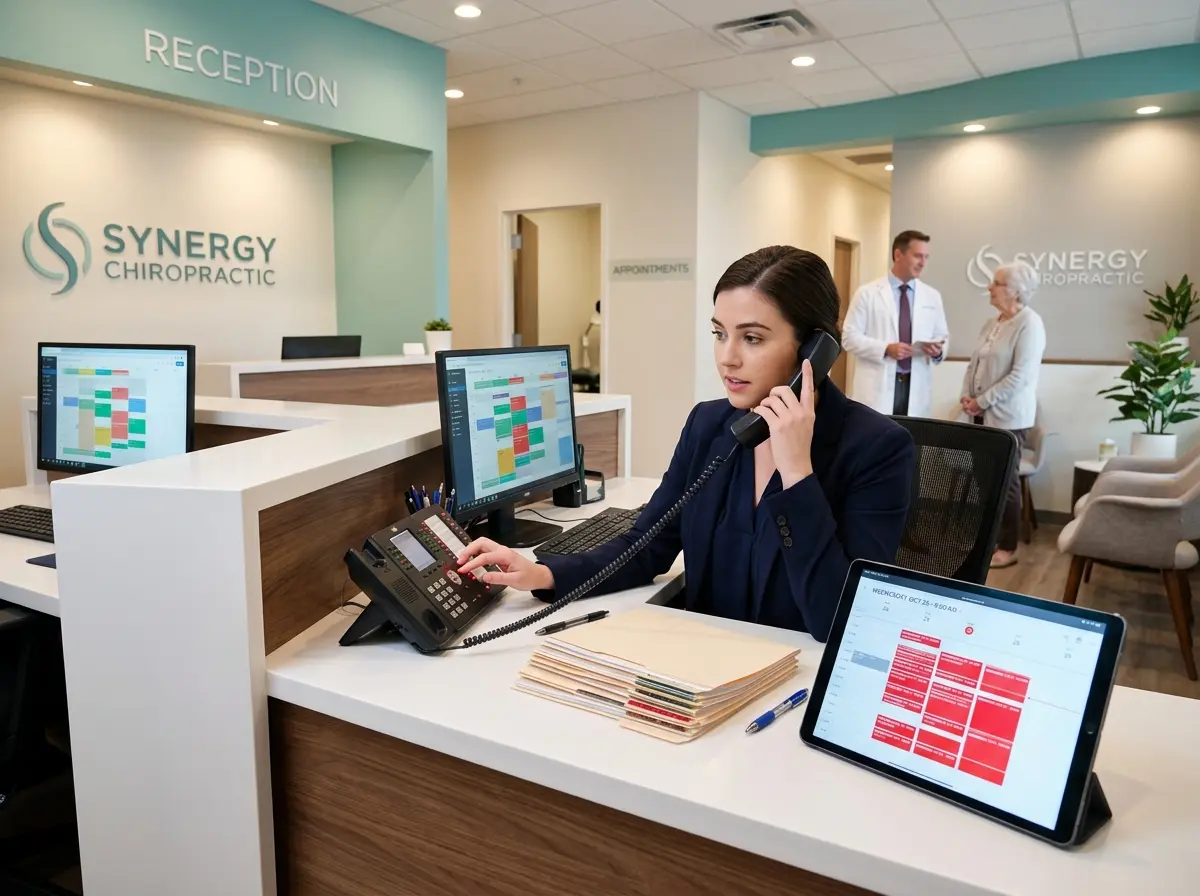
When "Just a Second" Turns Into a Scheduling Catastrophe
Picture this: your chiropractic office is humming along, patients are getting adjusted, and your front desk receptionist is doing the heroic work of simultaneously checking someone in, updating insurance information, and trying to answer the ringing phone — all while a new walk-in stands at the counter wondering if anyone notices them. Spoiler: they do notice, and they're already mentally Googling your competitor.
Appointment scheduling in chiropractic offices is one of those problems that looks manageable on the surface but quietly costs practices thousands of dollars every month in missed calls, double-bookings, no-shows, and frustrated patients who simply don't come back. According to a Software Advice survey, 94% of patients say they would switch to a new provider if that provider offered online booking — and yet many chiropractic offices are still running on phone tag and sticky notes.
The good news? This is an entirely solvable problem. The better news? You don't have to hire three more receptionists to solve it. Let's break down what's actually going wrong — and what you can do about it today.
The Real Reasons Your Scheduling Is Breaking Down
The Phone Is a Bottleneck, Not a Feature
The phone has been the primary scheduling tool in healthcare for decades, and it's showing its age. Every call that comes in while your receptionist is with a patient becomes a missed opportunity. Studies suggest that up to 67% of callers who reach a voicemail will hang up without leaving a message — and a significant portion of them will immediately call another practice. In a specialty like chiropractic where patients are often in acute pain or dealing with insurance referrals with tight timelines, the window to capture that appointment is very short.
Beyond missed calls, consider the time drain. A single scheduling call can take anywhere from three to eight minutes when you factor in confirming patient information, checking provider availability, explaining services, and walking a new patient through what to expect. Multiply that across a busy day, and your front desk staff is spending a substantial chunk of their shift just managing calendar logistics — leaving little bandwidth for the in-person experience that keeps patients loyal.
Inconsistent Intake Processes Create Downstream Chaos
New patient intake is another scheduling landmine. When intake forms aren't collected until the day of the appointment — or worse, handed to the patient on a clipboard in the waiting room ten minutes before they're supposed to be adjusted — you end up with delayed appointments, rushed clinical assessments, and frustrated providers. This isn't a people problem; it's a systems problem.
Inconsistent intake also creates data quality issues. Patient contact information entered differently across multiple systems, missing insurance details, and incomplete health history forms all slow down your billing cycle and increase claim denials. The scheduling problem and the intake problem are, in most practices, the same problem wearing different hats.
No-Shows and Cancellations Without a Real Recovery System
The average no-show rate in healthcare practices hovers around 18–20%, and chiropractic offices aren't immune. What makes it worse is that most practices don't have an active recovery protocol — when a patient cancels or simply doesn't show, that slot goes empty with no systematic effort to fill it from a waitlist or proactive outreach.
Automated reminders help, but they're only part of the solution. The other part is having a communication system that can actually respond when a patient replies to a reminder, asks to reschedule, or needs clarification on what to bring. A one-way reminder text does half the job. A responsive, conversational system does the whole job.
How the Right Tools (Including Stella) Can Help
Putting an AI Receptionist on the Front Lines
One of the most impactful changes a chiropractic office can make is ensuring that no phone call goes unanswered — ever. Stella, an AI robot employee and phone receptionist, handles incoming calls 24/7 with the same knowledge and professionalism as a trained staff member. She can answer questions about services, explain what a new patient can expect from their first visit, collect intake information conversationally before the appointment ever happens, and flag calls that need human attention for immediate forwarding.
For practices with a physical location, Stella also operates as an in-office kiosk, greeting patients who walk in, letting them know about current promotions or new service offerings, and handling routine questions so your front desk staff can focus on tasks that genuinely require a human touch. Her built-in CRM and conversational intake forms mean patient information is captured cleanly and consistently, reducing the clipboard chaos and giving your clinical team cleaner data before patients even sit down.
Building a Scheduling System That Actually Holds Up
Make Booking Frictionless From Every Entry Point
Modern patients want to book appointments the way they do everything else — on their own time, without waiting on hold. Offering online booking is now a baseline expectation, not a differentiator. But the implementation matters enormously. Your booking system needs to be linked directly to your live provider calendar, reflect accurate availability in real time, and send confirmation and reminder communications automatically without requiring staff to touch anything.
Think about every way a patient might try to reach you: phone call, website visit, social media message, walk-in. Each of those entry points should lead to a smooth, consistent scheduling experience. If three of the four work beautifully but your phone line goes to a voicemail at 5:01 PM, you're still losing patients on a regular basis. Audit your entry points honestly and patch the gaps.
Shift Intake to Before the Appointment
Pre-visit intake is one of the simplest operational changes with one of the highest returns. When a new patient schedules an appointment — whether online, by phone, or in person — they should immediately receive a link or a conversational prompt to complete their health history, insurance information, and consent forms before they ever walk through your door. This accomplishes several things simultaneously.
First, it shortens the in-office wait time and keeps your schedule on track. Second, it signals to the patient that your practice is organized and values their time — a meaningful first impression in a competitive market. Third, it gives your providers and billing team time to review information in advance, reducing surprises and increasing the likelihood of clean claims on the first submission. Pre-visit intake isn't a luxury feature; at this point, it's a competitive necessity.
Create a Real No-Show Recovery Protocol
A solid no-show recovery system starts with prevention: send appointment reminders at multiple touchpoints (48 hours out, 24 hours out, and a same-day reminder works well for most practices). But prevention won't catch every case, so you also need a response plan. When a patient cancels or no-shows, someone or something needs to reach out within a short window — ideally the same day — to reschedule them before they fall off your radar entirely.
Maintaining an active waitlist is equally important. If a slot opens up, you should be able to fill it quickly from patients who've already expressed interest in coming sooner. This requires a patient management system that makes waitlist communication easy and fast. The practices that recover no-show revenue are the ones that have systematized the response rather than leaving it to whoever happens to have a free moment.
Quick Reminder About Stella
Stella is an AI robot employee and phone receptionist built for businesses of all sizes — including chiropractic offices that are tired of missed calls, inconsistent intake, and front desk overwhelm. She answers phones around the clock, greets patients at your in-office kiosk, collects intake information through conversational forms, and manages patient contacts through a built-in CRM — all for $99 per month with no upfront hardware costs. She doesn't take lunch breaks, doesn't call in sick, and never puts a patient on hold to deal with something else.
Conclusion: Stop Letting Scheduling Quietly Drain Your Practice
The appointment scheduling crisis in chiropractic offices is real, but it's not inevitable. The practices that thrive are the ones that treat scheduling as a core operational system — not an afterthought managed by whoever picks up the phone. Here's where to start:
- Audit your current call handling. How many calls go unanswered each week? How many go to voicemail after hours? That number represents real revenue walking out the door.
- Implement pre-visit intake immediately. If you're still handing clipboards to new patients in the waiting room, fix that this week. The tools exist and they're not expensive.
- Build a no-show recovery protocol. Document the steps, assign ownership (or automate it), and track your recovery rate month over month.
- Ensure every scheduling entry point is covered. Phone, web, walk-in, and after-hours — all of them should lead to a consistent, professional experience for your patients.
You got into chiropractic care to help people feel better, not to untangle scheduling disasters at the end of every workday. With the right systems in place, you can spend a lot more time doing the former and a lot less time managing the latter. And that's a pretty good adjustment, if you'll pardon the expression.