Is Your Hold Music a Customer Repellent? Let's Talk.
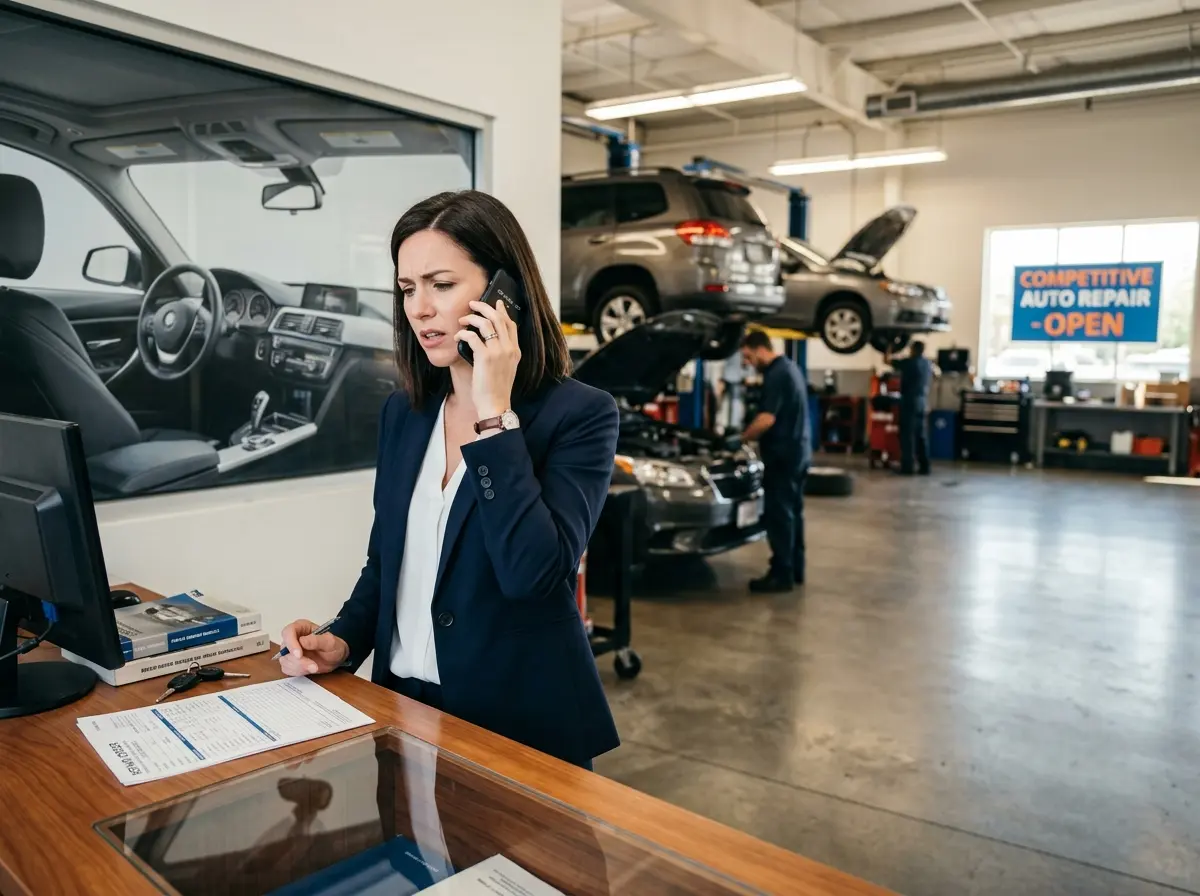
Picture this: a potential customer's car is making a noise that sounds like a small animal is trapped in the engine. They're stressed. They grab their phone, dial your auto repair shop, and then... they wait. And wait. Smooth jazz fills their ear. Maybe some light rock from 2003. Maybe just a repeating loop of your shop's phone number read aloud by someone who clearly did not want to be recording that day. By the time a human picks up — if one picks up at all — that customer has already Googled your competitor, scheduled an appointment online, and mentally moved on.
This scenario plays out hundreds of times a day at auto repair shops across the country, and most shop owners have no idea it's happening. You're focused on the cars in the bays, the technicians on the floor, and the parts on order. The phone? That's someone else's problem. Except when "someone else" is already elbow-deep in a transmission, the phone becomes nobody's problem — and your customer becomes somebody else's customer.
The good news is that fixing your phone experience doesn't require hiring a full-time receptionist, overhauling your entire operation, or enduring another debate about hold music playlists. It just requires a smarter approach to how your shop handles the first — and most critical — point of contact.
The Real Cost of a Bad Phone Experience
Missed Calls Are Missed Revenue
Here's a number worth sitting with: according to various customer experience studies, roughly 85% of customers whose calls go unanswered will not call back. They assume you're too busy, too disorganized, or simply not interested in their business. In the auto repair world, where a single service ticket can range from a $50 oil change to a $3,000 transmission job, every missed call is a potentially significant chunk of revenue walking out the door before it ever walked in.
And it's not just about missed calls in the literal sense — calls that ring out with no answer. It's also about calls that technically get answered but are immediately placed on hold, met with a distracted "can you hold?" or fumbled by a service writer who's trying to write up two cars at once. The customer experience begins the moment they dial, and first impressions are notoriously difficult to undo.
The Loyalty Problem Nobody's Talking About
Auto repair is, at its core, a trust-based business. Customers are handing you their vehicles — often their primary mode of transportation, their lifeline to work and family — and trusting you to fix them competently and honestly. That trust doesn't start when the car pulls into the bay. It starts on the phone.
When someone calls and experiences confusion, long hold times, or a rushed interaction with a distracted staff member, they don't just choose another shop this time. They mentally recategorize your business as one that doesn't have its act together. Repeat business and referrals — the lifeblood of any repair shop — are quietly eroded by an experience most owners never even think to measure.
What Customers Actually Expect When They Call
Today's customers have been conditioned by Amazon, Uber, and every app on their phone to expect fast, accurate, frictionless service. When they call an auto shop, they want to know: Do you handle the type of repair I need? How soon can I get an appointment? What's it going to cost me, roughly? How long will it take? These are not complicated questions. But if your phone system can't answer them quickly and confidently — because the person who picks up is juggling three other tasks — the customer experience suffers, and so does your bottom line.
How Smarter Phone Handling Changes Everything
Let Technology Do the Heavy Lifting
This is where it's worth having an honest conversation about what AI can actually do for an auto shop's front-of-house experience. Stella, an AI robot employee and phone receptionist, is designed specifically for businesses that need a reliable, knowledgeable, and always-available customer-facing presence — without the overhead of additional staff.
For auto repair shops, Stella answers incoming calls 24/7, responds to questions about services, pricing, hours, and policies, and collects customer intake information conversationally — the kind of details your service writers would normally have to gather manually. She can forward calls to your team based on conditions you set, or handle straightforward inquiries entirely on her own. When she takes a voicemail, she doesn't just record it — she generates an AI summary and sends a push notification to your manager so nothing falls through the cracks. Her built-in CRM even logs customer contact details, interaction history, and AI-generated profiles so your team always has context before picking up the phone.
At $99/month with no upfront hardware costs, it's the kind of solution that pays for itself the first time it catches a call your team would have missed on a busy Saturday morning.
Fixing Your Front-of-House: Practical Steps for Auto Shop Owners
Audit Your Current Call Experience Right Now
Before you can fix the problem, you need to actually experience it. Call your own shop. Do it during a busy period — a Monday morning, a lunch rush, a Saturday. Notice how long it takes to be answered. Notice what happens if the line is busy. Notice whether the person who picks up sounds helpful or harried. Then call one of your top competitors and compare the two experiences side by side.
Most shop owners who do this exercise are genuinely surprised — not always pleasantly — by what they find. It's a five-minute investment that can completely reframe how you prioritize your customer communication strategy.
Set Clear Standards for Phone Interactions
If human staff are handling calls, they need a clear, consistent framework for doing so well. This means establishing standards for how quickly calls must be answered, what information needs to be collected from every caller, how to handle calls when the shop is at peak capacity, and what to do when a call comes in after hours. Without these standards, you're leaving the quality of your customer's first impression entirely to chance — and to whoever happened to pick up the phone that day.
Document these standards. Train to them. And then build systems that enforce them even when your best service writer is in the middle of diagnosing a check engine light and simply cannot get to the phone.
Think Beyond Business Hours
A significant portion of car trouble doesn't happen between 8 AM and 5 PM, Monday through Friday. People notice warning lights on their evening commute. They hear strange sounds on Sunday afternoon. They make mental notes to call the shop — and then they forget by the next morning, or they call that evening when nobody answers and end up booking somewhere that had an online form or an after-hours answering solution. Extending your effective availability beyond traditional business hours, even through automated systems, captures customer intent at its peak and converts it into appointments rather than lost leads.
Quick Reminder About Stella
Stella is an AI robot employee and phone receptionist that works 24/7, never puts customers on hold with questionable jazz, and handles everything from answering service questions to collecting intake information to forwarding calls to your team. She also operates as an in-store kiosk for shops that want a customer-facing presence on the floor. At $99/month with no upfront costs, she's worth a look for any shop owner tired of losing customers to the phone.
Time to Stop Losing Customers to the Hold Button
Your auto repair shop's reputation is built on the quality of your work — but customers can only experience that quality if they actually book an appointment. Every dropped call, every long hold, every after-hours voicemail that disappears into the void is a gap between your reputation and your revenue.
The actionable next steps are straightforward. First, call your own shop and experience it as a customer would. Second, identify the biggest gaps — missed calls, hold times, after-hours coverage, inconsistent information. Third, decide whether those gaps are best closed by retraining staff, restructuring your phone workflow, or introducing an AI phone solution that handles the load your team simply can't. Fourth, implement and measure — track call volume, appointment conversion, and customer feedback before and after any changes.
The shops winning the customer experience game in auto repair aren't necessarily the ones with the best mechanics or the lowest prices. They're the ones that make it easy to do business with them from the very first interaction. That first interaction, more often than not, is a phone call. Make it count.