The Invisible Leak That's Costing You Patients
You've done everything right. Your practice is well-staffed, your equipment is up to date, your optometrists are excellent, and your waiting room has those little paper cups of water that make everything feel slightly more upscale. And yet, somehow, new patients aren't converting the way they should be. You're spending money on ads, maybe even getting decent call volume — but the chairs aren't filling up the way the math suggests they should.
Here's an uncomfortable truth: most optometry practices have a conversion problem that exists entirely between the moment a prospective patient first reaches out and the moment they walk through the front door. That gap — the phone call, the follow-up, the first impression, the intake process — is where patients quietly disappear, usually without a word of explanation. They just... go find someone else. Someone whose phone got picked up. Someone whose front desk didn't put them on hold for four minutes while dealing with an insurance dispute.
The good news? This is a solvable problem. And it doesn't require hiring three more people or performing a complete operational overhaul. Let's walk through where the leak actually is — and how to plug it.
Where New Patients Are Actually Dropping Off
The Phone Call No One Answered
Studies consistently show that missed calls are one of the leading causes of lost patients in healthcare. One report from Software Advice found that nearly 70% of patients who couldn't reach a provider's office by phone simply moved on to a competitor without leaving a message. Think about that. No voicemail. No callback number. Just gone.
Optometry practices are particularly vulnerable to this because call volume is unpredictable. Mondays are chaos. Lunchtime is chaos. The hour before closing is somehow also chaos. Your front desk staff — who are doing genuinely heroic work managing check-ins, insurance verifications, phone calls, and the occasional patient who insists their frames were "definitely ready" even though they weren't ordered yet — cannot be everywhere at once. And when a call goes unanswered at 7:30 PM on a Tuesday because your office is closed, that prospective patient has already Googled your competitor before the second ring finishes.
The fix isn't just about availability, though. It's about what happens when the call is answered. A rushed, distracted greeting from an overloaded front desk staff member doesn't inspire confidence. Patients are making a judgment call about whether they trust your practice within the first sixty seconds of interaction.
The Online-to-Phone Disconnect
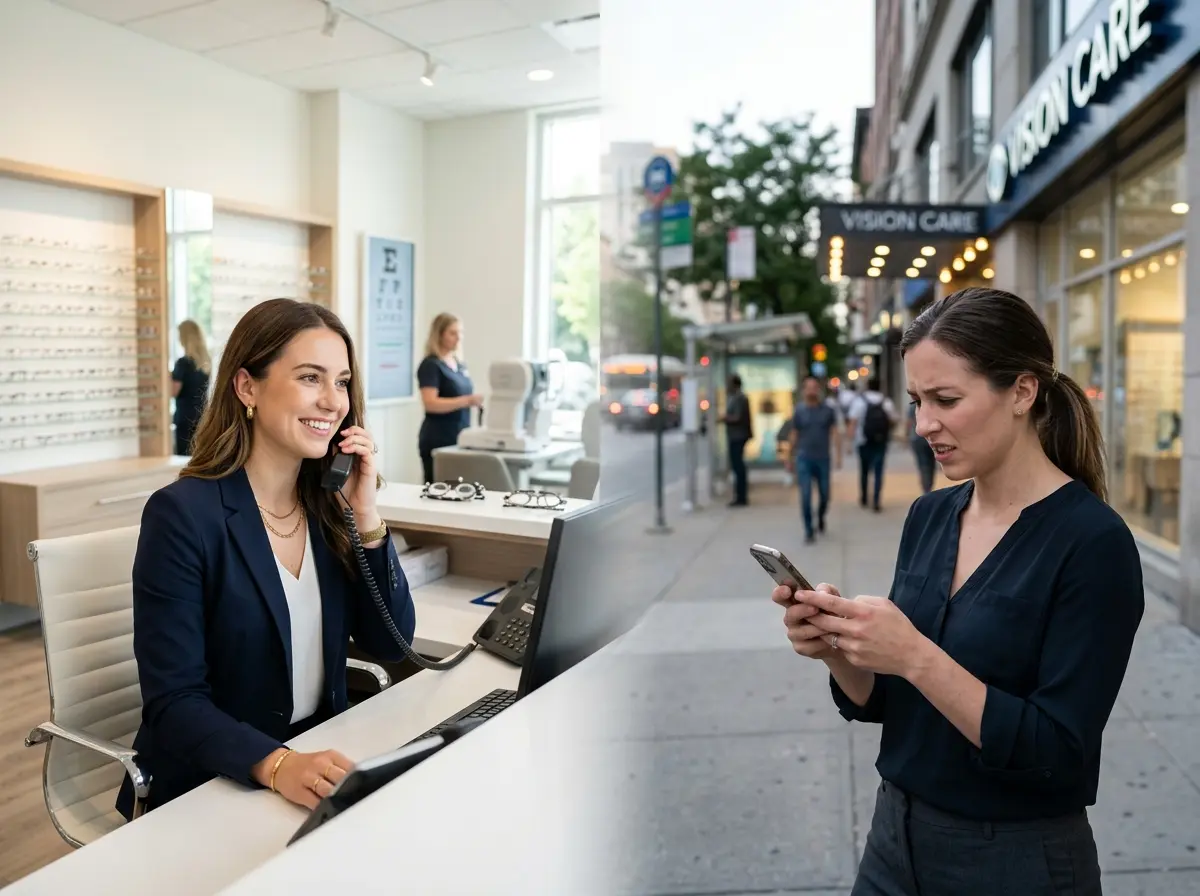
Here's a scenario that plays out in thousands of practices every week. A potential patient sees your Google ad, clicks through to your website, reads about your services, gets excited, and calls your office. Your front desk answers, but they're mid-check-in with someone else. The caller gets a quick, clipped response, is put on hold, and then — because humans have a remarkable capacity for impatience when they're already slightly anxious about their eye health — they hang up.
The disconnect between your polished online presence and the reality of a busy front desk is jarring. You've invested in marketing to get them to pick up the phone. But the experience they get when they call should match the professionalism of everything else they've seen. When it doesn't, the trust you've built evaporates instantly.
The Intake Process That Feels Like Homework
Even when a patient does successfully schedule an appointment, there's another drop-off point that often goes unexamined: the intake process. Sending patients a link to a PDF that they have to print, fill out by hand, and remember to bring to their appointment is — let's be honest — a relic of the early 2000s that has no business being anyone's first experience with your practice. Complicated, friction-heavy intake processes cause patients to show up unprepared, arrive late, or quietly reschedule indefinitely until they forget you exist.
Streamlining how you collect patient information before they ever walk through your door not only saves chair time, it signals to new patients that your practice is organized, modern, and respects their time. That first impression matters enormously in a competitive local market.
A Smarter Front Line: Technology That Actually Helps
Closing the Gap With AI That Works Around the Clock
This is where Stella comes in. Stella is an AI robot employee and phone receptionist designed to handle exactly the kind of communication gaps that cause optometry practices to lose new patients in the first place. On the phone side, she answers calls 24/7 with full knowledge of your services, hours, insurance policies, promotions, and appointment availability — giving every caller a professional, helpful interaction whether it's 2 PM on a Wednesday or 8 PM on a Saturday.
Stella also handles conversational intake through phone calls and web-based forms, collecting patient information naturally before they arrive — no PDFs, no fax machines, no hoping they remember their insurance card. Her built-in CRM stores patient contact details with custom fields, notes, and AI-generated profiles, so your team has everything they need before a new patient ever sits down in your chair. For practices with a physical location, she also operates as a friendly in-store kiosk, greeting walk-ins and answering common questions so your front desk staff can stay focused on what actually requires a human touch.
Building a Patient Experience That Converts
Fix the First Impression Before They Arrive
Converting a new patient isn't just about having a great optometrist — it's about the entire journey from first contact to first appointment. And that journey needs to feel intentional. Start by auditing your own practice from a patient's perspective. Call your own number during a busy period. Try to schedule an appointment online. Go through the intake process as a new patient would. You may be surprised — and slightly horrified — by what you find.
Some practical improvements that consistently improve conversion rates in medical and vision practices include:
- Same-day or next-day appointment availability for new patients where possible — patients looking for a new optometrist often need one soon.
- Confirmation and reminder communications via text or email that include clear instructions on what to bring and what to expect.
- A consistent, warm tone across every touchpoint, from your website copy to your hold music to the greeting patients receive when they walk in.
Train Your Team on the Phone As Much As In Person
Front desk staff in optometry practices receive significant training on scheduling software, insurance processing, and frame inventory. Phone skills training? Often an afterthought. This is a meaningful gap. The way a call is answered, how questions are handled, whether the team member sounds engaged or exhausted — all of it shapes a potential patient's willingness to follow through on booking.
Consider implementing brief weekly role-play exercises where staff practice handling common caller scenarios: patients asking about insurance, confused callers who aren't sure if they need a comprehensive exam or just a contact lens fitting, and the occasional very opinionated caller who wants to discuss why their previous optometrist "just didn't get them." Building muscle memory around warm, helpful phone interactions is one of the highest-ROI investments a front desk team can make.
Follow Up Like You Mean It
A significant number of prospective patients who express interest — calling to ask about services, submitting a contact form, or even starting the booking process — never actually schedule because no one followed up. They got busy. They got distracted. They forgot. Life happened. A simple, well-timed follow-up — whether it's an automated text, a brief callback, or an email — can recover a substantial portion of those almost-patients.
The key is making follow-up systematic rather than dependent on someone remembering to do it. When follow-up lives in someone's head rather than a reliable system, it happens inconsistently at best and not at all during your busiest weeks. Build it into your process so that no expressed interest slips through the cracks without at least one thoughtful nudge.
A Quick Note on Stella
Stella is an AI robot employee and phone receptionist built for businesses exactly like yours — available 24/7, always professional, and never in need of a lunch break or a pep talk on a Monday morning. At $99/month with no upfront hardware costs, she's designed to be genuinely accessible for independent and small group practices. Whether she's answering phones after hours or greeting patients at a kiosk in your lobby, she keeps your practice looking sharp when your team can't be everywhere at once.
What to Do Starting This Week
The patient leak between the phone and the front door is real, it's measurable, and — most importantly — it's fixable. Here's where to start:
- Call your own practice during peak hours and after closing. Experience exactly what a new patient experiences. Take notes.
- Audit your intake process end to end. If it involves a PDF or a fax, it's time for an upgrade.
- Implement a follow-up system for anyone who expresses interest but doesn't schedule within 48 hours. Even a single automated text can recover lost bookings.
- Invest in phone experience training for your front desk team — even 20 minutes a week adds up quickly.
- Consider AI support for the hours and call volume your team can't cover alone. The cost of missed calls is almost certainly higher than the cost of a solution.
Your optometry practice is probably better than a new patient's first phone interaction suggests. Closing that gap is less about overhauling everything and more about systematically patching the small, fixable moments where interest turns into indifference. Start there, and the chairs will follow.