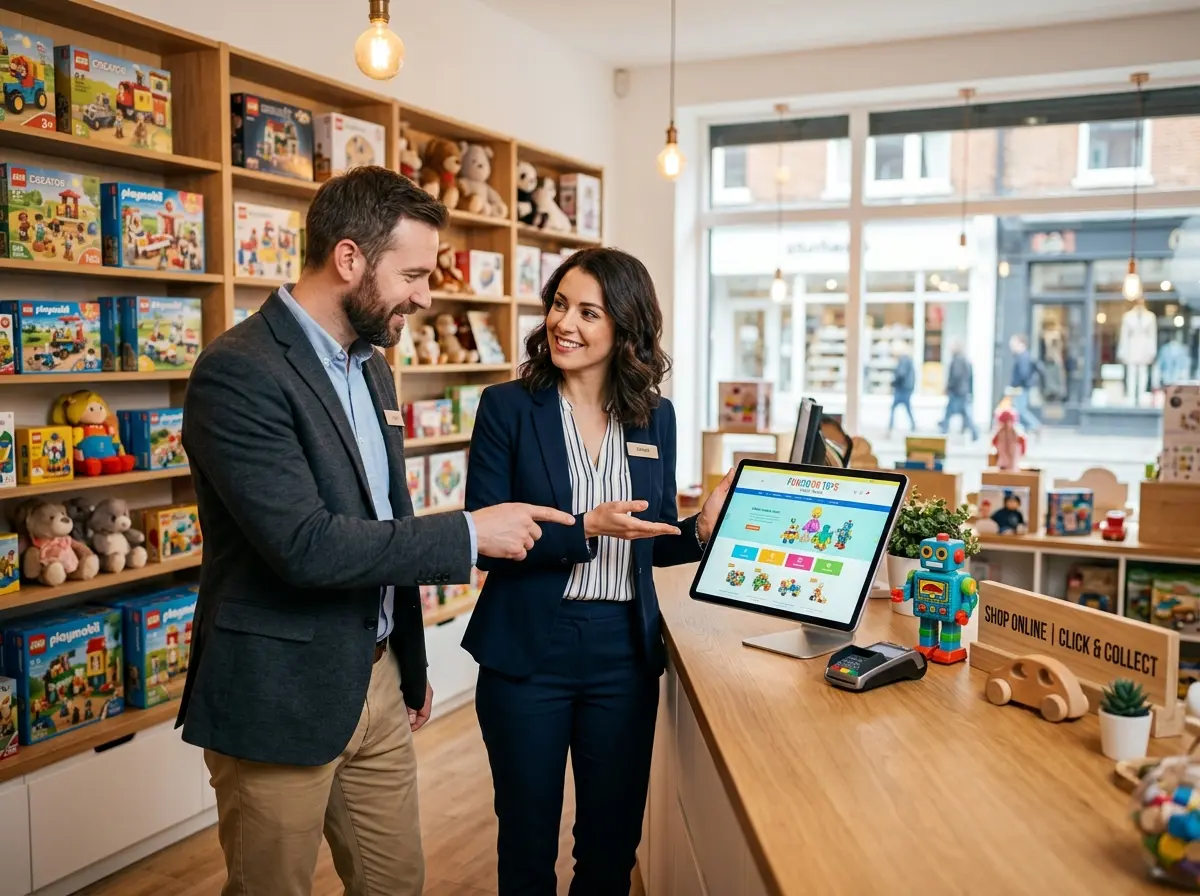
Introduction: Your Toy Store Deserves More Than a Digital Afterthought
Let's be honest — if your toy store's website is just a glorified business card with your hours and a blurry photo of your storefront, you're leaving serious money on the table. In an era where parents are Googling "best STEM toys for 7-year-olds" at 11pm while their kids are (supposedly) asleep, your e-commerce site isn't just a nice-to-have. It's a revenue channel, a brand ambassador, and a 24/7 sales associate all rolled into one.
Here's the good news: you don't have to choose between your beloved brick-and-mortar shop and a thriving online presence. The smartest toy store owners are building e-commerce experiences that complement their physical stores — driving foot traffic online to offline and vice versa, creating a seamless experience that keeps customers coming back whether they're browsing on their couch or wandering your aisles. According to the Harvard Business Review, omnichannel customers spend an average of 4% more in-store and 10% more online than single-channel customers. So yes, this is absolutely worth your attention.
This guide will walk you through exactly how to build an engaging e-commerce site that doesn't cannibalize your in-store sales — but amplifies them.
Building an E-Commerce Foundation That Works for Toy Stores
Choose the Right Platform (Not Just the Cheapest One)
Choosing an e-commerce platform is like choosing a toy for a child — you need the right fit for the right stage of development. Shopify is a strong all-around contender for most toy stores, offering robust inventory management, easy product variants (think: different sizes, colors, age ranges), and a healthy ecosystem of apps. WooCommerce is a solid choice if you're already running a WordPress site and want more control. BigCommerce is worth considering if you're planning to scale aggressively.
What matters most for a toy store specifically is the ability to handle seasonal inventory surges (hello, holiday madness), age-based filtering so parents can find appropriate products quickly, and gift messaging options because let's face it — most toys are bought as gifts. Whatever platform you choose, make sure it integrates with your point-of-sale system so your in-store and online inventory stay in sync. Running out of the hottest toy of the season online while you have 40 units collecting dust in the back room is the kind of thing that keeps business owners up at night.
Product Pages That Actually Sell
A product page with a single stock photo and a manufacturer's description is not going to cut it. Parents are researching purchases carefully — they want to know if a toy is durable, age-appropriate, educational, and worth the price tag. Your product pages should do the heavy lifting here.
Invest in original photography that shows the toy in action — ideally with kids playing with it (with proper permissions, of course). Write descriptions that speak to both the parent's practical concerns and the child's sense of wonder. Highlight safety certifications, age recommendations, and key developmental benefits. Include customer reviews prominently, because 93% of consumers say online reviews impact their purchasing decisions. And don't forget to cross-link related products — if someone's looking at a building set, show them compatible expansion packs. That's not pushy selling; that's helpful curation.
Seamless Inventory Sync Between Online and In-Store
Nothing erodes customer trust faster than ordering something online only to get an email saying it's out of stock. For toy stores running both channels, real-time inventory synchronization is non-negotiable. Tools like Lightspeed, Square for Retail, or Shopify POS can bridge your physical and digital inventory elegantly. Beyond avoiding embarrassing stockout emails, synced inventory also enables powerful features like "buy online, pick up in store" (BOPIS) — a feature that's grown enormously popular and gives customers the best of both worlds while driving foot traffic to your physical location.
Using Smart Technology to Enhance Both Channels
Let AI Handle the Repetitive Stuff So You Can Focus on the Fun Stuff
Running a toy store — both online and offline — means fielding an endless stream of questions: "Do you have this in stock?" "What's your return policy on opened toys?" "Is this appropriate for a 4-year-old?" Multiply that by the holiday season and you've got a customer service situation that can overwhelm even the most energetic team. This is exactly where Stella, the AI robot employee and phone receptionist, becomes a genuine asset for toy store owners.
In your physical store, Stella stands as a human-sized AI kiosk that proactively greets customers, answers product questions, highlights current promotions, and even upsells related items — all without pulling your staff away from the sales floor. At the same time, she's answering your phone calls 24/7 with the same product knowledge she uses in person, so the parent calling at 9pm to ask about holiday gift options gets a helpful, accurate response instead of voicemail. For a business juggling both online and in-store operations, having a consistent, knowledgeable presence across every customer touchpoint is a significant competitive advantage — and at $99/month, it's hard to argue with the math.
Driving Traffic Between Your Online Store and Physical Location
Make "Click and Collect" a Core Part of Your Strategy
Buy online, pick up in store isn't just a convenience feature — it's a traffic driver with remarkable upsell potential. Research from the International Council of Shopping Centers found that 69% of shoppers who used BOPIS made additional purchases while in the store to pick up their order. For a toy store, that means a parent who ordered a birthday present online walks in to collect it and walks out with wrapping paper, a card, and "oh, while I'm here" impulse buys they didn't plan on.
To make BOPIS work well, create a dedicated pickup area in your store that's easy to find, train staff on fast order retrieval, and send clear confirmation emails with pickup instructions. Consider including a small promotional insert in pickup orders — a coupon for their next in-store visit or a note about an upcoming in-store event. The goal is to make the online-to-offline transition feel intentional and welcoming, not like an afterthought.
Use Your Website to Promote In-Store Experiences
Your physical toy store has something that Amazon categorically cannot replicate: the experience. Kids touching toys, parents watching their children light up, the smell of fresh cardboard, a knowledgeable staff member making the perfect recommendation. Your e-commerce site should actively promote this. Feature your in-store events (toy demos, game nights, holiday photo ops with a beloved character), highlight your expert staff picks, and create content that celebrates what makes shopping with you special.
A dedicated "Events" page, a blog with toy recommendations from your team, or even short video tours of your store all serve to remind online shoppers that there's a real, wonderful place they can visit. This kind of content builds loyalty and positions your store not just as a retailer, but as a destination — which is increasingly the only sustainable advantage an independent toy store has over the retail giants.
Leverage Email Marketing to Connect Both Worlds
Email remains one of the highest-ROI marketing channels available to small businesses, and for toy stores it's particularly powerful given the gift-driven nature of the business. Build your email list through both channels — offer a small discount for signing up online, and have a tablet or sign-up sheet at your register in-store. Segment your list so you can send targeted messages: exclusive online deals for your digital shoppers, event invitations for your local customers, and birthday or holiday reminders timed around key dates.
Platforms like Klaviyo (excellent for e-commerce integration) or Mailchimp (simpler, great for smaller lists) make it straightforward to automate campaigns and personalize messaging. A well-timed email in October reminding parents that the holiday shopping season is right around the corner — with a link to your gift guide — is the kind of touchpoint that turns occasional buyers into loyal regulars.
Quick Reminder About Stella
Stella is an AI robot employee and phone receptionist designed to give businesses a reliable, professional presence around the clock. She greets customers in your physical store, answers phone calls 24/7, promotes deals, handles common questions, and collects customer insights — all for just $99/month with no upfront hardware costs. For a toy store navigating both in-store and online channels, she's the kind of always-on team member who genuinely never calls in sick during the holiday rush.
Conclusion: Your Next Steps Toward Omnichannel Success
Building an e-commerce site that complements your physical toy store isn't about going digital at the expense of what makes your store special. It's about creating more ways for customers to discover you, engage with you, and buy from you — on their terms. The stores that thrive in today's retail environment aren't choosing between online and in-person; they're making both work together in a way that multiplies the impact of each.
Here's where to start:
- Audit your current website — Is it mobile-friendly? Does it accurately reflect your inventory? Are your product pages compelling and informative?
- Implement inventory sync — Connect your POS and e-commerce platform so stock levels are always accurate across both channels.
- Launch a BOPIS option — Even a simple "order online, pick up today" feature can meaningfully increase both online conversions and in-store foot traffic.
- Start building your email list — Both in-store and online, actively collect customer emails and begin sending regular, valuable communications.
- Invest in the right support tools — Whether that's better photography, smarter marketing automation, or an AI kiosk and phone receptionist to handle customer interactions while you focus on strategy.
Your toy store already has the heart. Now it's time to give it the digital infrastructure to match. The competition isn't standing still, but neither are you — and with the right tools in place, you'll be ready for every season, every customer, and every question that comes your way.