Introduction: The Review Gap Nobody Talks About
Here's an uncomfortable truth: most of your happiest customers will say nothing online, while one mildly frustrated person will craft a Shakespearean tragedy on Google Reviews. It's not fair. It's not logical. But it is the reality of running a home services business in the digital age.
For home services companies — think HVAC, plumbing, lawn care, cleaning, pest control, you name it — reputation is everything. You're sending strangers into people's homes, after all. Trust is the product, and online reviews are the proof. Yet most companies finish a job, wave goodbye, and then hope that satisfied customers will take five minutes out of their day to leave a glowing review. Spoiler: they won't. Not unless you ask.
This is the story of how one home services company stopped leaving reviews to chance, built a simple post-job survey workflow, and used it to both capture 5-star reviews and catch unhappy customers before they could churn — or worse, vent publicly. The best part? The whole system is repeatable, scalable, and doesn't require hiring a full-time customer success manager.
The Problem: Silence After the Service Call
Happy Customers Are Quiet Customers (By Default)
Research consistently shows that customers who have a negative experience are two to three times more likely to leave a review than customers who had a great one. That asymmetry is brutal for service businesses. You could complete 50 flawless jobs and one botched appointment, and your Google profile starts looking like that one job defined your entire company.
The issue isn't customer satisfaction — it's customer activation. Happy customers feel good, tip the technician, and move on with their lives. They're not sitting around thinking, "I should really tell the internet about how well that guy fixed my garbage disposal." You have to nudge them — at exactly the right moment, with exactly the right ask.
Churn Hides in Plain Sight
For recurring home services — lawn care, house cleaning, pest control — churn is the silent killer. A customer doesn't always call to cancel. They just... stop scheduling. They ghost you. By the time you notice, they've already hired your competitor and moved on. The frustrating part is that many of these customers had a fixable complaint. The technician was late. The communication was poor. Something small went sideways, and nobody followed up.
A post-job survey doesn't just collect reviews — it opens a communication channel after every single appointment. That's your early warning system. A customer who gives you a 3-star internal rating and mentions "the team left a mess in the backyard" is a customer you can still save. But only if you catch them before they walk out the door for good.
The Case Study: A Regional Lawn Care Company Gets Strategic
A mid-sized lawn care company operating across three suburban markets was averaging around 3.8 stars on Google — not terrible, but not exactly the kind of rating that makes a homeowner choose you over the competitor with 4.7 stars and 200 reviews. Their technicians were doing solid work. The disconnect was purely in the follow-up. They had no post-job process. Jobs were completed, invoices were sent, and that was it.
They implemented a two-stage post-job survey sent via SMS within two hours of job completion. The first question was a simple 1-to-5 satisfaction rating. If the customer rated 4 or 5, they were immediately prompted with a direct link to leave a Google review. If they rated 1, 2, or 3, the survey branched to ask what went wrong — and a customer service rep received an instant alert to follow up personally within the hour. Within 90 days, their Google rating climbed to 4.6 stars, and their monthly churn rate dropped by 22%.
How to Build Your Own Post-Job Survey System
Timing and Delivery Are Everything
The survey has to land when the experience is still fresh and the customer is still in a positive emotional state — ideally within one to two hours of job completion. Send it too late and the moment has passed. The preferred delivery method for most home services customers is SMS, which sees open rates north of 90%, compared to email's modest 20-30%. Keep the initial message short, warm, and personal-feeling even if it's automated. Something like: "Hi [Name], thanks for having us out today! Mind taking 30 seconds to share how it went?"
The Two-Path Survey Design
The magic of an effective post-job survey is the branching logic. It's not just a feedback form — it's a triage system. Here's how to structure it:
- Step 1: Ask one simple question — a satisfaction rating from 1 to 5.
- Step 2 (for ratings 4-5): Display a message thanking them and provide a direct link to your Google Business Profile review page. Make it one tap.
- Step 2 (for ratings 1-3): Ask a brief open-ended follow-up: "We're sorry to hear that — what could we have done better?" Then route this response to a manager immediately.
This approach accomplishes two things simultaneously: it amplifies your best experiences publicly while containing your worst ones privately. You're not suppressing negative feedback — you're intercepting it so you can address it like a professional before it becomes a 1-star rant about your company's character.
Where Technology Can Carry the Load
Automating the Follow-Up Without Losing the Human Touch
One of the biggest barriers to implementing a post-job survey system is the operational overhead. Someone has to send the surveys, monitor the responses, flag the unhappy customers, and route the alerts. For a small team already juggling scheduling, billing, and actual service delivery, that's a tall order.
This is where tools like Stella — the AI robot employee and phone receptionist — can quietly do a lot of heavy lifting in the background. Stella's built-in CRM and intake form capabilities make it straightforward to capture customer information during the initial booking call or through a web-based intake flow, ensuring every customer record is complete and tagged appropriately before the job even starts. When your post-job survey response comes in, having a clean, organized contact record means the right person gets alerted, the interaction gets logged, and nothing falls through the cracks.
Stella also handles inbound calls 24/7, which matters more than it might seem in this context. Unhappy customers who don't fill out your survey will sometimes just call — and they'll call at 7pm on a Friday. Having Stella answer professionally, take down their concern with an AI-generated summary, and immediately notify a manager means you're not losing that recovery opportunity just because nobody was at the desk.
Turning Survey Data Into Business Intelligence
Track Patterns, Not Just Individual Scores
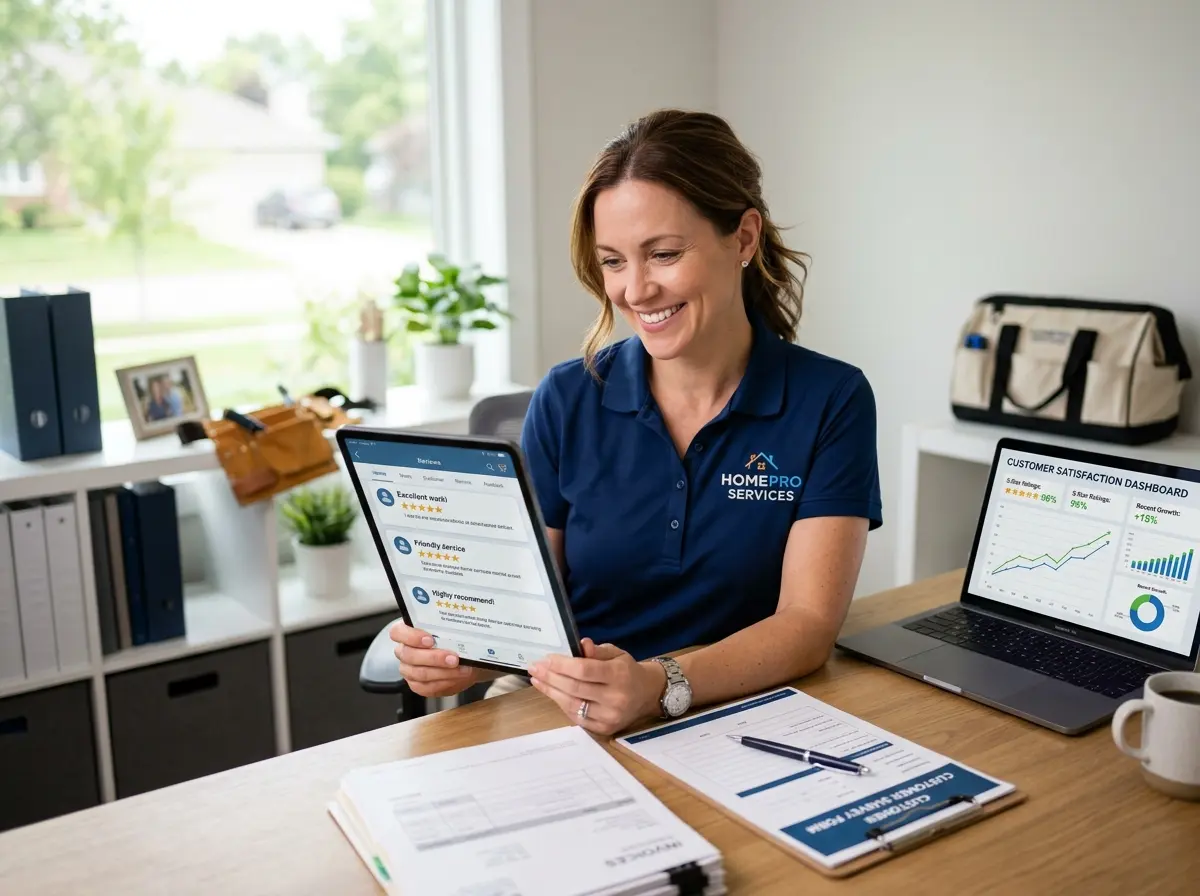
A single 3-star review tells you one customer was unhappy. A pattern of 3-star reviews all mentioning "arrival time" tells you you have a scheduling problem. The real value of a post-job survey system isn't any individual response — it's the aggregate data over weeks and months. Are complaints clustering around a specific technician? A specific type of job? A specific day of the week? That's operational intelligence you can act on.
Build a simple dashboard — even a spreadsheet works in the beginning — that tracks average satisfaction scores by technician, service type, and time period. Review it monthly. You'll start to see the signal through the noise, and you'll make better hiring, training, and scheduling decisions as a result.
Use Positive Responses as Marketing Fuel
Your post-job surveys are also a content goldmine that most businesses completely ignore. When a customer responds with enthusiastic written feedback — even just a sentence or two — that's testimonial material. With their permission, those responses can become website quotes, social media posts, or case study snippets. The customer who says "Your team was on time, professional, and left my yard looking incredible" just handed you a marketing asset. Don't waste it.
Close the Loop With Every Respondent
Whether the feedback is glowing or critical, respond to it. For unhappy customers, this is non-negotiable — a personal call or message acknowledging the issue and offering a resolution can turn a churning customer into a loyal one. For happy customers, a brief thank-you message ("We saw your kind words — thank you so much, it means a lot to the team!") reinforces the relationship and makes them more likely to book again. This is the step most businesses skip, and it's the step that separates companies with 4.8-star reputations from everyone else.
A Quick Reminder About Stella
Stella is an AI robot employee and phone receptionist that works for businesses both as a physical kiosk inside your location and as a 24/7 phone answering solution. She handles calls, collects customer information through conversational intake forms, manages contacts through a built-in CRM, and keeps your business running professionally even when your team is off the clock — all for $99 per month with no upfront hardware costs. For home services companies juggling leads, bookings, and follow-ups, she's the kind of employee who never calls in sick and never misses a message.
Conclusion: Stop Hoping and Start Asking
The home services companies that dominate their local markets on Google aren't necessarily doing better work than their competitors. Often, they're just doing better follow-up. A thoughtful post-job survey system is one of the highest-leverage investments you can make in your reputation — and it costs far less than the business you're losing to competitors with shinier review profiles.
Here's what to do this week:
- Choose your survey tool. SMS-based platforms like Podium, NiceJob, or even a simple Typeform with branching logic will get you started.
- Write your two-path survey. One satisfaction question, two branches — reviews for the happy, recovery for the unhappy.
- Set up your alert system. Any rating under 4 should trigger an immediate notification to a manager, not a weekly digest.
- Audit your CRM. Make sure every customer contact is complete and properly tagged so your follow-up feels personal, not robotic.
- Review your data monthly. Look for patterns, celebrate wins, and fix what keeps showing up.
Your customers are already forming opinions about your business after every single job. The only question is whether you're going to be part of that conversation — or just find out about it later on Google.