The Waiting Room: Where Time Slows Down and Anxiety Speeds Up
Let's be honest — nobody loves waiting rooms. They're the purgatory of the healthcare experience: fluorescent lights humming overhead, a TV stuck on a news channel nobody asked for, and a pile of magazines from 2019 that have somehow survived three pandemics. For physical therapy patients in particular, who are often already dealing with pain, recovery stress, or post-surgical nerves, that waiting room experience sets the tone for everything that follows.
Here's the thing most practice owners miss: the waiting room is clinical real estate. It's not just a holding pen — it's the first chapter of your patient's therapeutic journey. And if that chapter reads like a horror novel, you've got a problem on your hands before your therapist even says "hello."
So what happens when a physical therapy office decides to actually think about its waiting room design? Spoiler: patient anxiety drops, satisfaction scores climb, and the whole practice feels more professional and calming. Let's walk through exactly how it's done.
The Psychology Behind Patient Anxiety in Waiting Rooms
Before you can fix something, it helps to understand why it's broken. Waiting room anxiety in physical therapy settings is a well-documented phenomenon, and it's not just patients being dramatic. Research from the Journal of Environmental Psychology has consistently shown that physical environments have a measurable impact on stress levels, pain perception, and overall health outcomes. In other words, your decor is literally affecting how much pain your patients feel. No pressure.
The Uncertainty Factor
One of the biggest drivers of waiting room anxiety isn't the wait itself — it's the uncertainty of the wait. Patients who are told "it'll be about 15 minutes" consistently report lower anxiety than patients left to wonder indefinitely, even when the actual wait time is identical. The human brain handles discomfort far better when it knows what to expect. Unclear signage, no visible staff, and zero communication about wait times are anxiety accelerators hiding in plain sight.
Sensory Overload vs. Sensory Deprivation
Waiting rooms tend to fall into one of two dysfunctional camps: either they're aggressively stimulating (blaring televisions, competing conversations, harsh lighting) or depressingly sterile (blank white walls, silence so thick you could cut it with a scalpel). Both extremes are stressful, just for different neurological reasons. The sweet spot — which evidence-based design calls restorative environment theory — involves moderate sensory engagement: soft natural light, gentle background sound, organic textures, and a sense of visual flow that calms rather than overwhelms.
The Trust Signal Problem
Patients entering a physical therapy office for the first time are making rapid subconscious judgments about whether they can trust the people about to put their hands on their bodies. A cluttered, dated, or chaotic waiting room triggers doubt. A clean, thoughtfully designed space says "we pay attention to details here" — and that applies to your treatment protocols just as much as your throw pillows.
A Modern Tool for a Modern Practice: Addressing Anxiety at the Front Door
Here's where things get interesting. One of the most anxiety-inducing moments for a new physical therapy patient isn't actually the waiting — it's the arrival. Walking into an unfamiliar space, not knowing where to check in, whether to sit or stand, who to talk to, or whether anyone even knows you're there. That liminal moment of confusion is a golden opportunity for practices to either set patients at ease or inadvertently pile on the stress.
How AI-Powered Reception Changes the First Impression
Stella, the AI robot employee and phone receptionist, can be a surprisingly effective tool for physical therapy practices looking to reduce that arrival anxiety. Positioned near the entrance, Stella greets patients by name (when check-in is connected), answers immediate questions like "do I need to fill out paperwork?" or "where do I sit?", and provides a calm, consistent, always-available presence that signals to patients: you've been seen, you're expected, and you're in the right place.
Stella also handles phone inquiries 24/7, which matters more than you might think. Patients researching physical therapy options — often in pain, often anxious — frequently call after hours. A live, knowledgeable AI voice that can answer questions about services, insurance, what to expect at a first appointment, and more, goes a long way toward reducing anxiety before the patient even walks through your door. That's a first impression that starts days before the appointment.
The Redesign Playbook: What Actually Works
Let's get practical. When a physical therapy office sets out to redesign its waiting room for anxiety reduction, there are several evidence-backed strategies that consistently move the needle. These aren't expensive overhauls — many of them are surprisingly affordable adjustments that deliver outsized returns in patient experience.
Lighting, Color, and Nature
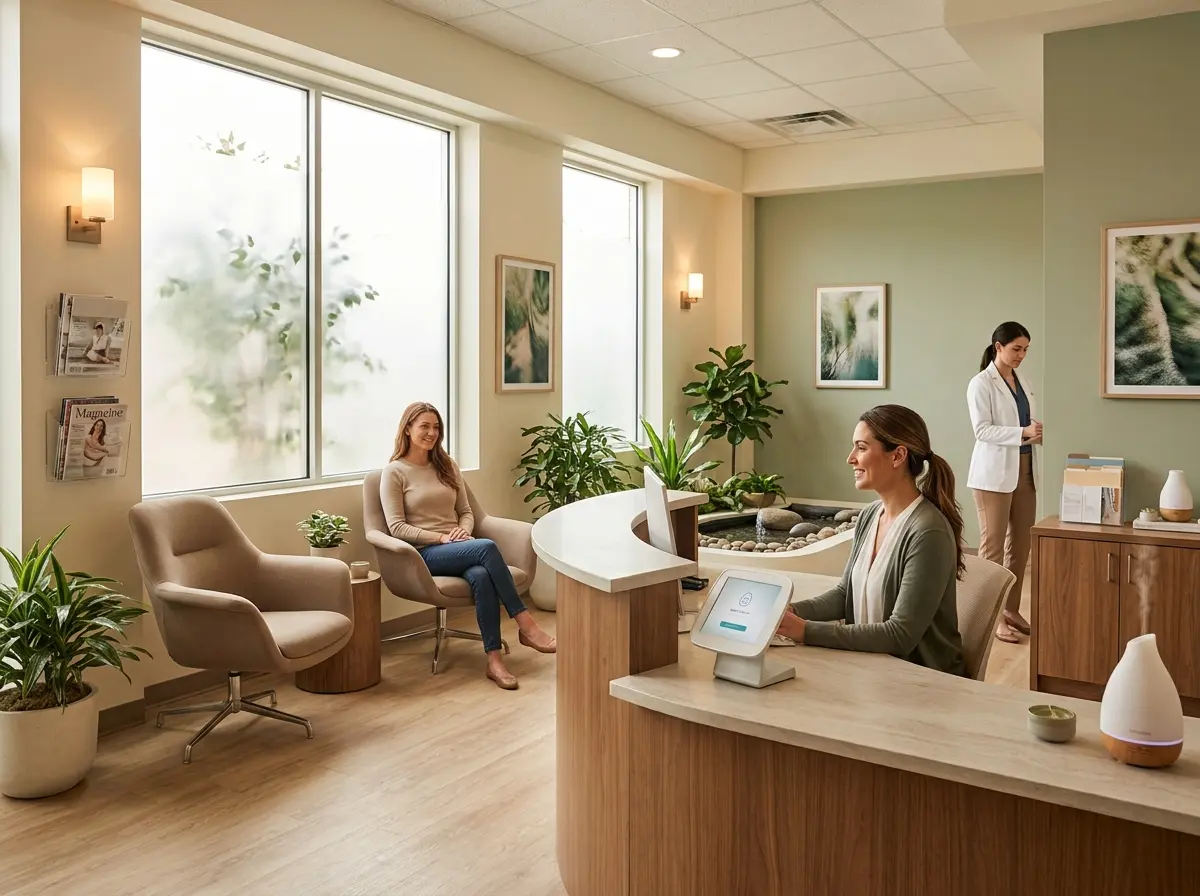
If you do nothing else, fix your lighting. Swap harsh fluorescent overhead lights for warm-toned LED panels or, better yet, maximize natural light with window treatments that diffuse rather than block sunlight. Studies from the Center for Health Design show that access to natural light reduces patient-reported stress by up to 22%. Pair that with a color palette anchored in soft blues, greens, and warm neutrals — colors that neurologically signal calm — and you've already done more than most practices ever will.
Adding even a small amount of nature — a few well-maintained plants, a nature photography print, or a small water feature — activates what researchers call "attention restoration," essentially giving the brain's stress response a brief vacation. Fake plants, for the record, don't cut it. Patients notice, and somehow it feels even more depressing than no plants at all.
Seating Arrangement and Personal Space
Most waiting rooms arrange chairs in rows along the walls, which is efficient for storage but terrible for human comfort. People don't naturally want to sit shoulder-to-shoulder with strangers while waiting to discuss their herniated disc. Instead, consider cluster seating arrangements that create semi-private groupings, offer a mix of chair heights (some patients can't lower themselves into deep-cushioned seats without pain), and ensure there's always a clear sightline to the reception desk. Visibility reduces uncertainty, and uncertainty, as we've established, is the enemy.
Information Architecture: The Underrated Anxiety Killer
Clear, warm, and well-placed signage is doing more therapeutic work than it gets credit for. Patients who understand exactly what to do when they arrive — where to check in, what forms are needed, how long the wait typically is, where the restrooms are — experience measurably less stress. Consider a welcome board that displays the day's therapist schedule, a brief "here's what to expect" overview for new patients, and a realistic wait time indicator. It's the difference between a patient sitting in peace and a patient constructing elaborate worst-case scenarios in their head.
Quick Reminder About Stella
Stella is an AI robot employee and phone receptionist built for businesses of all kinds — including healthcare practices like yours. She stands inside your office as a friendly kiosk presence and answers phone calls 24/7 with the same knowledge she uses in person, all for just $99/month with no upfront hardware costs. If you're rethinking your patient experience from the ground up, she's worth a serious look.
Putting It All Together: Your Action Plan
Redesigning a waiting room for anxiety reduction doesn't require a six-figure renovation budget or a degree in interior design. It requires intentionality — the willingness to walk into your own waiting room as if you've never been there before and ask yourself honestly: does this space make me feel calm, informed, and cared for? If the answer involves any hesitation, you have room to improve.
Here's a practical starting point for physical therapy practice owners ready to take action:
- Audit your current space — Photograph it, sit in it for 15 minutes, and note every source of stress or confusion you encounter.
- Prioritize lighting and color — These changes are often low-cost and high-impact. Start here before buying anything else.
- Redesign your seating layout — Move chairs away from wall-to-wall rows and experiment with small groupings that offer personal space.
- Improve your information environment — Create clear, warm signage that answers the top five questions every new patient has before they even need to ask.
- Address the arrival moment — Whether through better-trained front desk staff, digital check-in, or an AI-powered greeter, make sure patients feel immediately acknowledged when they walk in.
- Extend the experience to the phone — Your waiting room experience starts when a patient calls, not when they arrive. Ensure that experience is equally calm and informative.
The physical therapy waiting room will probably never be anyone's favorite place. But with thoughtful design choices, clear communication, and the right tools in place, it can stop being a source of stress and start being the first step in the healing process. And honestly? That's exactly what your patients — and your practice — deserve.