The Service Lane Is Broken (But It Doesn't Have to Be)
Let's be honest — the traditional dealership service lane experience has the reputation of a trip to the DMV, but with more upselling. Customers pull in, wait awkwardly, struggle to flag down a service advisor who's juggling six other people, get handed a clipboard with a form that could double as a legal brief, and then sit in a waiting room watching cable news until someone finally calls their name. It's not exactly the white-glove experience that builds lifelong loyalty.
Meanwhile, dealerships are spending thousands of dollars on marketing to bring customers in, only to lose them to the independent shop down the street because the service experience felt impersonal, slow, and frustrating. According to Cox Automotive's Service Industry Study, only about 30% of new car buyers return to the dealership for service after their warranty expires. That number should make every service director's stomach drop.
The good news? Artificial intelligence is quietly transforming the service lane — and the dealerships that are paying attention are seeing real results in retention, revenue per repair order, and customer satisfaction scores. This isn't science fiction. It's happening right now, and it's more accessible than you probably think.
How AI Is Reshaping the Service Lane From the Ground Up
Personalized Check-In Experiences That Actually Feel Personal
The days of handing a customer a generic multi-page form and hoping they fill it out accurately are numbered. AI-powered intake systems can now recognize returning customers, pull their vehicle history, and present them with a pre-populated check-in experience that already knows their car, their last service date, and what's likely coming due. Instead of treating every customer like a stranger, the process treats them like what they actually are — a known person with a history and preferences.
Imagine a customer pulling into the service bay and being greeted by a kiosk that says, "Welcome back, Jennifer! Your 2021 Highlander is in for an oil change today. Based on your mileage, you're also coming up on your 30,000-mile tire rotation — would you like to add that?" That's not just convenience. That's the kind of moment that makes a customer feel like someone is actually paying attention. It also, not coincidentally, is an upsell that the service advisor didn't have to think about.
Dealerships using AI-assisted check-in tools have reported meaningful increases in service add-on acceptance rates — not because customers are being pressured, but because the recommendations are timely, relevant, and feel helpful rather than pushy.
Predictive Service Recommendations Based on Real Data
AI doesn't just help at the moment of check-in — it helps before the customer even arrives. Predictive analytics tools can analyze a customer's vehicle data, service history, regional driving patterns, and manufacturer maintenance schedules to proactively reach out when service is likely needed. Some platforms are now integrating with telematics data to identify issues before the check engine light even comes on.
This kind of proactive outreach transforms the dealership's relationship with its customers. Instead of waiting for someone to remember to schedule an appointment, the dealership becomes the trusted advisor who reaches out first. That shift — from reactive to proactive — is one of the most powerful things AI can do for customer retention.
Smarter Communication Throughout the Service Visit
One of the most common complaints about dealership service is the communication black hole. The customer drops their car off, and then... silence. They don't know if it's been looked at, what was found, or when it'll be ready. They call the service desk, get put on hold, and wonder why they didn't just go to Jiffy Lube.
AI-driven communication tools can automate status updates via text, handle common inbound questions without tying up service advisors, and even present digital multi-point inspection results with photos and explanations in plain English. When a customer can see a video of their brake pad thickness and a clear explanation of why a repair is recommended, approval rates climb significantly. Transparency, powered by technology, builds trust faster than any sales training.
Putting AI to Work Before Customers Even Walk Through the Door
How Stella Can Help Dealerships Win the First Impression
A lot of the service lane experience is shaped before the customer ever arrives — and that means phone calls matter enormously. A customer who calls to schedule service and gets put on hold, transferred twice, or reaches voicemail at 7 PM is already having a bad experience. Stella, an AI robot employee and phone receptionist, solves this by answering every call — 24 hours a day, 7 days a week — with the same knowledge and professionalism as your best service advisor on their best day.
For dealerships with a physical location, Stella also stands inside the dealership as a human-sized kiosk, greeting customers who walk in, answering questions about services and current promotions, and handling intake — all without pulling a service advisor away from a vehicle or a customer consultation. Her built-in CRM captures customer information and generates AI-powered profiles, so the data collected at check-in or over the phone doesn't disappear into a void. It becomes actionable intelligence.
The Business Case for AI in the Service Lane
Retention Revenue Is the Most Profitable Revenue You're Not Maximizing
Fixed operations — the service and parts department — typically account for nearly 50% of a dealership's gross profit, according to NADA data, despite representing a fraction of the floor space and headcount compared to vehicle sales. Yet most dealerships underinvest in the technology that could make service more efficient, more personalized, and stickier. The math here isn't complicated: a customer who returns for service twice a year for ten years is worth far more than the margin on the original vehicle sale. AI tools that improve retention don't just make customers happier — they directly protect and grow one of the most profitable parts of the business.
Reducing Friction for Advisors Means Better Experiences for Everyone
It's worth noting that AI in the service lane isn't about replacing service advisors — it's about making their jobs less chaotic. When an advisor isn't answering the same five FAQ phone calls per hour, isn't manually looking up service histories, and isn't chasing down customers to approve additional work, they have more time and mental bandwidth for the human parts of the job: building rapport, explaining complex repairs with empathy, and making customers feel genuinely cared for. The advisors who thrive with AI support aren't threatened by it — they're freed by it.
Measuring What Actually Matters
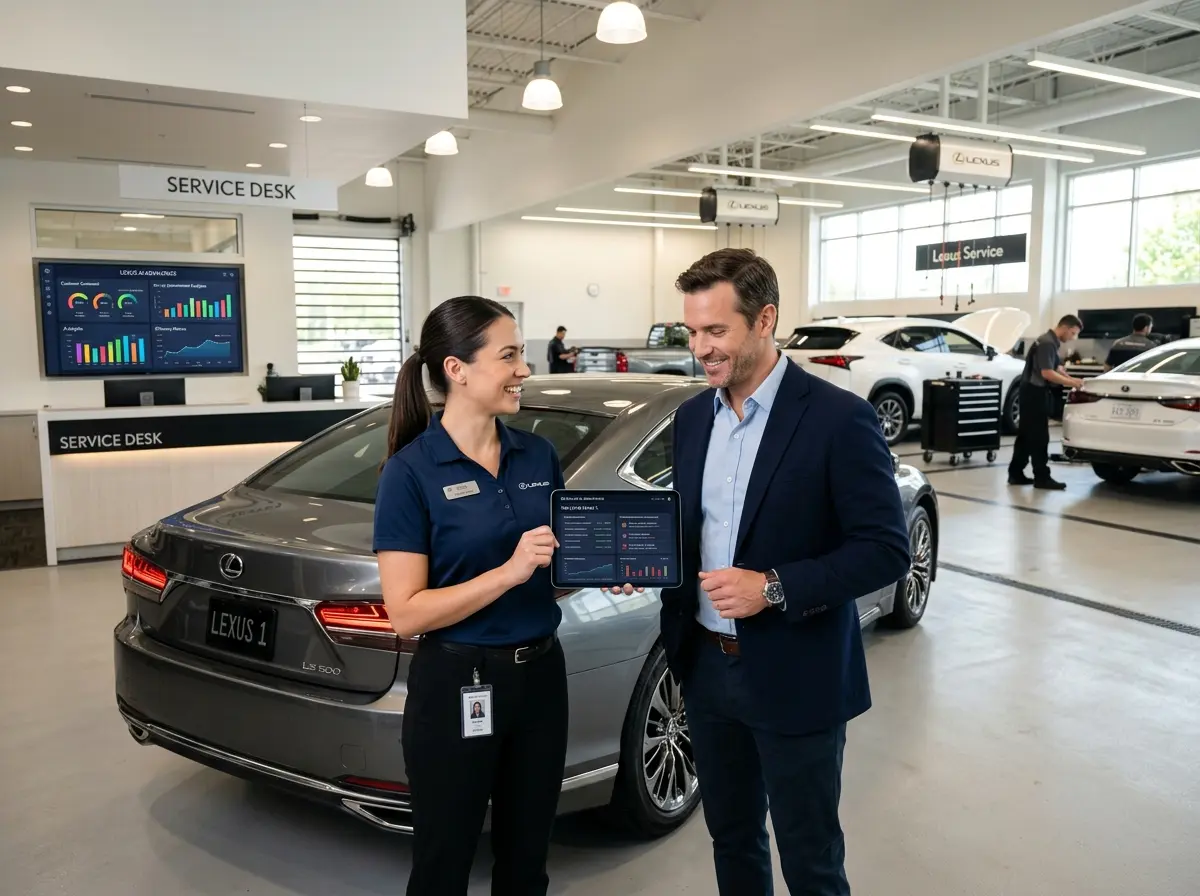
One of the underrated advantages of AI-powered service lane tools is the data they generate. Dealerships can finally answer questions like: Which promotional offer had the highest acceptance rate? What's the average wait time before a customer abandons a call? Which customers are overdue for service and haven't been contacted? Which advisors have the highest add-on approval rates, and what are they doing differently?
This kind of visibility was previously only available to large dealer groups with dedicated analytics teams. Now it's accessible to single-point dealers on a budget. Making decisions based on real customer interaction data — rather than gut feeling and end-of-month reports — is a competitive advantage that compounds over time.
Quick Reminder About Stella
Stella is an AI robot employee and phone receptionist designed for businesses like auto dealerships — she greets customers in person from her kiosk, answers calls around the clock, collects intake information, and manages customer data through a built-in CRM. She runs on a straightforward $99/month subscription with no upfront hardware costs, making enterprise-level AI accessible without an enterprise-level budget. If your service lane is losing customers to missed calls and impersonal experiences, Stella is worth a serious look.
Your Next Move: Start Small, Think Long-Term
The dealerships winning the service retention battle right now aren't necessarily the ones with the biggest budgets or the fanciest facilities. They're the ones that took AI seriously before their competitors did and started building systems that make every customer interaction feel intentional and personal.
Here's a practical starting point for any dealership ready to move in this direction:
- Audit your current first contact experience. Call your own service line at 8 PM on a Tuesday and see what happens. If no one answers, that's your first problem to solve.
- Look at your service history data. How many customers visited once and never returned? That's your retention leak, and AI-powered outreach can help plug it.
- Evaluate your intake process. Is it fast, personalized, and digitally connected? If customers are still filling out paper forms, you're leaving both efficiency and revenue on the table.
- Identify your communication gaps. Where do customers go silent during the service visit? That's where AI-driven status updates and digital inspection tools can make the biggest immediate impact.
The service lane of the future isn't a distant concept — it's being built right now by dealerships that understand that personalization at scale requires technology, and that AI is the most practical way to deliver it. The question isn't whether your customers deserve a better experience. They obviously do. The question is whether you're going to be the dealership that gives it to them, or the one that watches your competitors do it first.