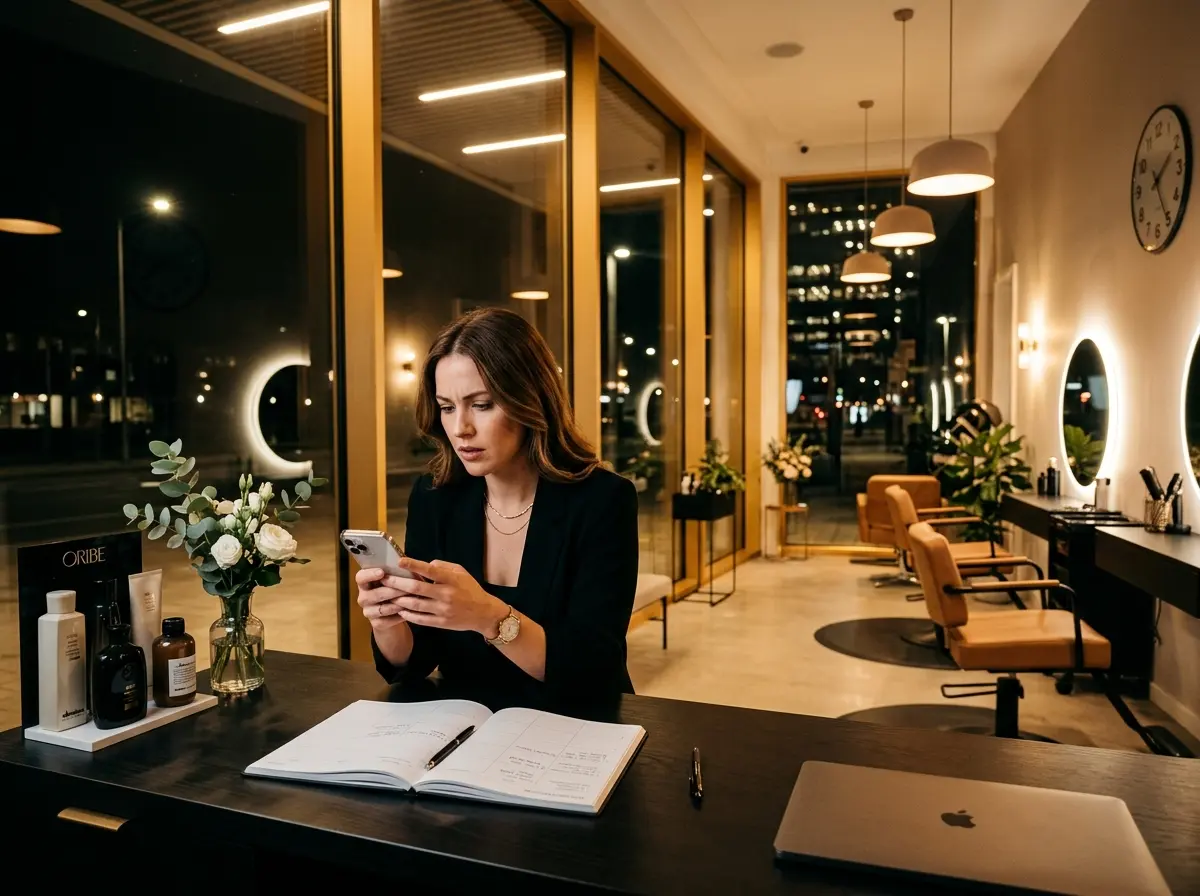
While You're Sleeping, Your Competitors Are Taking Your Clients
Here's a scenario that plays out in salons across the country every single night: A potential client finishes binge-watching her favorite show at 10:47 PM, suddenly remembers she needs a haircut before her big presentation on Friday, grabs her phone, and calls your salon. She gets voicemail. She hangs up, Googles "hair salon near me," and books with someone else — someone whose phone was answered, or at least whose online booking was intuitive enough to seal the deal.
You wake up in the morning completely unaware that you lost a booking. Maybe two. Maybe five. You'll never know, because missed calls don't leave a paper trail, and people who get voicemail rarely call back.
The after-hours call problem is one of the most quietly expensive issues in the salon industry, and most owners don't realize how bad it is until they actually start tracking it. The good news? It's also one of the most solvable. Let's break it down.
The Real Cost of a Missed After-Hours Call
It's Not Just One Booking — It's a Lifetime of Them
When a salon owner hears "missed call," they tend to think about the value of a single appointment. A blowout here, a color service there — maybe $80 to $150, not the end of the world. But that math is dangerously shortsighted. A loyal salon client is worth hundreds or even thousands of dollars per year, and they tend to refer friends and family when they love their experience. Lose them before they ever walk in the door, and you're not losing one appointment — you're losing a relationship that could have been worth thousands over several years.
According to research from BrightLocal, 62% of consumers who call a business and don't get an answer will not call back. They just move on. In an industry as competitive as beauty services, where there are often three other salons within a five-minute drive, that's a brutal statistic to ignore.
When Do Clients Actually Call?
Here's the uncomfortable truth: people don't call during business hours nearly as often as you'd hope. Think about your own habits. When do you make personal appointments? If you're like most people, it's during your lunch break, after the kids are in bed, or during that weird 9 PM energy burst when you suddenly feel productive.
Studies consistently show that a significant portion of service-related calls happen outside of traditional business hours — evenings, early mornings, and weekends. For salons specifically, Saturday and Sunday evenings are prime booking windows, which happen to be exactly when your front desk staff has long since gone home and your personal cell phone is on Do Not Disturb (as it should be).
The Voicemail Trap
Some salon owners feel comfortable with voicemail as a solution. "They can just leave a message," goes the logic. This is optimistic to the point of being adorable. Research suggests that over 80% of callers hang up when they reach a voicemail, particularly first-time callers who have no established relationship with your business. Voicemail feels like a dead end. It creates friction. And for a potential client who just wanted to ask a quick question — "Do you do balayage?" or "How late are you open on Thursdays?" — it's a completely unsatisfying non-answer that sends them straight to a competitor.
How Technology Can Close the Gap — Without Hiring a Night Owl
The Right Tool for After-Hours Answering
The obvious solution to an unanswered phone is to have someone answer it — but hiring a receptionist to cover overnight shifts at a small salon is neither practical nor economical. This is exactly the kind of problem that AI phone receptionists were built to solve.
Stella, an AI robot employee and phone receptionist, can answer your salon's calls 24/7 with the same knowledge and professionalism as your best front desk staff. She knows your services, your pricing, your hours, your policies, and your current promotions — and she's ready to talk about all of it at 11 PM on a Sunday without complaint or overtime pay. For salons with a physical location, she also operates as an in-store kiosk, greeting walk-ins and engaging customers proactively while your staff focuses on the actual services. Her built-in CRM and conversational intake forms mean that when a potential client calls, Stella can collect their contact information, service preferences, and other details — so even if the booking isn't confirmed on the spot, you have everything you need for a meaningful follow-up.
Fixing Your After-Hours Strategy From the Ground Up
Audit Your Current After-Hours Experience
Before you can fix the problem, you need to understand exactly how bad it is. Start by doing something deceptively simple: call your own salon after hours and experience what a potential client experiences. Is the voicemail greeting professional and warm, or is it a robotic generic message? Does it give callers useful information — like your hours or website — or does it just tell them to leave a message and hang up? Better yet, ask a friend to call and then honestly tell you what the experience felt like.
Then dig into your call data. Most phone systems — even basic ones — provide some level of call analytics. Look at missed call rates, times of day when calls are going unanswered, and how often voicemails are actually being left versus how often people simply hang up. What you find may be eye-opening.
Optimize Your After-Hours Messaging
Even if you're not yet ready to implement an AI receptionist, there are meaningful improvements you can make right now to your after-hours experience. A well-crafted voicemail greeting can significantly reduce frustration and increase the likelihood that a caller will follow through. Here's what to include:
- A warm, professional greeting that confirms they've reached the right place
- Your business hours, clearly stated, so they know when a human will be available
- An alternative action, such as visiting your website to book online or sending a text
- A clear callback promise — "We return all calls by 9 AM the next business day" — so callers know they won't be forgotten
It won't capture every lead, but it's dramatically better than a generic beep and silence.
Build a Consistent Follow-Up System for Missed Calls
For every missed call that does leave a voicemail, you need a process — not a good intention, but an actual system — for following up promptly. Assign ownership of missed call follow-ups to a specific person. Set a target response time (ideally within the first hour of the next business day). Consider using a CRM or contact management tool to log missed calls and ensure no one falls through the cracks.
Speed matters here more than most people realize. Research from Harvard Business Review found that businesses that respond to leads within an hour are seven times more likely to have a meaningful conversation with a decision-maker compared to those who wait even two hours. For a salon, that "decision-maker" is just a person who wants a haircut — but the principle holds. Follow up fast, or someone else will.
Quick Reminder About Stella
Stella is an AI robot employee and phone receptionist designed for businesses exactly like yours. She answers calls around the clock, handles common questions, promotes your services, and collects customer information — all for a flat $99 per month with no upfront hardware costs. Whether you need her on the phones, standing in your salon as an interactive kiosk, or both, she's ready to work the shift nobody else wants.
Stop Letting Good Leads Walk Out the Door at Closing Time
The after-hours call problem isn't going away on its own. As consumer behavior continues to shift toward late-night browsing and impulse booking, the window between "I should make an appointment" and "I just booked somewhere else" keeps getting shorter. Salons that solve this problem — whether through AI answering, better voicemail systems, or a combination of both — will consistently outperform those that don't.
Here's what you can do starting today:
- Call your own salon after hours and honestly evaluate the experience a new client would have.
- Pull your missed call data for the last 30 days and calculate the realistic revenue impact.
- Update your voicemail greeting immediately if it's generic, unhelpful, or just plain bad.
- Build a follow-up process with clear ownership and a response time target.
- Explore AI answering tools that can handle after-hours calls so you stop losing bookings to voicemail purgatory.
Your salon works hard for its reputation. It would be a shame to lose clients to a competitor simply because nobody picked up the phone. The solution is out there — and it doesn't require you to stay up until midnight.