Your Store Layout Is Either Making Sales or Killing Them — There's No In Between
You've curated the perfect collection. Your pieces are on-trend, your pricing is competitive, and your Instagram looks like it was designed by a team of aesthetic geniuses. And yet, customers walk in, do a quick lap, and walk right back out — sometimes without even making eye contact. Frustrating? Absolutely. Mysterious? Not really.
Here's a truth that retail consultants charge thousands of dollars to tell you: your store layout is either your best salesperson or your worst one. It doesn't take breaks, it doesn't call in sick, and it silently influences every single purchase decision your customers make — whether you've intentionally designed it to or not.
The good news is that retail science (yes, it's a real thing) has given us decades of data on how shoppers move, think, and spend. According to research from the Nielsen Norman Group and various retail behavior studies, customers make the majority of their purchase decisions in-store, often influenced by placement, visual cues, and spatial flow rather than any prior intention. That means your layout isn't just décor — it's strategy.
So let's talk about how to turn your boutique into a well-oiled, revenue-generating machine — one thoughtfully placed rack at a time.
The Foundation: Understanding How Shoppers Actually Move
Before you start rearranging fixtures at 11 PM with a measuring tape clenched between your teeth, it helps to understand a few foundational principles of shopper behavior. Spoiler: people are wonderfully predictable.
The Decompression Zone (Don't Skip This One)
The first 5 to 15 feet inside your front entrance is called the decompression zone — and it's one of the most misunderstood pieces of retail real estate in existence. Shoppers entering your store are transitioning from the outside world: they're still mentally processing traffic, their to-do list, and whether they remembered to lock their car. Placing your best merchandise or a cluttered display right at the entrance is like trying to have a serious conversation with someone who just walked in from a snowstorm.
Keep this zone clean, open, and visually inviting. A single striking display, a tasteful sign, or a welcoming focal point works beautifully here. Save your promotional signage and product density for a few steps further in.
The Invariant Right Turn
Studies consistently show that the majority of shoppers in Western countries instinctively turn right when they enter a store. Paco Underhill, author of the retail classic Why We Buy, famously documented this pattern across hundreds of retail environments. What this means for you is simple: your right-side wall and the area immediately to the right of your entrance is prime real estate. Put your most visually compelling, high-margin, or new-arrival pieces there. Let the natural foot traffic do its job.
The Racetrack Layout and Natural Flow
Many successful boutiques use a variation of the racetrack layout — a looping path that guides customers through the entire store before naturally returning them to the exit. This isn't accidental; it's intentional architecture that maximizes exposure to your full inventory. Even if your space doesn't allow for a full loop, you can create a guided path using fixture placement, lighting, and strategic product groupings that pull the eye (and feet) forward. The goal is to eliminate dead zones — those sad corners where merchandise goes to be ignored.
Merchandising That Actually Moves Product
The Power of the Hero Display
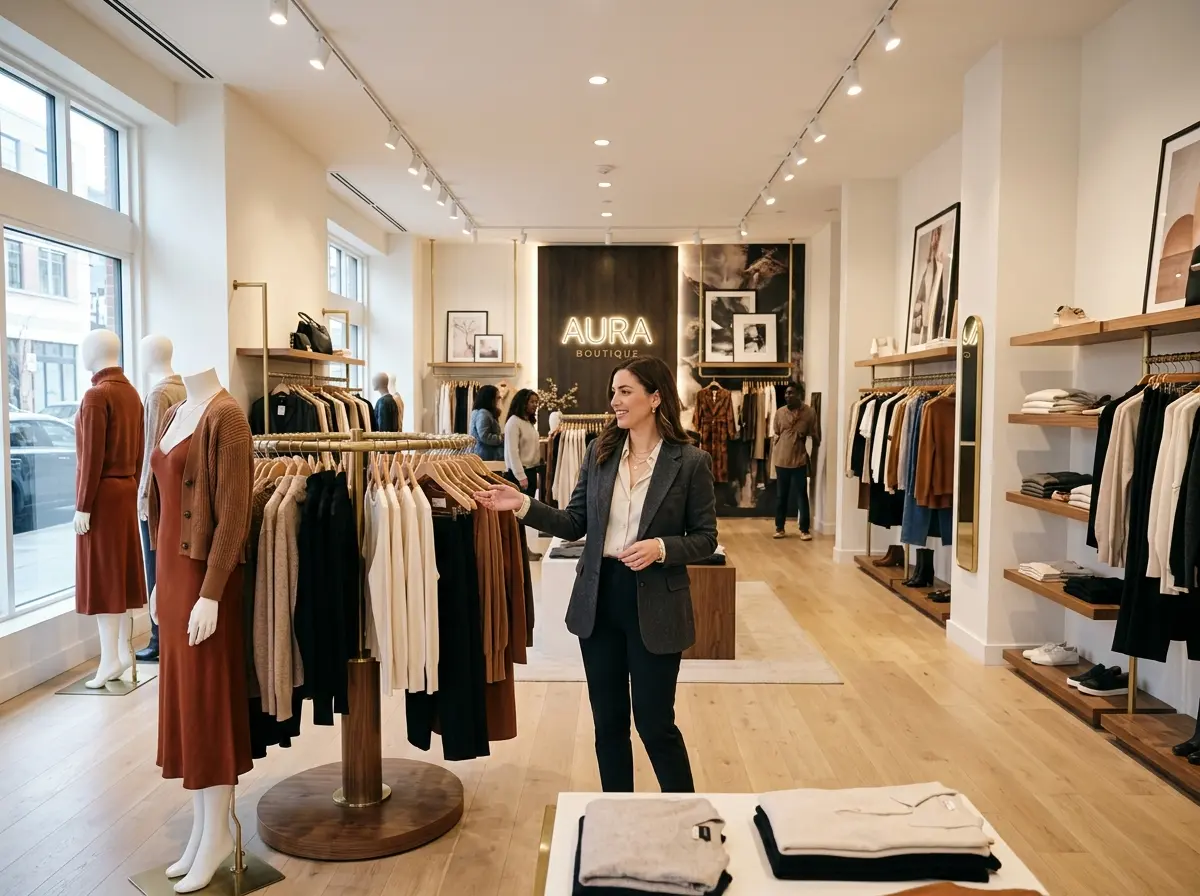
Every strong boutique layout includes what merchandisers call a hero display — a focal point that stops customers in their tracks and communicates your brand story at a glance. This could be a fully styled mannequin grouping, a curated seasonal vignette, or a statement wall that showcases your current must-haves. The hero display isn't just decorative; it's doing the heavy lifting of suggesting outfits, communicating price points, and creating aspiration. Customers don't just want clothes — they want a vision of themselves. Give them one.
Update your hero display regularly. A boutique that looks the same every visit gives repeat customers no reason to linger — or return.
The Rule of Three and Visual Groupings
When it comes to styling fixtures and shelves, odd numbers are your friend. The rule of three — grouping items in sets of three at varying heights — creates visual interest and prevents the dreaded "warehouse rack" aesthetic that makes boutiques look like they're one step away from a clearance event. Vary the height, texture, and color of your displays to guide the eye naturally across the space. And please, for the love of good taste, don't overcrowd your racks. Overstuffed clothing rails signal "discount bin" to customers, regardless of what your price tags say. Give your pieces room to breathe.
Your Secret Weapon on the Sales Floor
Here's where things get interesting. You can have the most beautifully designed boutique layout in the city, but if your staff is buried in the back doing inventory, answering the same five phone questions on repeat, or simply stretched too thin to engage every customer who walks through the door — you're leaving money on the table.
Filling the Gaps Your Layout Can't Cover
This is exactly where Stella earns her keep. Stella is a human-sized AI robot kiosk that stands inside your store and proactively engages customers — greeting them, answering questions about products and promotions, highlighting current deals, and even upselling complementary items. While your layout is guiding customers through the space, Stella is there to close the loop with the kind of personalized interaction that turns browsers into buyers. She never has an off day, never gets distracted, and never forgets to mention the buy-two-get-one promotion you've been trying to push all month.
And when your phone rings — because it always does, at the worst possible moment — Stella handles that too. She answers calls 24/7, responds to questions about hours, inventory, and policies, and forwards calls to your team when needed. Your staff stays focused on the customers standing right in front of them.
The Details That Separate Good Boutiques from Great Ones
Lighting as a Merchandising Tool
Lighting is perhaps the most underutilized tool in boutique retail, and it's a genuine shame. The difference between flat, even overhead lighting and strategic, layered illumination is the difference between a department store and a destination boutique. Use accent lighting to draw attention to hero displays and new arrivals. Use warmer tones in fitting rooms — because a customer who feels flattering under your lighting is a customer who buys. Studies suggest that well-lit products are perceived as higher quality and higher value, which means your lighting investment pays for itself in margin.
The Fitting Room Experience Is a Conversion Machine
If you're not treating your fitting rooms as a critical conversion zone, you're missing one of the highest-ROI improvements available to you. A customer who enters a fitting room converts at a dramatically higher rate than one who doesn't — some industry estimates put fitting room conversion at 67% or higher. That means your fitting room experience deserves real attention: clean, well-lit spaces; enough hooks and room to move; perhaps a small display of accessories or complementary pieces just outside the door. Train your staff to check in warmly, offer alternative sizes without being asked, and suggest pairings. Every detail compounds.
Strategic Placement of Impulse Items and Accessories
Accessories are margin gold for clothing boutiques, and their placement should never be an afterthought. Position jewelry, scarves, belts, and small accessories near the register, alongside your hero displays, and adjacent to the items they complement. A customer who came in for a blouse doesn't always know she needs the earrings that make the whole outfit click — until she sees them placed exactly right. The checkout counter, in particular, should be treated as its own merchandising zone: curated, intentional, and rotated regularly to stay fresh for your regulars.
Quick Reminder About Stella
Stella is an AI robot employee and phone receptionist built for businesses like yours. In your boutique, she stands on the sales floor engaging customers, answering questions, and promoting your current offers — so your human team can focus on styling and relationship-building. She also answers your phones around the clock, handles call forwarding, and takes AI-summarized voicemails, keeping your business responsive even when you're not in the room. All of this starts at just $99/month with no upfront hardware costs.
Putting It All Together: Your Next Steps
A high-converting store layout isn't something you design once and forget about — it's a living, evolving part of your boutique's sales strategy. The most successful boutique owners treat their floor plans with the same intentionality they bring to buying trips and marketing campaigns. Here's how to get started without overhauling everything at once.
First, walk your own store as a customer would — enter through the front door, turn right instinctively, and notice what catches your eye and what doesn't. Be honest. Then evaluate your decompression zone, your primary traffic path, and the placement of your highest-margin pieces. Are they working hard enough for you?
Next, identify one or two quick wins: clear out a cluttered entrance, reposition your hero display, add accent lighting to a focal area, or merchandise your checkout counter intentionally. Small changes compound quickly in retail environments, and you don't need a full renovation to see results.
Finally, think about the human element. Layout and design will take customers most of the way — but engagement closes the sale. Whether that's through well-trained staff, thoughtful service touchpoints, or a tool like Stella working the floor while you handle the bigger picture, make sure your customers feel seen, helped, and inspired from the moment they walk in to the moment they walk out — ideally with a bag in hand.
Your store has been talking to customers this whole time. The only question is whether it's been saying the right things.