Introduction: Accessibility Is the Floor, Not the Ceiling
Congratulations — your store has a ramp. You've got the legally mandated accessible parking spots, maybe a wider checkout lane, and a bathroom that technically fits a wheelchair if you don't mind squeezing past the mop bucket. You're compliant. You're legal. You're also, if we're being honest, doing the bare minimum.
Here's the thing: accessibility and inclusivity are not the same thing. Accessibility is about removing physical and logistical barriers so that people can enter your store. Inclusivity is about making people feel genuinely welcome, valued, and served once they're inside. One is a checklist. The other is a culture.
And the business case? It's enormous. The global disability market alone represents over $13 trillion in annual disposable income. Add in aging populations, neurodiverse shoppers, non-English speakers, and customers with varying communication preferences, and you're looking at a massive, underserved market that most retailers are quietly (and expensively) ignoring.
This post is your practical guide to going beyond the ramp — building a retail environment where every customer feels like they belong, and where your business benefits from every single one of them.
Designing an Inclusive Physical Environment
Before you can win anyone's loyalty, you have to win their comfort. The physical layout of your store sends an immediate signal about who you were thinking of when you designed it — and who you weren't.
Layout and Navigation
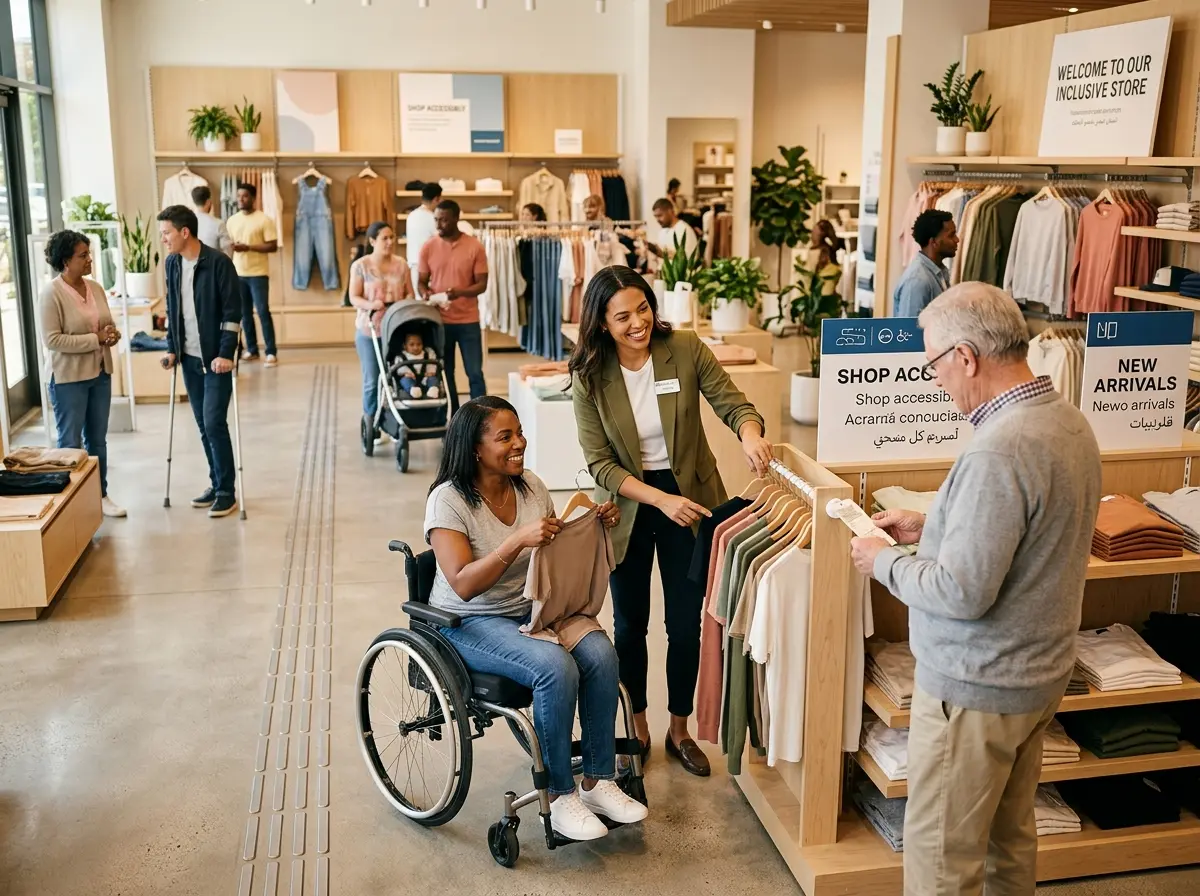
Wide aisles aren't just for wheelchair users. They benefit parents with strollers, elderly customers with walkers, shoppers with anxiety who need breathing room, and anyone who's ever knocked over a display of artisanal hot sauces trying to squeeze past a rack of sale items. Aim for a minimum of 36 inches between fixtures, though 44 inches is significantly more comfortable. Keep pathways clear, logical, and easy to navigate without asking for help — because many customers won't ask, they'll just leave.
Signage matters more than most retailers realize. High-contrast, large-font signs with simple language benefit people with low vision, cognitive differences, and — let's be real — everyone who forgot their glasses at home. If your store has multiple departments or sections, wayfinding signage should be at eye level and positioned low enough to be readable from a seated position.
Sensory Considerations
Retail environments can be genuinely overwhelming. Bright fluorescent lighting, loud background music, strong product fragrances, and crowded displays create a sensory experience that many shoppers — particularly those who are neurodivergent, have sensory processing differences, or deal with chronic pain and fatigue — find exhausting or even impossible to navigate.
Consider introducing designated quiet hours with reduced lighting and music. Many major retailers, including Target and IKEA, have experimented with sensory-friendly shopping hours to significant customer appreciation. Even small changes — switching to warmer lighting, reducing music volume, and giving customers a sensory map of the store — can make a meaningful difference without costing you a fortune.
Seating and Rest Areas
This one is criminally underused. Providing seating throughout your store — not just at checkout — is one of the simplest, most inclusive things you can do. Elderly shoppers, customers with chronic illness or pain, pregnant shoppers, and anyone on a long errand run will thank you with their loyalty. A few well-placed chairs or benches costs almost nothing and communicates that you actually thought about your customers as human beings with physical needs. Revolutionary, we know.
Inclusive Staffing, Training, and Customer Interaction
Your physical environment can be perfect, and a single awkward interaction with a staff member can undo all of it. Inclusive retail isn't just about the building — it's about the people (and yes, the technology) inside it.
Training Staff for Inclusive Customer Service
Staff should be trained to interact respectfully with customers of all abilities and communication styles. This means knowing not to speak to a caregiver instead of the customer directly, understanding how to assist without being patronizing, and recognizing when a customer might need more time, more space, or a different kind of help altogether. Role-playing scenarios during onboarding can help staff practice these interactions in a low-stakes environment before they're handling them in real time.
It also means training staff to ask rather than assume. "How can I help you today?" is always better than launching into an unsolicited tutorial on how to use a product someone has probably been using their entire life.
How Technology Can Bridge the Gap
Sometimes the most inclusive interaction is one that doesn't require a human at all — not because humans aren't valuable, but because some customers simply prefer a lower-pressure, self-directed experience. Stella, the AI robot employee and phone receptionist, is genuinely useful here. As a friendly, human-sized kiosk that stands inside your store, Stella greets every customer who walks in, answers questions about products, services, hours, and policies, and does it all without judgment, impatience, or the subtle awkwardness that can sometimes come with human interaction.
For customers who feel anxious asking staff for help, or who have communication differences that make spontaneous conversation challenging, Stella provides a consistent, patient, always-available point of contact. She also answers your phones 24/7, meaning customers who prefer to call ahead — to check on accessibility features, product availability, or store layout — always get a knowledgeable, helpful response, no matter when they call.
Communication, Language, and Digital Inclusivity
Inclusivity doesn't stop at your front door. In an era where most customers interact with your business digitally before they ever set foot in your store, your online presence needs to be just as inclusive as your physical one.
Multilingual and Plain Language Communication
If your community includes non-English speakers — and statistically, it very likely does — having multilingual signage, staff who speak additional languages, or translation tools available in-store is a powerful signal of welcome. Even small efforts matter: a bilingual greeting, a menu or product list available in multiple languages, or a QR code that links to translated content can meaningfully expand your accessible customer base.
Plain language also matters more than most business owners think. Avoid jargon, overly complex product descriptions, and fine print that requires a law degree to decipher. Clear, simple communication serves everyone — including busy customers who just want to know if the thing does the thing.
Accessible Digital Touchpoints
Your website, online store, and social media presence should all meet Web Content Accessibility Guidelines (WCAG) standards. This includes image alt text, captions on videos, keyboard-navigable menus, and sufficient color contrast. Beyond legal compliance (yes, this can be a legal issue), accessible digital design improves user experience for everyone — search engines included. An accessible website is also a better-ranking website. Turns out doing the right thing and doing the smart thing occasionally overlap.
Flexible Purchasing and Communication Options
Not everyone wants to shop the same way. Offering multiple purchasing channels — in-store, online, by phone, curbside pickup — gives customers the flexibility to engage with your business on their own terms. Some customers need to call ahead. Some prefer email. Some want to walk in, browse independently, and check out without speaking to a single human being. Build systems that accommodate all of these preferences, and you'll convert customers who would otherwise shop elsewhere — probably somewhere that figured this out already.
Quick Reminder About Stella
Stella is an AI robot employee and phone receptionist that works in your store as a friendly, human-sized kiosk and answers your phones 24/7 — with the same business knowledge in both places. She greets customers, answers questions, promotes your current deals, and handles calls around the clock, all for just $99/month with no upfront hardware costs. Whether you're looking to reduce staff pressure, serve more customers more consistently, or simply never miss a call again, Stella's got it covered.
Conclusion: Inclusion Is a Business Strategy, Not Just a Value Statement
Making your retail store truly inclusive isn't about hanging a poster in your window or adding a line to your website's "About" page. It's about systematically examining every touchpoint of the customer experience — from your parking lot to your product descriptions to your phone hold music — and asking honestly: who did we forget to think about here?
Here are your actionable next steps to get started:
- Audit your physical space with fresh eyes (or better yet, with someone who uses a mobility aid, has low vision, or identifies as neurodivergent). Note every friction point.
- Review your signage for font size, contrast, and height placement. Update anything that fails the test.
- Schedule a staff training session focused specifically on inclusive customer service. Make it practical, not just a lecture.
- Run an accessibility audit on your website using free tools like WAVE or Google's Lighthouse. Fix the easy wins first.
- Consider your communication channels. Are you available by phone at all hours? In multiple languages? Through multiple platforms? If not, identify the gaps.
- Explore technology solutions that provide consistent, patient, always-available customer interaction — in-store and over the phone.
The retailers who thrive over the next decade won't just be the ones with the best products or the slickest storefronts. They'll be the ones who made the most people feel genuinely welcome. That's not idealism — that's market share. And it's available to you right now, starting with a ramp that actually leads somewhere worth going.