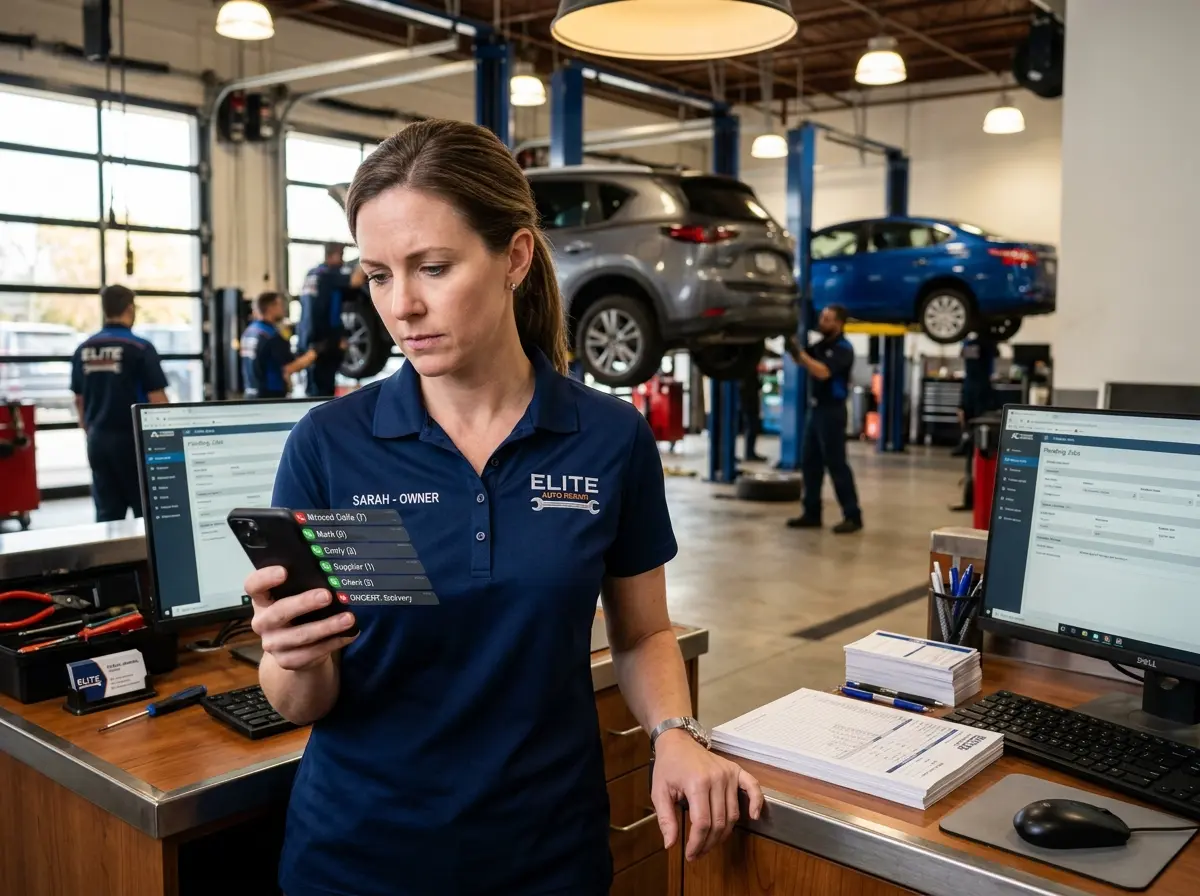
When the Phone Rings and Nobody Answers, Your Competitor Does
Picture this: a car owner is sitting in a parking lot, engine making a sound that she can only describe as "definitely not normal." She grabs her phone and calls the first auto shop that comes up in her search. It rings. And rings. And rings. She hangs up and calls the next one. That shop answers. Guess who just won a new customer — and it wasn't you.
This scenario plays out dozens of times a day across auto shops everywhere, and most owners have absolutely no idea it's happening. You're busy. Your techs are busy. The one person at the front desk is trying to check in a vehicle, handle a walk-in, and drink a coffee that's been cold for three hours. Answering every call? Practically impossible. But here's the uncomfortable truth: every unanswered call is a missed revenue opportunity, and in the auto repair industry, those opportunities add up fast.
Let's talk about what's really at stake, why this problem is more serious than most shop owners realize, and — more importantly — what you can actually do about it.
The Real Cost of Missed Calls in the Auto Industry
The Numbers Are Not on Your Side
The data on missed calls is, frankly, a little alarming. Studies suggest that 85% of callers who don't reach a business on the first try will not call back. They move on. And in the auto repair world, where a single service visit can range from a $50 oil change to a $3,000 transmission job, "moving on" is an expensive problem. If your shop misses even five calls a day at an average ticket value of $300, you're potentially leaving over $450,000 on the table every year. That's not a rounding error — that's a second location.
Beyond the immediate revenue loss, there's the lifetime value to consider. A loyal auto shop customer can be worth thousands of dollars over several years, plus referrals to friends and family. Losing them on the first call doesn't just cost you that one job — it costs you everything they would have brought with them.
Why Auto Shops Are Especially Vulnerable
Auto shops operate in a uniquely high-pressure customer environment. People calling about their cars are often stressed, sometimes stranded, and almost always in a hurry. They're not going to leave a voicemail and wait patiently for a callback. They need answers now — about pricing, availability, timelines, and whether you can handle their specific problem. If you can't provide that immediately, they'll find someone who can.
Compounding the issue is the nature of shop floor operations. Your service advisors and technicians are focused on the vehicles already in the bays — as they should be. The phone is an interruption, not a priority, and that cultural reality means calls get missed during peak hours, before opening, after closing, and any time things get hectic. Which, if you run a busy shop, is most of the time.
The Voicemail Trap
Some owners shrug and say, "We have voicemail — people can leave a message." And yes, technically they can. But most won't. Research consistently shows that younger consumers in particular strongly prefer not to leave voicemails, and even those who do often feel frustrated by the delay. A voicemail that gets returned three hours later — when the customer has already booked with your competitor — isn't a solution. It's a consolation prize that nobody wanted.
How Technology Is Changing the Front Desk Forever
Meet the Modern Solution to an Age-Old Problem
Thankfully, you don't have to choose between hiring a full-time receptionist you can barely afford and letting calls go unanswered indefinitely. AI-powered phone and customer management tools have matured significantly, and one of the most practical options available right now is Stella — an AI robot employee designed to handle exactly this kind of problem.
Stella answers calls 24/7, knows your shop's services, pricing, hours, and policies, and can have a natural, helpful conversation with a customer who's wondering if you can fit in a brake job by Thursday. She can collect customer information through conversational intake forms right over the phone, forward calls to your staff when the situation genuinely requires a human, and take voicemails with AI-generated summaries pushed directly to your phone as notifications — so you're never blindsided by a message you didn't know was sitting there. Her built-in CRM also keeps track of every customer interaction, complete with custom fields, tags, and AI-generated profiles, so your team always has context when following up.
For shops with a physical location, Stella also operates as a friendly, human-sized kiosk right inside your shop — greeting walk-ins, answering questions, and promoting current specials without requiring a single second of your service advisor's attention. At $99 a month with no upfront hardware costs, it's the kind of tool that pays for itself the first time it captures a call you would have missed.
Practical Strategies for Never Missing a Customer Again
Audit Your Current Call Handling (Honestly)
Before you can fix the problem, you need to understand its scope. Spend one week tracking every incoming call: how many come in, how many are answered, how many go to voicemail, and how many voicemails actually receive a timely callback. Most shop owners who do this exercise are genuinely surprised — and not in a good way. This audit gives you a baseline so you know exactly how much revenue is slipping through the cracks and where your process breaks down most often.
Look specifically at your peak hours, your before-and-after business hours window, and your lunch period. These are typically the worst offenders. If you notice patterns, you can start addressing them systematically rather than just hoping someone happens to be near the phone when it rings.
Set Clear Callback Standards and Stick to Them
If a call does go to voicemail — whether because of circumstances outside your control or as a deliberate overflow strategy — you need a firm, enforced policy on callback time. A callback within 15 to 30 minutes is the gold standard. Anything beyond an hour is likely too late for a customer who is actively shopping for help. Train your front desk staff on this expectation, make it a KPI, and track it the same way you track technician efficiency or parts turnaround time. What gets measured, gets managed — and right now, most shops aren't measuring this at all.
Make It Easy for Customers to Reach You Their Way
Not every customer wants to call. Some prefer to text. Some want to book online. Some will message you on social media at 11 PM expecting a response by morning. Meeting customers where they are — rather than where it's convenient for you — is increasingly the difference between growing shops and struggling ones. Consider enabling SMS communication for your shop, adding an online scheduling option, and ensuring your after-hours experience is handled gracefully rather than dropped into a voicemail void. A multi-channel approach means fewer customers fall through the cracks, regardless of how or when they try to reach you.
Quick Reminder About Stella
Stella is an AI robot employee and phone receptionist that works around the clock so your shop never misses a call, a walk-in, or a sales opportunity — even when your team is elbow-deep in an engine bay. She greets customers in person at your kiosk, answers phones with full knowledge of your services, handles intake, manages your CRM, and keeps your staff in the loop without adding to their workload. For $99 a month, she's arguably the hardest-working employee you've ever had — and she never calls in sick.
Stop Letting Your Competitor's Phone Ring Instead of Yours
The unanswered call crisis in auto shops is real, it's costly, and — here's the good news — it's entirely solvable. The shops that are winning right now aren't necessarily the ones with the best technicians or the lowest prices. They're the ones that are reachable. They pick up. They respond. They make it easy for a stressed-out car owner to get help fast, and they capture that customer before the competition even has a chance.
Here's where to start:
- Audit your call handling this week. Get the real numbers on how many calls you're missing and when.
- Establish a strict callback policy and hold your team accountable to it.
- Explore AI-powered tools like Stella to cover the gaps your human staff simply can't fill.
- Expand your communication channels so customers can reach you the way they prefer.
- Track everything. Calls answered, callbacks completed, appointments booked — make this data visible and review it regularly.
Your phones are ringing right now. The only question is whether you're the one answering them — or whether your competitor is about to send that customer a confirmation email.