Pour Decisions: Why Your Glass Menu Is Leaving Money on the Table
Let's be honest — your glass menu is doing the Lord's work. It lowers the barrier to entry, helps indecisive customers feel less committed, and keeps the evening moving. But here's the thing: if your staff isn't converting even a fraction of those glass orders into bottle sales, you're essentially running a very sophisticated, very atmospheric water fountain. The margins on bottles are better, the table experience improves, and customers who buy bottles tend to linger longer and spend more overall.
Upselling bottles from the glass menu isn't about being pushy or salesy — it's about being helpful. Most customers don't realize how close they are to bottle territory until someone does the math for them. Two glasses of a $16 pour? That's $32. A bottle of the same wine? Maybe $48. Suddenly, the "splurge" is actually the reasonable choice. The gap between a guest who orders three glasses and one who orders a bottle often comes down to one well-timed, well-worded recommendation.
This guide breaks down how to train your team, structure your menu, and use the right cues to move more bottles — without making your guests feel like they're being upsold at a used car lot.
The Art of the Bottle Conversation
Timing Is Everything (Seriously, Don't Blow It)
The single most common upselling mistake in wine bars is timing. Suggesting a bottle before guests have settled in feels aggressive. Suggesting it after they've already ordered a second round feels like an afterthought. The sweet spot is the moment a guest orders a second glass of the same wine — that's your opening. At that point, the math practically sells itself, and the guest has already demonstrated brand loyalty to that particular bottle.
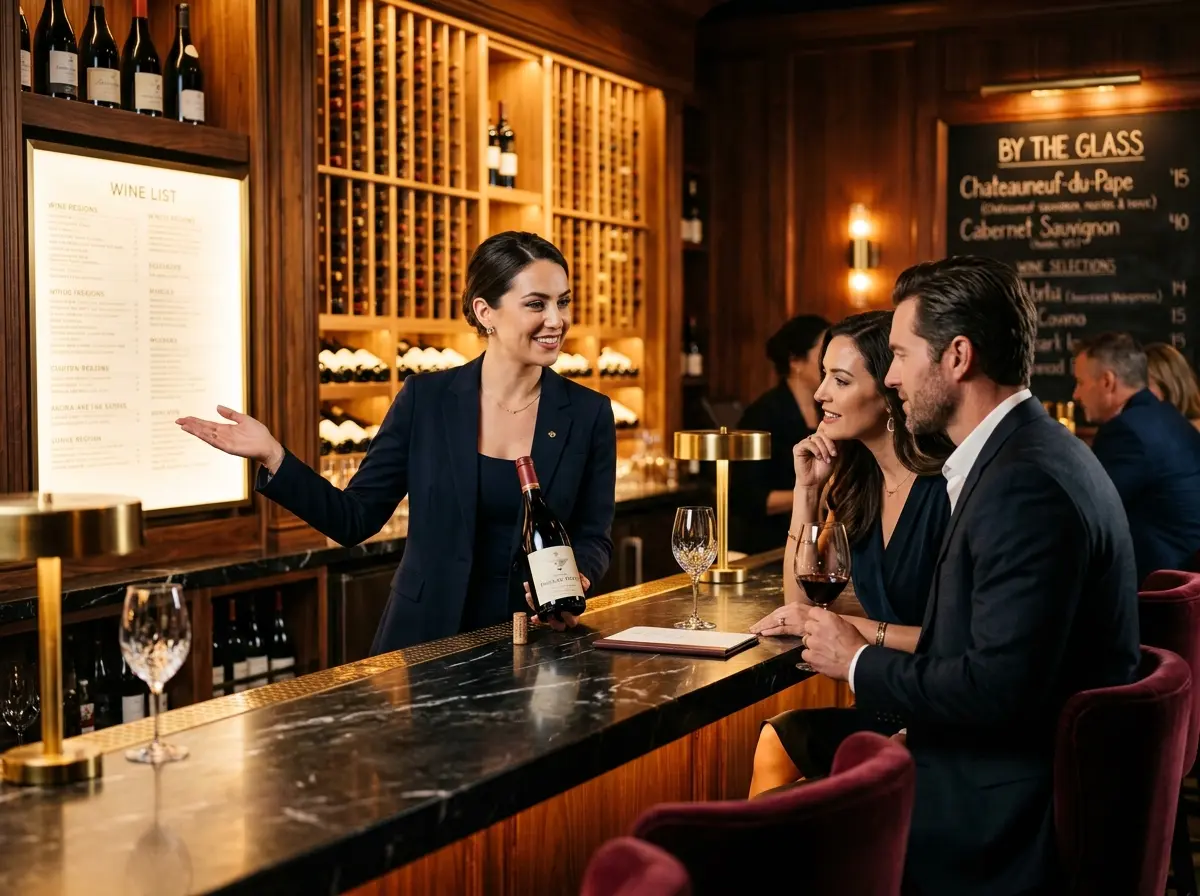
Train your staff to listen for the cue: "I'll have another glass of the Malbec." That's not just a drink order — that's an invitation. A well-trained server responds with something like, "You're clearly enjoying that one — want to know a fun fact? Two more glasses and you've basically paid for the bottle. We can go ahead and open one for the table if you'd like." Casual, informative, not desperate. That's the tone you're going for.
The Language of the Upsell
Words matter enormously in a wine bar setting. Your clientele came here because they want an experience, not a transaction. Avoid language that sounds transactional ("Would you like to upgrade?") and lean into language that sounds experiential and generous.
Some phrases that actually work:
- "This one opens up beautifully over the next hour — a bottle really lets it breathe properly."
- "That's one of my personal favorites — the bottle is actually great value compared to the glass price."
- "If you're planning to stay a while, the bottle makes a lot of sense for your table."
Notice what these all have in common: they're framed around the customer's benefit, not your revenue. They reference experience, value, or time — all things that matter to someone settling in for a good evening. Avoid phrases like "it's a better deal" in isolation, because "deal" sounds like a clearance rack, not a curated cellar.
Know Your Menu Cold (So Your Staff Can Too)
Nothing kills a bottle upsell faster than a server who hesitates, second-guesses the price, or has to "check on that." Your team should know the glass-to-bottle price comparison for every wine on your menu — without pulling out a notepad. Consider running a weekly five-minute pre-shift quiz on the top ten sellers. Make it competitive. Put a small prize on it. The ROI on a $10 gift card that results in twenty extra bottle upsells per week is, well, obvious.
Also make sure your staff can articulate the why behind each bottle. Tasting notes are nice, but storytelling sells. "This is from a family vineyard in Rioja — they've been doing this for four generations" is worth more than "notes of dark cherry and leather" to most guests. Give your team the stories, and they'll give you the sales.
Let Technology Handle What It's Good At
Free Up Your Staff to Sell, Not Just Serve
Here's a quiet truth about wine bars: your best upsellers aren't upselling half the time because they're too busy answering questions about parking, hours, reservations, or whether you have a gluten-free charcuterie board. Every minute a server spends explaining your corkage fee policy is a minute they're not standing at a table suggesting a second bottle.
This is where Stella — an AI robot employee and phone receptionist — genuinely earns her keep. Stella can greet guests as they walk in, answer common questions about your menu and policies, and handle your incoming phone calls 24/7 so your floor staff can stay focused on the guests in front of them. Whether a customer is calling to ask about your wine flight options or walking up to the host stand with six questions before they've even been seated, Stella handles it — professionally, consistently, and without ever needing a break. That means your human team can do what humans do best: build rapport, read the room, and recommend the bottle.
Structuring Your Menu to Do Half the Work for You
Make the Math Visible
One of the easiest and most underutilized menu tricks is simply showing the glass-to-bottle value comparison directly on your menu. Something as simple as listing the glass price alongside a subtle note like "Bottle available — ask your server" plants the seed without requiring any verbal effort. Some wine bars go further, printing both prices side by side. When guests can see that four glasses cost nearly as much as a bottle, the conversation starts itself.
You don't need a full redesign. A simple callout next to your most popular by-the-glass options — the ones guests order repeatedly — is enough. A/B test it on a seasonal menu insert if you're not ready to commit to a full reprint. The data will tell you what you need to know within a month.
Feature "Bottle Spotlights" Strategically
Designate two or three bottles per season as featured upsell targets — wines with strong margins, good stories, and approachable price points. Train your staff to know these inside and out. Mention them at the table. Put a small tent card on the table if your aesthetic allows it. These featured bottles become the path of least resistance for your team: when in doubt, suggest the spotlight bottle.
Pairing these spotlights with a food item works exceptionally well. "We're actually featuring a Grenache right now that pairs beautifully with the charcuterie board — a lot of guests have been loving that combination lately" is a soft, natural, completely non-aggressive way to move both a bottle and a food item in one sentence. That's two revenue lines touched with a single recommendation.
Create a "Second Glass Trigger" System
Build a simple internal system where servers are prompted — either by policy or a gentle POS reminder — to make a bottle suggestion whenever a guest orders their second glass of the same wine. This doesn't have to be complicated. A sticky note in the server station that says "2nd glass = bottle conversation" is genuinely enough to shift behavior if you reinforce it consistently in pre-shift meetings.
Research from the National Restaurant Association consistently shows that trained upselling behaviors, even simple ones, can increase average check size by 10–30%. In a wine bar where bottle margins can be two to three times higher than glass margins, even modest conversion improvements have meaningful financial impact across a busy week.
Quick Reminder About Stella
Stella is an AI robot employee and phone receptionist that works in-store as a friendly kiosk and answers your business phone calls around the clock — all for $99/month with no upfront hardware costs. She's always on, always professional, and never calls in sick on a Saturday night. For wine bars looking to reduce staff distractions and keep the floor focused on hospitality and sales, she's a remarkably easy addition to the operation.
Turn Your Glass Menu Into a Bottle Pipeline
The glass menu is not your enemy — it's your funnel. Every guest who orders a glass is a potential bottle sale, and most of them are closer to saying yes than you think. The key is a combination of trained timing, smart language, menu design that does the heavy lifting, and an operational environment where your staff actually has the bandwidth to have the conversation.
Here's your action plan to get started:
- Audit your current menu — identify the top five by-the-glass wines and calculate the glass-to-bottle price gap for each. If the gap is under $20, that's a conversation waiting to happen.
- Run a staff training session this week — focus on timing (second glass = bottle suggestion) and language (experiential, not transactional).
- Designate two bottle spotlights for this month — make sure every server can explain them in thirty seconds and knows the food pairing.
- Consider a small menu update — even a simple "Bottle available" note next to popular glass pours can shift guest thinking before a word is spoken.
- Reduce staff distractions — evaluate what's pulling your team away from table time, and look at tools like Stella to handle the front-of-house questions and phone traffic that don't need a human touch.
Your wine list is already good — that's why people are ordering from it. The opportunity now is to help more of those guests get more of what they're already enjoying, at a price point that works better for everyone. That's not upselling. That's hospitality done right.