The Forgotten Frontline: Why Your Host Stand Deserves More Respect
Let's be honest. You've probably spent more time agonizing over your menu font than you have thinking about what actually happens in the first 90 seconds a guest walks through your door. And yet, those 90 seconds — the greeting, the seating, the first impression — can determine whether a customer leaves a glowing five-star review or quietly vows never to return while smiling politely at you on the way out.
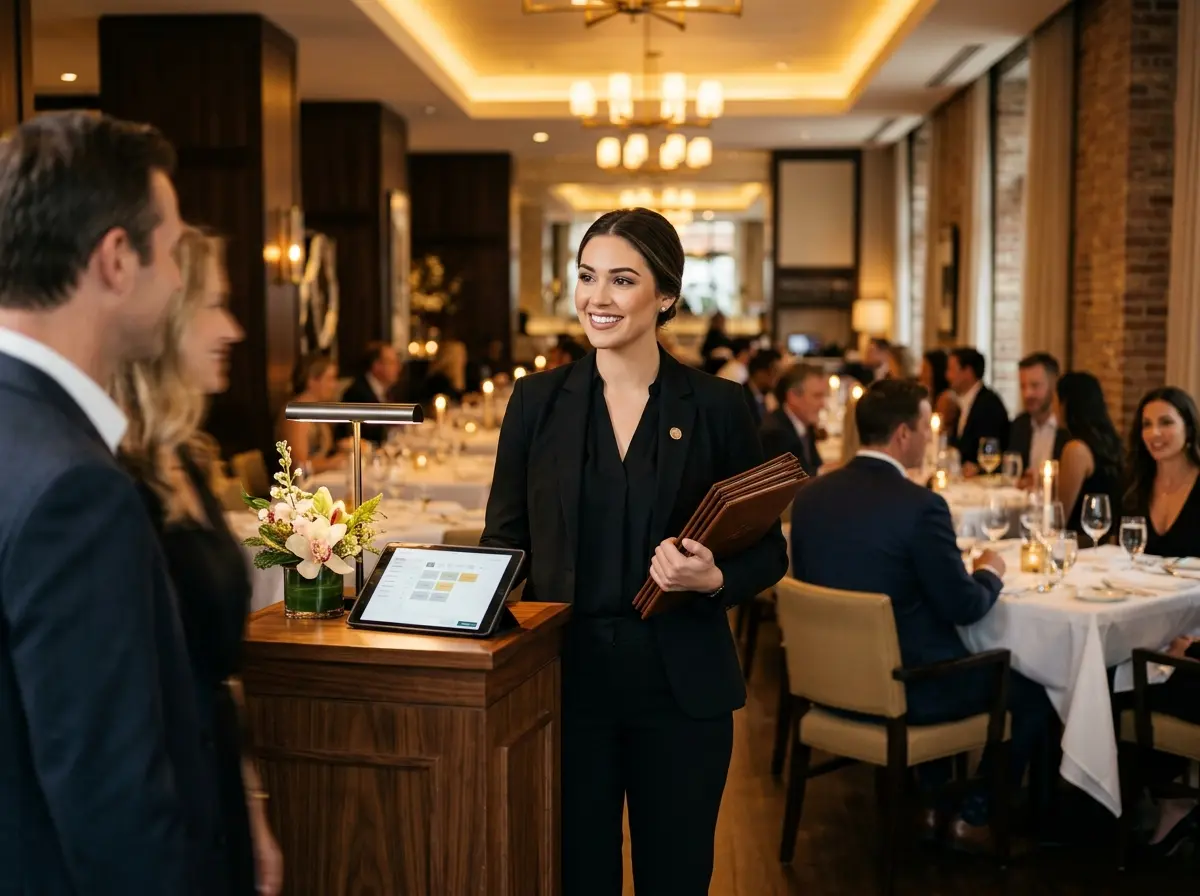
The host stand is the handshake of your restaurant. It's the moment a stranger decides whether they like you. And for most restaurants, it's being staffed by a 19-year-old who's simultaneously managing a waitlist, answering the phone, placating a walk-in party of eight, and quietly panicking. No judgment — we've all been there. But there's an enormous opportunity sitting right at your entrance that most restaurant owners are completely ignoring.
This post is about turning your host stand from a logistics bottleneck into a genuine customer experience powerhouse. Let's dig in.
The Host Stand's Real Job (Hint: It's Not Just Seating People)
First Impressions Are Worth Real Money
Research from Harvard Business School found that a one-star increase in a restaurant's Yelp rating leads to a 5–9% increase in revenue. And what do you think drives that extra star? It's rarely the food alone. More often, it's how guests felt — and that feeling starts before they ever sit down. A warm, confident, informed greeting sets the emotional tone for the entire meal. A distracted, overwhelmed, or absent host does the opposite.
The host stand should be functioning as your brand's opening act. That means proactive engagement — not just "How many in your party?" but a genuine welcome that reflects your restaurant's personality. Are you a lively taqueria? Be energetic. An upscale steakhouse? Be polished. The host stand is where your brand promise either gets kept or quietly broken.
The Upsell Opportunity You're Walking Past Every Night
Here's something most restaurant owners don't think about: the host stand is prime real estate for soft promotion. While guests are waiting — whether it's two minutes or twenty — they are captive and curious. They're looking around. They're forming opinions. They're deciding whether to order that second round of drinks or try the new seasonal dessert.
A well-trained host (or a well-designed host stand experience) can mention tonight's specials, highlight a new menu addition, or casually note that the house cocktail is the current crowd favorite. This isn't aggressive upselling — it's hospitality. It's the difference between a guest who orders the same thing they always do and one who tries something new and loves it. That guest comes back more often and brings friends.
The Phone Is Ringing — And Your Host Is Already Overwhelmed
If your host stand also serves as the de facto phone reception desk, congratulations — you've given one person an impossible job. The phone rings during the dinner rush, and your host has to choose: ignore the caller, put the in-person guests on hold, or perform some heroic act of multitasking that satisfies no one. Missed calls mean missed reservations. Missed reservations mean empty tables. Empty tables mean money walking out the door — or more accurately, never coming in.
According to a study by Invoca, 80% of callers who reach a voicemail don't leave a message — they simply call a competitor. If your host stand is your phone answering system, you're hemorrhaging potential customers every single service.
How Technology Can Give Your Host Stand a Serious Upgrade
Let Your Host Be Human Again
This is where a tool like Stella — the AI robot employee and phone receptionist — becomes genuinely interesting for restaurant owners. Stella can stand at or near your host area as a friendly, human-sized AI kiosk that proactively greets guests, answers questions about the menu, highlights current specials, and promotes promotions — all without requiring a single second of your human staff's attention. Meanwhile, Stella also answers your phone calls 24/7, handles reservation inquiries, shares hours and policies, and can forward calls to staff when needed. Your human host can then do what only humans can truly do: make guests feel genuinely welcomed and cared for.
At $99/month with no upfront hardware costs, it's the kind of upgrade that pays for itself the first time it saves a reservation that would have otherwise gone to voicemail.
Designing a Host Stand Experience That Actually Works
Train for Hospitality, Not Just Logistics
Most host training focuses on the mechanics: manage the waitlist, quote accurate wait times, seat tables in rotation. These things matter — but they're table stakes, not differentiators. The hosts who create memorable experiences are the ones trained to read the room and respond accordingly.
That means acknowledging guests immediately upon entry, even if they can't be helped that second. It means using the guest's name if they made a reservation. It means knowing — at a high level — what's good tonight, what's selling out, and what the kitchen is proud of. Create a short pre-shift briefing ritual specifically for your host. Five minutes before doors open, they should know tonight's specials, any 86'd items, and any VIP reservations. This is standard practice in fine dining and virtually nonexistent in casual concepts. It shouldn't be.
Use the Wait Time as an Asset
Waiting is emotionally unpleasant — unless you make it interesting. Restaurants that turn their wait into an experience see significantly higher satisfaction scores even when wait times themselves haven't changed. Here's what that can look like in practice:
- Offer a complimentary amuse-bouche or bread service while guests wait at the bar or a holding area — this also drives drink orders.
- Display dynamic content near the host stand: specials, featured cocktails, or even behind-the-scenes content from the kitchen.
- Have your host or an AI kiosk mention a promotion conversationally — "We just launched a new happy hour menu if you'd like to take a look while you wait."
- Collect contact information with consent during the wait for your loyalty program or future marketing — a simple conversational intake process, done right, feels like service rather than data collection.
The point is that dead wait time is a missed opportunity. Your guests' attention is available — the question is whether you're using it.
Measure What's Happening at the Door
You track table turns, food cost, and labor percentage — but when did you last measure host stand performance? Most operators don't, because there's no obvious metric. Here are a few worth tracking:
Start by monitoring phone answer rates during peak service hours. If calls are being dropped or going to voicemail, quantify the volume — even a rough estimate of missed calls multiplied by your average check size will make you uncomfortable in a productive way. Next, look at review sentiment. If Yelp or Google reviews mention the greeting, the wait experience, or the first impression — positively or negatively — that's signal. Finally, track upsell conversion from the host interaction. If your host mentions tonight's special to every arriving guest, does it appear more often on checks? It should. Run the experiment for a month.
Quick Reminder About Stella
Stella is an AI robot employee and phone receptionist designed to work alongside your team — greeting customers in person at a physical kiosk and answering phone calls around the clock with full knowledge of your business. She handles the repetitive, high-volume interactions so your human staff can focus on delivering the kind of hospitality that no technology can replace. For restaurants specifically, she's a natural fit at or near the host stand, where the volume of questions, calls, and interactions tends to be highest.
Your Next Steps: Small Changes, Real Impact
The host stand isn't glamorous. It doesn't get the attention that a new menu launch or a kitchen renovation gets. But it is, without exaggeration, one of the highest-leverage customer experience touchpoints in your entire operation — and most restaurants are running it on autopilot.
Here's what you can do this week, with zero budget required:
- Audit your current host greeting. Stand outside your restaurant and walk in like a guest. What happens? How long before someone acknowledges you? What's said? Is it warm, informed, and on-brand — or is it frantic and forgettable?
- Add a two-minute pre-shift host briefing. Specials, 86'd items, VIP reservations, and one thing the kitchen is proud of tonight. Do this every service for 30 days and watch what changes.
- Track your missed calls for one week. Just count them. The number will motivate you.
- Identify one thing guests can experience during the wait — a sample, a conversation, a promotion — and make it a consistent practice.
The restaurants winning on customer experience right now aren't necessarily the ones with the best food. They're the ones that understand every touchpoint matters — including, and maybe especially, the one that happens before the guest sits down. Your host stand is already there. It's already central. It just needs to be taken seriously.
Give it the attention it deserves, and it will pay you back.