Why Your Members Are Ghosting You (And How to Make the Gym Actually Sticky)
Let's be honest — gym membership churn is practically a tradition at this point. Someone signs up in January, fired up on motivation and New Year's energy, and by March they've quietly disappeared into the ether while still paying their monthly dues. (The payment part you don't mind. The part where they eventually notice they haven't been in six weeks and cancel? That's the problem.)
The fitness industry averages a 30–50% annual churn rate, which means roughly a third to half of your members walk out the door every year. Acquiring a new member costs anywhere from five to ten times more than retaining an existing one. So if your retention strategy is currently "hope they forget to cancel," it might be time to upgrade your approach.
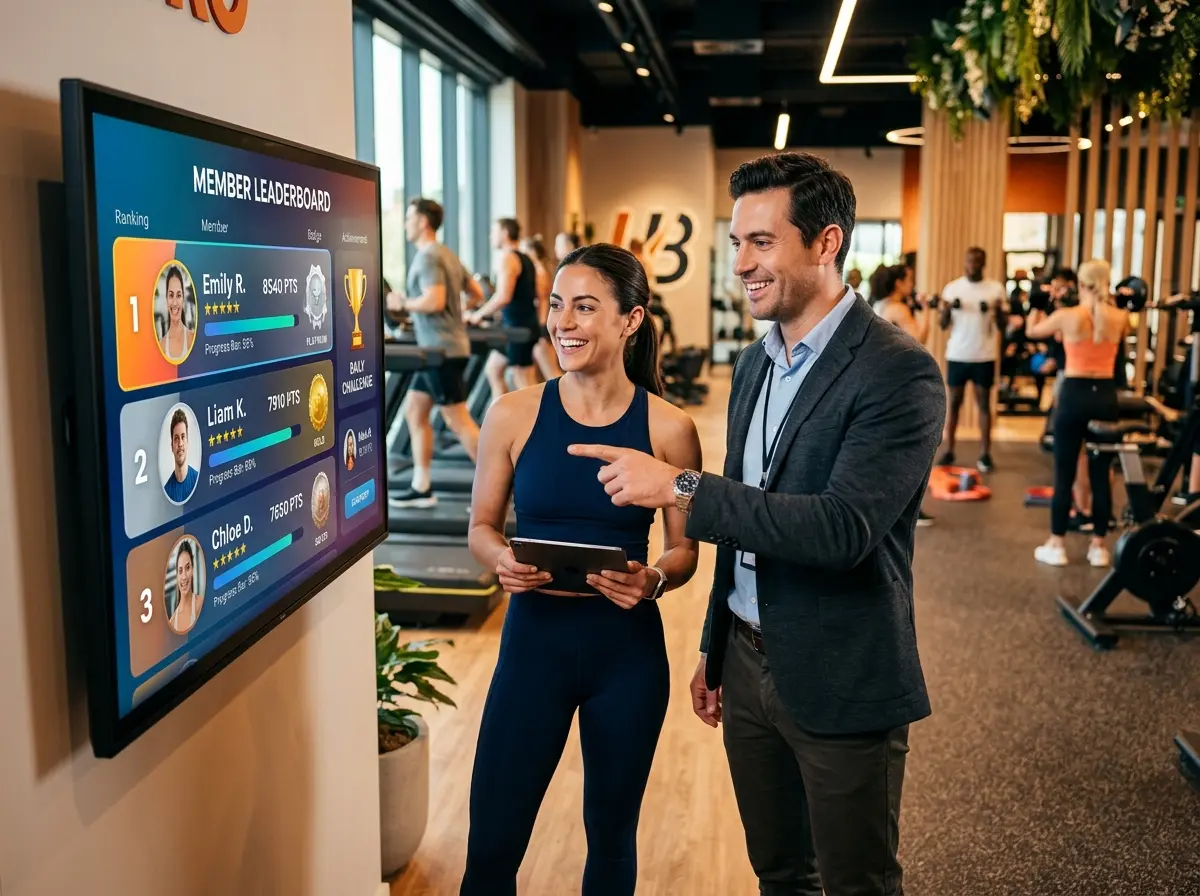
Enter gamification — challenges, leaderboards, badges, points, and progress tracking — the same psychological mechanics that make mobile games embarrassingly addictive, now applied to your gym. When done right, gamification doesn't just keep members coming back. It makes them want to come back. There's a difference, and it's worth a whole lot of monthly recurring revenue.
The Psychology Behind Gamification (It's Not Just About Prizes)
Why Humans Are Wired to Play
Gamification works because it taps into deeply rooted human psychology — specifically our need for progress, recognition, and belonging. When a member earns a badge for their 10th consecutive week of attendance or climbs two spots on the leaderboard after a killer Tuesday class, their brain releases dopamine. That little neurological reward creates a habit loop: behavior, reward, repeat. You're not bribing them to come back. You're wiring their brain to associate your gym with feeling good about themselves.
Research backs this up. A study published in the Journal of Sport and Health Science found that social comparison features — like leaderboards — significantly increased exercise frequency among gym members. And platforms that use structured challenges see retention rates improve by as much as 25–40% compared to gyms with no engagement programming. People don't quit things they're winning at (or at least competing in).
The Three Pillars: Challenges, Leaderboards, and Rewards
Not all gamification is created equal. To build a sticky gym experience, you generally want to work with three core mechanics:
- Challenges: Time-bound goals that give members a reason to show up consistently. Think "30-day squat challenge," a six-week weight loss competition, or a monthly class attendance streak. Challenges create urgency and short-term momentum.
- Leaderboards: Public or semi-public rankings that introduce healthy competition. They work best when segmented — ranking a 60-year-old retiree against a 28-year-old competitive athlete isn't motivating, it's demoralizing. Segment by age group, experience level, or challenge type.
- Rewards and Badges: Digital or physical acknowledgment of milestones. Free month of membership, branded merchandise, a shoutout on your social media — it doesn't have to be expensive. It has to feel earned.
Real-World Examples That Actually Work
Planet Fitness uses its "Black Card" perks and referral incentives as a soft gamification layer — members are rewarded for bringing friends and reaching usage milestones. CrossFit gyms (boxes) have long used the whiteboard leaderboard to build community and competition simultaneously, which is a big reason why CrossFit members tend to be obsessively loyal. Orangetheory's heart rate zone system turns every single class into a personal performance challenge, giving members something to beat every time they walk through the door.
You don't need Orangetheory's tech budget to replicate this. A whiteboard, a simple app, or even a well-structured spreadsheet posted on your website can get you started. The mechanism matters less than the consistency of the engagement.
Using Technology to Run Challenges Without Running Yourself Ragged
Tools and Platforms Worth Knowing About
Managing a gym challenge manually — tracking check-ins, updating leaderboards, announcing winners — is the kind of administrative spiral that makes gym owners question their life choices. Fortunately, several platforms can automate the heavy lifting. Apps like Wodify, Mindbody, and Glofox offer built-in challenge tracking and member engagement features. If you're running a smaller operation, even something as lightweight as a Trello board or a simple loyalty punch-card system can kickstart the habit without requiring a software overhaul.
The key is picking a system you'll actually maintain. A beautifully designed leaderboard that gets updated once and then neglected is worse than no leaderboard at all — it signals to your members that you stopped caring.
How Stella Can Help Keep Engagement Running Smoothly
Here's where front-desk operations quietly make or break your gamification efforts. Members ask questions constantly: "When does the challenge end?" "How do I sign up?" "What's the prize?" If your staff is occupied with classes or coaching, those questions go unanswered — and unanswered questions become unanswered members who find another gym.
Stella, the AI robot employee and phone receptionist, can handle exactly this kind of ongoing member communication. As an in-store kiosk, she greets members as they walk in, proactively tells them about active challenges and promotions, and answers questions about how to participate — all without pulling your staff off the floor. On the phone, she handles incoming calls 24/7, so a member calling at 8 p.m. to ask about the leaderboard standings doesn't get voicemail. She can also collect member information through conversational intake forms and log it directly into her built-in CRM, making it easy to track challenge sign-ups, follow up with participants, and segment your most engaged members for future campaigns.
Designing Challenges That Actually Reduce Churn
Structure Your Challenges Around Attendance, Not Just Performance
One of the most common gamification mistakes gym owners make is designing challenges that only reward the fittest members. If winning requires being the fastest or lifting the most, you've just created a competition where 80% of your membership has already lost before they start. That's not motivating — that's a reason to stay home.
The most effective retention-focused challenges reward consistency over performance. A "check in 20 times this month" challenge is winnable by a beginner and a veteran alike. A "try 5 different class types this quarter" challenge introduces members to parts of your gym they might not have explored, deepening their connection to the facility. Design your challenges so that showing up is the point — because showing up is exactly what you need them to do.
Build Community Into the Mechanics
Solo challenges are fine. Team challenges are better. When members are grouped into small teams and competing together, they develop accountability relationships with each other — and those relationships are far stickier than any loyalty program. People will skip the gym. People are much more reluctant to let down their teammate who is texting them at 6:45 a.m. asking where they are.
Consider running quarterly team-based challenges where groups of 4–6 members compete on cumulative attendance or class variety. Post team standings on a whiteboard near the entrance. Celebrate the winning team publicly. Watch how quickly "I'm thinking about canceling" becomes "I can't cancel, we're in second place."
Close the Loop: Recognition, Reflection, and Re-enrollment
A challenge that ends without ceremony is a missed opportunity. When a challenge wraps up, make it an event — announce winners in your app, feature them on social media, hand out awards at the front desk. Then immediately tease the next challenge. The goal is to create a continuous cycle where members are always either mid-challenge or excited about the next one. Give them a reason to stay enrolled, and most of them will.
Also, don't ignore the members who didn't finish. A short personal follow-up — "Hey, we noticed you dropped off week three. We're running another challenge next month, want in?" — communicates that you noticed, you care, and there's always another chance. That kind of personal outreach is disproportionately powerful for retention.
Quick Reminder About Stella
Stella is an AI robot employee and phone receptionist that works inside your gym as a friendly kiosk and answers your phone calls 24/7. She promotes your challenges, answers member questions, and handles front-desk communication so your staff can focus on coaching and service. At just $99/month with no upfront hardware costs, she's built for businesses that want a professional, reliable presence without the overhead.
Conclusion: Stop Hoping They'll Stay. Give Them a Reason To.
Member churn isn't inevitable — it's a symptom of disengagement. When members feel like they're part of something, competing toward something, and recognized for something, they don't cancel. They recruit their friends. They post about your gym online. They become the kind of walking advertisement that no paid ad can replicate.
Here's your action plan to get started:
- Launch one challenge this month. Start simple — a 30-day attendance streak or a "try something new" class challenge. Don't overthink the tech; a whiteboard and a sign-up sheet will do for round one.
- Segment your leaderboards. Make sure every member has a fair shot at competing. Group by experience level or age if needed.
- Build in a recognition moment. Plan how you'll celebrate winners and how you'll close the loop at the end of each challenge cycle.
- Automate your front-desk communication. Make sure members can always get answers about your challenges — whether they're walking in or calling at 9 p.m.
- Run it again. Consistency is everything. One challenge is a novelty. A quarterly challenge calendar is a culture.
Your members didn't join your gym to fail quietly and cancel by spring. Give them a game worth playing, and most of them will keep showing up to play it.