The Phone Is Ringing — And You're Elbow-Deep in a Broken Water Heater
Let's paint a picture. It's 2:47 PM on a Tuesday. Your best technician is under a crawl space, your office manager is juggling three callbacks, and your phone just rang for the fourth time in twenty minutes. You don't know if it's a $12,000 commercial HVAC job, someone asking if you service areas you haven't covered in three years, or a person who just wants to know your hours (which, by the way, are listed on your website).
Here's the uncomfortable truth: most home services companies treat every incoming lead exactly the same. They answer, they scramble, they quote, and they hope. But not every call deserves the same level of urgency — and not every caller is ready to book. Without a smart triage process up front, your team is constantly interrupted by low-value inquiries while actual high-value leads sometimes slip through the cracks.
AI-powered lead triage isn't a luxury anymore. For home services businesses — plumbers, HVAC companies, electricians, landscapers, roofers — it's quickly becoming the competitive edge that separates the companies scaling intelligently from the ones perpetually drowning in chaos. Let's talk about why getting a human involved before triage happens is costing you more than you think.
The Hidden Cost of Unfiltered Lead Handling
Your Team's Time Is Literally Money
Every time a skilled human employee picks up a phone call, you're spending money — whether or not that call converts. When a senior dispatcher or office manager answers a call asking whether you do chimney cleaning (you don't), that's two to five minutes of payroll burned on a dead end. Multiply that by dozens of similar calls per week, and you start to see the problem in dollar signs rather than minor inconveniences.
According to industry estimates, home services businesses can spend 40–60% of their receptionist's time on calls that never result in booked jobs. That's not a small inefficiency — that's a structural problem. And it only gets worse as your call volume grows. Scaling a home services company without fixing lead triage is like pouring water into a bucket with a hole in it. You can keep pouring, but you already know how this ends.
Missed Calls Are Missed Revenue
The flip side is just as painful. When your team is buried in low-value calls, high-value leads don't always wait. Research from Lead Response Management studies consistently shows that the odds of qualifying a lead drop by over 400% if you wait longer than five minutes to respond. In home services, where customers often call two or three competitors simultaneously, being the second or third callback is frequently the same as being invisible.
After-hours calls are an entirely separate problem. Unless you're paying for an answering service or running a 24/7 operation, a significant percentage of your inbound leads are hitting voicemail when they call at 7 PM because the kitchen pipe just burst. That customer will find someone else by morning. The opportunity is gone, and you never even knew it existed.
Not All Leads Are Created Equal — And That's Okay
Some callers are ready to schedule immediately. Some are price shopping. Some are in genuine emergencies. Some are in the wrong service area. The problem isn't that these different types of leads exist — that's just business. The problem is treating them identically and routing them all to your most expensive resource (a human being) before you know anything meaningful about them.
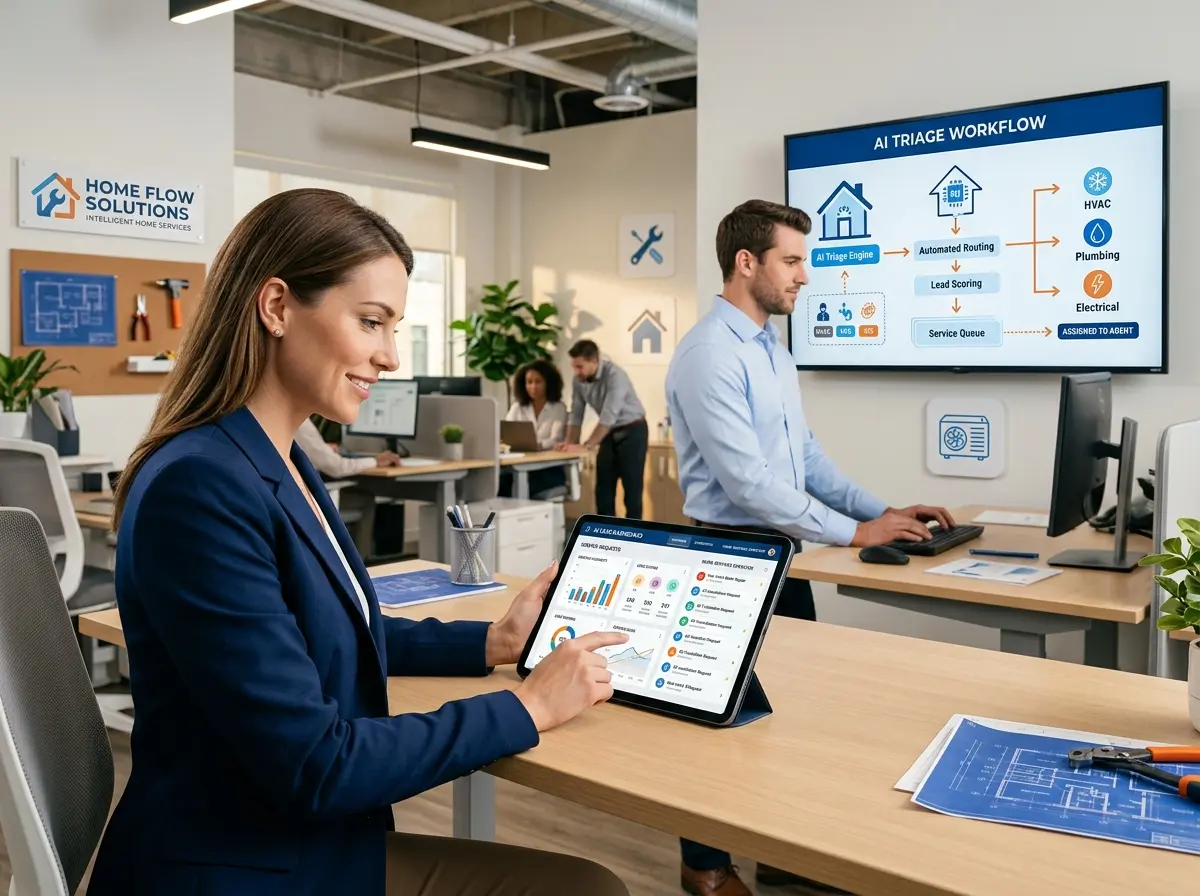
Effective lead triage means gathering key information first: What service do they need? Where are they located? Is this urgent or routine? Do they have an existing relationship with your business? With that data in hand, your team can make intelligent decisions about prioritization rather than reacting blindly to whoever called most recently.
How AI Can Step In Before Your Team Has to Step Up
Intelligent Intake That Works Around the Clock
This is exactly where Stella, an AI robot employee and phone receptionist, fits naturally into a home services workflow. Stella answers every inbound call — day or night — and conducts a conversational intake process before any human gets involved. She can ask about the type of service needed, the customer's location, the urgency level, and any relevant details specific to your business. That information gets captured cleanly, tagged in her built-in CRM, and summarized so your team walks into every conversation already knowing what they're dealing with.
Stella's configurable call-forwarding logic means that genuinely urgent calls — the burst pipe at midnight, the HVAC failure in August — can still reach a human immediately. Meanwhile, routine inquiries, general questions, and low-urgency leads are handled, logged, and queued for follow-up during business hours. Your team stops playing triage nurse and starts functioning as a closing team.
Building a Lead Triage System That Actually Works
Define Your Lead Tiers Before You Automate Anything
Before any AI system — or any process, for that matter — can triage your leads effectively, you need to define what a qualified lead actually looks like for your business. This sounds obvious, but most home services companies have never formally done it. Start by categorizing your typical inbound inquiries into tiers.
A Tier 1 lead might be someone in your service area requesting an emergency repair and ready to schedule immediately. A Tier 2 lead might be someone requesting a routine estimate within the next week. A Tier 3 lead might be someone comparing prices with no firm timeline. And then there are the calls that simply don't convert — wrong service area, services you don't offer, or general inquiries with no real purchase intent. Once you know your tiers, you can build intake questions and routing logic around them.
Design Your Intake Questions Strategically
Good triage depends on good questions. The goal isn't to interrogate your customers — it's to gather enough information to route them correctly and serve them faster. Keep it conversational and minimal. For most home services businesses, five to seven well-chosen questions can capture everything needed to classify a lead accurately.
Think about what your most experienced dispatcher instinctively asks in the first sixty seconds of a call. What's the service or problem? What's the address? Is it urgent? Have they worked with you before? Is there an existing service contract? Those questions, asked conversationally by an AI before the call ever reaches a human, transform a cold inbound call into a warm, pre-qualified handoff. Your dispatcher is no longer starting from zero — they're starting with context.
Set Clear Escalation Rules and Stick to Them
Automation without clear escalation logic creates its own problems. You need explicit rules for when AI handles the full interaction, when it forwards to a human, and when it escalates immediately regardless of business hours. For home services companies, emergency escalation is non-negotiable. A customer with a gas leak or a flooded basement is not the right candidate for an AI-managed voicemail and a next-day callback.
Build your escalation criteria around urgency signals, service type, and customer status. Existing high-value customers may warrant faster human response. Certain keywords — "emergency," "flooding," "no heat," "electrical smell" — should trigger immediate escalation. Routine estimates, FAQs, and general inquiries can stay in the AI lane. Document these rules, configure them into your system, and revisit them quarterly as your business evolves.
Quick Reminder About Stella
Stella is an AI robot employee and phone receptionist built for businesses of all sizes, available for just $99/month with no upfront hardware costs. She answers calls 24/7, conducts intelligent intake, manages a built-in CRM, and routes leads based on your configured rules — so your human team only gets involved when it actually makes sense. For home services businesses dealing with high call volumes and unpredictable lead quality, she's the front-line filter that keeps operations running cleanly.
Stop Letting Every Call Cost You the Same — Start Triaging Smarter
Lead triage isn't about creating barriers between your business and your customers. It's about making sure the right resource handles the right inquiry at the right time. When a $15/hour call is routed to a $60,000/year dispatcher, that's not customer service — that's an expensive organizational habit masquerading as one.
Here's where to start:
- Audit your current call volume for one week. Categorize each call by type, duration, and outcome. You'll almost certainly find patterns you didn't expect.
- Define your lead tiers based on service type, urgency, location, and customer history. Make these explicit and share them with your team.
- Design your intake questions — no more than seven — that surface the information needed to classify and route a lead correctly.
- Set your escalation rules and document them clearly, especially for after-hours emergencies.
- Implement an AI-powered front line that handles intake consistently, captures data cleanly, and routes intelligently — so your human team can focus on closing, not sorting.
The home services companies winning right now aren't necessarily the ones with the most technicians or the biggest trucks. They're the ones who've figured out that operational efficiency starts at the first point of contact — the moment a potential customer reaches out. Fix that moment, and everything downstream gets easier.
Your team deserves to spend their energy on the work that actually builds your business. Let the robots handle the rest.